
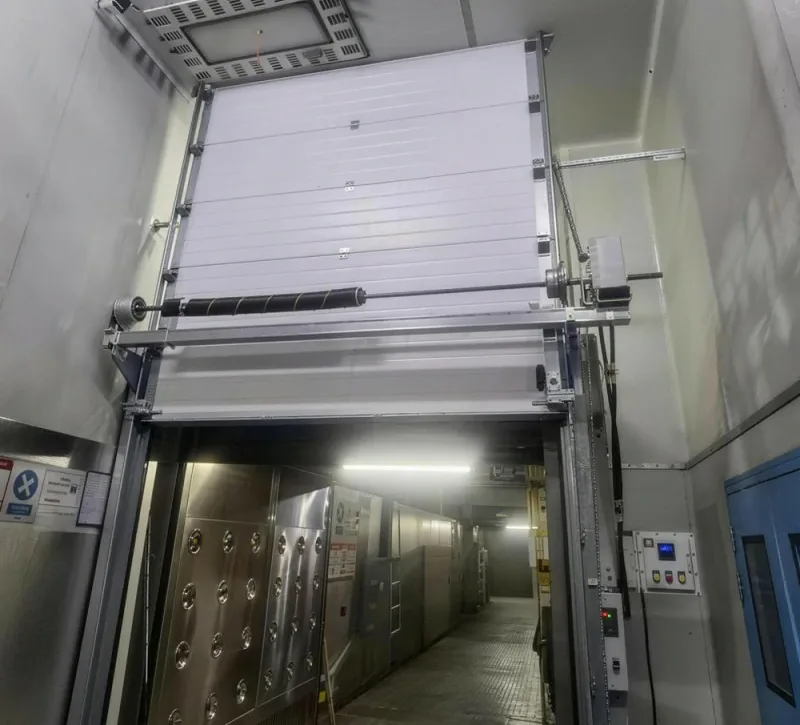
A very wide door for an aerospace parts plant is a structural project before it is a door project, because above a certain span the opening size stops being one variable among several and becomes the variable that determines everything else. Leaf weight, wind area, track layout, counterbalance and drive sizing all follow from the span, and the building's ability to carry the loads follows from the same number.
A note on what this page is. Client names, sites and measured results are withheld under confidentiality, and no span, weight or performance figure is claimed here as a delivered result. What the page sets out is how a wide opening is scoped, and where the decisions concentrate.
Why span dominates
Leaf weight rises with area, and area rises with both width and height. A door twice as wide at the same height has twice the leaf mass, which doubles the load on the hinges, the rollers, the shaft and the header. Wind load also acts on area, so the force the door has to resist rises with the same factor. Everything downstream — spring specification, track section, fixing detail, drive rating — is a function of a number that was set by the building's opening, not by the door.
The practical consequence is that a wide door cannot be specified by choosing a product and then sizing it. It has to be designed against the opening, and the design has to be agreed with whoever is responsible for the structure that will carry it.
Wind load classification is not a product label
Wind load resistance is classified under EN 12424, with the test method in EN 12444. The classification states the pressure a door resists under defined conditions — and the conditions include how the door is fixed. A door rated for a pressure class and installed into a lightweight wall with shallow anchors does not deliver that class in service.
This is the point on which wide doors most often fail in practice, because the failure is not in the door. It is in the interface between the door and a building that was not designed for the load the door transmits.
The number to agree early is therefore not just the class but the fixing: what the header carries, what the jambs carry, and who is responsible for the anchors. On a very wide opening these are structural questions with structural answers, and they belong in the project before the door is ordered.
What the building has to provide
Three things, and all three are frequently missing on retrofit projects. A header capable of carrying the shaft and the counterbalance without deflecting — deflection matters because a shaft that sags changes the balance and loads the tracks unevenly. Jambs capable of carrying the vertical track and the wind load transmitted through it. And a floor that will hold the bottom seal across the full width, because a wide door cannot follow an uneven floor the way a narrow one can.
Span, layout and structural note
| Opening | Usual track layout | Structural question | Handling on site |
|---|---|---|---|
| Narrow, low headroom | Standard lift | Header carries the shaft only | Manual handling, small team |
| Wide, normal headroom | High lift or standard lift with larger radius | Header deflection and jamb loading | Lifting equipment for the leaf sections |
| Very wide, limited headroom | Vertical lift or a different product family | Full height of wall carries the track | Planned lift plan, temporary supports |
| Very wide and tall | Often not a sectional door at all | Structure and wind load both dominant | Specialist installation |
The last row is the honest boundary of the product family. Beyond a certain combination of width and height, a sectional leaf stops being economic and a different construction is the right answer; recognising that early saves a project from a design that cannot be built.
What a large leaf demands of its hardware
Counterbalance is the first item. Springs are rated in cycles, and a large leaf needs a spring set sized for its weight with a rating that matches the expected duty. An under-specified spring does not fail immediately; it fails after a period that depends on cycles, and it fails at the least convenient time.
The second is the safety edge, because a large leaf stores energy and a power-operated door falls under EN 12453 regardless of size. The third is the drive, which has to move the leaf and hold it, and the fourth is the manual release, because a large door with no way to move it by hand during a power failure is a blocked opening.
Mechanical aspects of the door — the parts that carry load and the guards around them — are covered by EN 12604, which sits alongside the safety requirements of EN 12453.
Commissioning a large door
A wide door is commissioned at several positions rather than two, because the behaviour that matters is the behaviour in the middle of the travel, not at the limits. The checks that catch problems are: whether the leaf drifts when stopped part way, which indicates balance; whether the gap at the jambs is even along the full height, which indicates the track is plumb; whether the bottom seal meets the floor across the width, which indicates the floor is level; and whether the safety edge stops and reverses the leaf from every point along its width.
Commissioning is also when the fixing is verified, because a wind load classification is only meaningful if the anchors are the ones the design assumed.
What goes wrong, in order of frequency
The opening is measured but the structure is not assessed, and the door arrives with a fixing that the wall cannot take. The wind class is quoted without the fixing detail, so the number is true of the door and not of the installation. The spring rating is chosen for the leaf weight but not for the duty, so it fails early. And the manual release is treated as an accessory rather than as the means of operating the door when the power is off.
Questions that come up in scoping
What is the largest opening a sectional door can cover?
There is no single number, because the limit depends on the combination of width, height, wind exposure and the building's structure. What can be said is that the constraint arrives earlier than most projects expect, and that the honest answer comes from a design check rather than from a catalogue maximum.
How is the wind class decided?
From the site's exposure and the building's height, expressed as a pressure, and then matched to a class in EN 12424 with the fixing detail that the class assumes. The classification is a statement about an assembly, so it has to be agreed with the party responsible for the structure.
Can a very wide door be insulated as well as a standard one?
Yes, but the weight penalty is larger, because a wide insulated leaf is heavy and the hardware has to carry it. The trade-off is between thermal performance and the structural cost of the leaf, and on very wide openings it is often resolved by accepting a lower thermal specification rather than by adding structure.
Does a large door need a different safety approach?
It needs the same requirements applied more carefully. The safety edge has to protect the full width, the closing force has to be limited and monitored, and the activation devices have to be placed so that a person cannot be inside the travel path when the door moves. EN 12453 sets out the requirement categories for power-operated doors.
What should a project ask for at quotation stage?
The design basis: leaf weight, spring rating in cycles, wind class with the fixing assumed, drive rating, and the manual release arrangement. A quotation that gives dimensions and a price without those five items has not yet designed anything. The sector context is in aviation and hangar door solutions.
Related reading
For the product side, see high-lift sectional doors and vertical lifting doors, both of which are the layouts that wide openings usually resolve to. The reason a sectional leaf stops being the right answer at some spans is covered in how a door panel is made.