
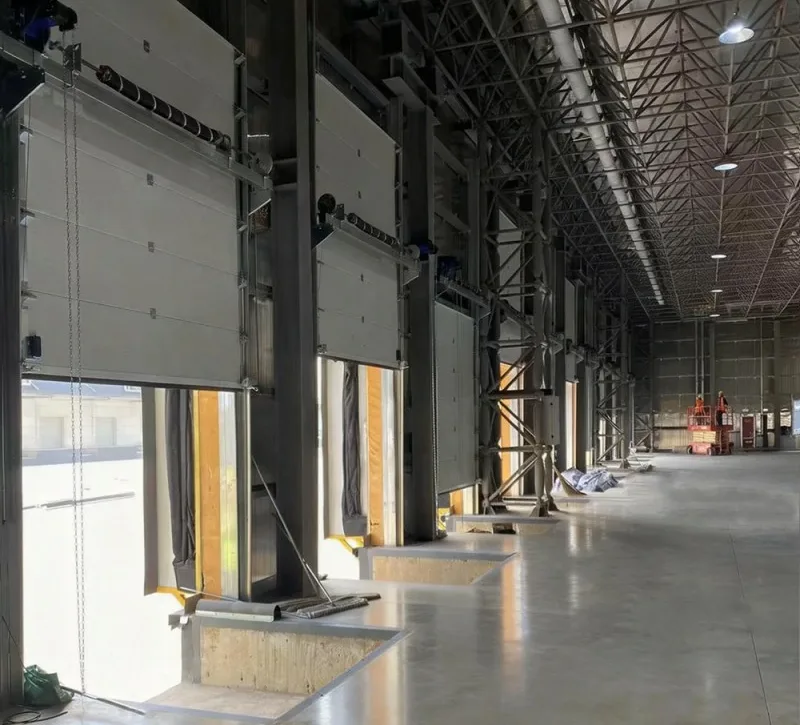
A cold store entrance is a sequence, not a door
Cold chain facilities are usually described by their doors, and specified door by door. That is the wrong unit. A cold store entrance is a sequence of temperature steps, and each step has a different requirement: the outer door sees the largest differential and the least traffic; the inner door sees the traffic and a smaller step; the space between them is what makes both work.
Getting the sequence right is more valuable than getting any individual door right, because a good door in a badly arranged entrance still ices up, still condenses on the warm side, and still loses the energy the door was bought to save.
The steps, and what each one is for
Cold storage is not one temperature. Chilled storage, frozen storage and blast freezing are different zones with different differentials, and a facility usually has several.
| Boundary | Typical differential | Governing problem |
|---|---|---|
| Ambient to chilled store (around 0 to 4 °C) | Moderate | Condensation on the warm side, floor wetness |
| Ambient to frozen store (around −18 °C and below) | Large | Ice on the track, seal hardening, heavy condensation |
| Frozen store to blast freezer (below −30 °C) | Large, but between cold zones | Frost on the interface, door mechanism stiffness |
| Chilled to frozen (internal) | Large | Traffic across a big step; a single door cannot carry both duties |
The figures above are the usual operating bands for these zones rather than a specification of any particular plant. What matters is the principle: the size of the step decides the door type, and the traffic decides whether a door is the right device at all.
Why the warm side is where it fails
Moisture in the air condenses on any surface below its dew point, and in a cold store entrance that surface is on the warm side: the door frame, the track, the threshold, the floor in front of the door. The cold side is dry because the moisture has already left the air.
This is why the visible failures of a cold store door appear on the warm face. Water runs down the frame and pools at the threshold, which is a slip hazard and, in a food facility, a hygiene problem. At low temperature the same water freezes, and the door then has to break through ice on every cycle — which is when seals tear and the door starts to fail structurally.
Panel U-value does not address any of this, because the condensation is on the metal that penetrates the envelope. Three measures do, and they work together: a thermal break in the frame, rail heating at the track, and a bottom seal that stays flexible at low temperature. Specifying one without the others leaves the mechanism that produced the problem in place.
What the airlock is for
An airlock between the outer door and the inner door does three things, and each is worth having independently.
It reduces the differential across each door. Instead of one door holding ambient to frozen, two doors hold ambient to intermediate and intermediate to frozen. The seals on each door see a smaller step, which extends their life and reduces the ice load.
It traps the infiltrating air. When the outer door opens, the air that enters meets a still space rather than the cold store itself, and much of its moisture condenses there rather than on the cold store surfaces.
It lets the two doors have different specifications. The outer door can be an insulated sectional door that stays closed and holds the envelope; the inner door can be a fast door that carries the traffic. Each is optimised for what it actually does.
Where space does not allow an airlock, the single door has to do both jobs, and the compromise shows up as either poor thermal performance or slow traffic — usually both.
Door type by position
Outer wall, closed most of the time. An insulated sectional door. The leaf holds the envelope, the seals carry the differential, and the cycle time is irrelevant because the door opens a few times a shift. That is the insulated lifting door.
Inner partition, traffic crossing. A fast door, because open time is what loses the energy here. A flexible curtain insulates poorly but closes in a second or two, and over a shift that beats a well-insulated door that stands open. That is the PVC high-speed roll-up door.
Freezer boundary with heavy traffic. The hardest case. The door needs speed and insulation at once, and no single product gives both well. The usual resolution is a fast insulated door at the boundary and a strict discipline about opening only for the transfer, or an airlock with a fast door inside and an insulated door outside.
Large openings for vehicles. Where the opening is large enough that a sectional leaf is the practical choice, the traffic question returns: a large insulated door that opens slowly is right for a few movements a shift and wrong for continuous dock traffic. For a modest differential at a large opening, the standard-lift sectional door is the economical choice.
Details that decide whether it works in service
Rail heating. Sized by track length, and running whenever the boundary is cold rather than only when the door moves, because the ice forms while the door is closed.
Bottom seal. Must stay flexible below freezing. A hardened seal is not visibly broken, which is why its failure is discovered from the energy bill or from the ice.
Threshold detail. The floor at a cold store door is where water pools and ice forms. A threshold that drains the warm side and does not bridge the insulation is part of the door specification, not a builder's detail.
Closing accuracy. A door that stops slightly short leaves the seal uncompressed along its full width. On a cold store that is a continuous leak at the coldest point of the building.
Frequently asked questions
Do I need two doors at a cold store entrance?
Where traffic and differential are both significant, yes. One door cannot be both fast and heavily insulated without compromising both, and an airlock lets each door be specified for what it actually does.
Why does ice form on the track rather than on the panel?
Because the track is metal and penetrates the insulated envelope, so it reaches freezing on the warm side. The panel is insulated; the track is not, unless it is heated.
Is a PVC fast door suitable at a freezer boundary?
For the inner boundary with low traffic, yes; at the outer boundary with a large differential, the curtain insulates poorly and the door needs rail heating. The position decides, not the product alone.
What temperature can a cold store door handle?
The door is a component, and the boundary is the system. Any figure quoted for the door alone is a component value; what matters is the assembled detail — panel, seals, thermal break, rail heating and the building fabric.
How is energy loss measured?
By the open time at the boundary, not only by the U-value. A door that stands open for an hour a day loses more than a door with a poorer panel that is closed all day.