
What the plant actually produces
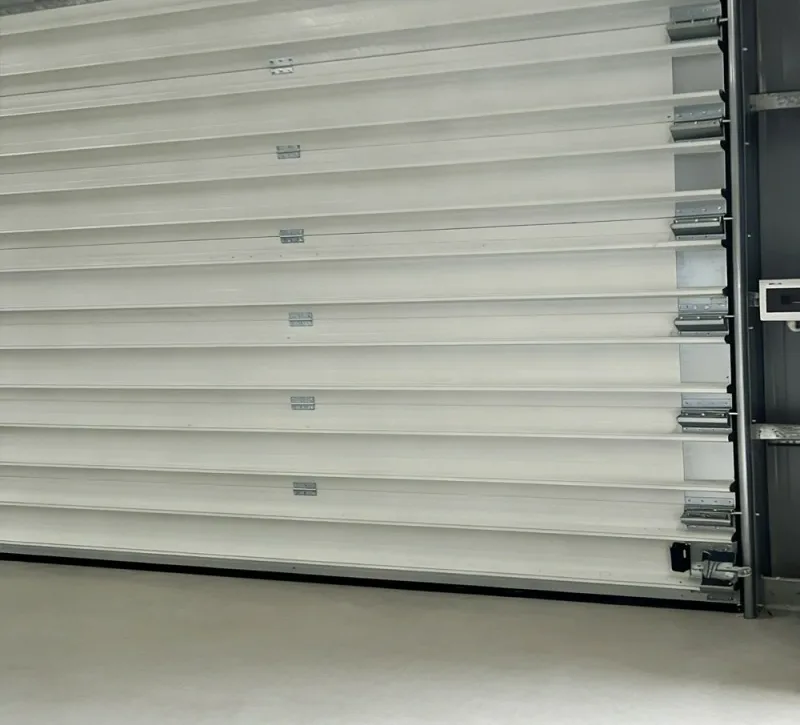
The works builds industrial doors and the equipment that goes with them: sectional lifting doors in their lift variants, high-speed rigid and roll-up doors, stacking doors, and loading dock equipment. The dock side covers levellers and the seals and shelters that close the gap around a vehicle.
That combination is deliberate rather than incidental. A loading bay is a door plus a leveller plus a seal, and the four components have to fit each other. Building them in one place means the interfaces are settled at design stage instead of being discovered when two suppliers' products meet at a dock for the first time.
Capacity, stated as a rate rather than a total
Capacity is more useful expressed per month than per year, because it tells a buyer whether their order is a normal event or a strain on the line.
| Product group | Monthly capacity | What it means for a project |
|---|---|---|
| Loading dock levellers | 400-500 units | A multi-dock project is a routine order rather than a special build |
| Dock seals | 500-800 sets | Seals and shelters can be supplied with the doors on one schedule |
| Industrial doors | Made to opening size | Each door is built to the measured opening, not cut down from a stock size |
Doors differ from the dock products in one important way: they are not built to a catalogue size. A door is specified against a measured opening, a lift layout and a leaf weight, and the counterbalance is calculated from those. That is why a door order starts with a drawing rather than with a part number.
Where the output goes
Roughly three quarters of production serves the domestic market and about a quarter is exported. The split matters to an overseas buyer for a practical reason: it means export packing, documentation and shipping arrangements are a routine part of the operation rather than an exception handled case by case.
For an export project the differences that show up are in the details — packing that survives a sea container, drawings and instructions in the destination language, and a spare parts list that can be ordered after the warranty period rather than only during it. That is a larger point than it sounds: an export order is routine work for the team rather than a first attempt, which is what makes the schedule credible.
Why the door and the dock come from one works
A door on a dock is one of four components, and the failure that matters is at the interfaces. The leveller has to sit within the door opening's dimensions; the seal has to close against the shelter; the shelter has to be sized for the vehicles the dock will see.
When those components come from different suppliers, each is correct on its own and the assembly is not. The gap that appears is between the door frame and the seal, or between the shelter and the building face — and it is found during commissioning, when there is no time to change any of them.
Supplying them together means the dimensions are agreed before manufacture. It does not remove the need for a site survey; it removes the argument about whose dimension was wrong.
What the plant does not claim
Two things are worth stating plainly, because they are commonly overstated in this industry.
Capacity is not the same as lead time. A monthly rate tells you the line can produce that volume; it does not tell you when your order will be scheduled. Lead time depends on the order book and on how complete the specification is when it arrives.
A test report covers what it tested. The panel on this product family has a measured core density of 44 kg/m³ and a thermal conductivity of 0.023 W/(m·K), with a DIN 4102-1 B2 reaction to fire, all from a report on the panel itself. That is a material and component statement, and it does not extend to a fire rating of a door or to a thermal rating of an installation.
What a buyer should ask
Four questions that a manufacturer with a real line can answer without preparation.
What is the monthly capacity for this product group? A rate, not a total.
Is the door built to my opening or selected from a size list? The answer determines whether the counterbalance is calculated or assumed.
Are the dock components supplied with the doors? If not, who owns the interface dimensions.
What is in the documentation package? Drawings, the test reports that exist, and the spare parts list.
The product specifications themselves are on the lifting door family page and the loading dock equipment page. What a project with a manufacturer looks like in practice is set out under order to delivery.
Frequently asked questions
Does monthly capacity mean I can get my order this month?
No. Capacity is what the line can produce; scheduling depends on the order book and on whether the specification is complete. A door cannot be scheduled until the opening is measured and the layout agreed.
Are doors made to size?
Yes. It is built to the measured opening, the agreed lift layout and the calculated leaf weight. It is not a stock size cut down on site.
Can doors and dock equipment be ordered together?
They can, and at a dock they should be, because the components have to fit each other. Ordering separately leaves the interface dimensions to be resolved on site.
What documentation comes with an order?
Drawings for the door as built, the test reports that exist for the materials and components, and a spare parts list that can be ordered after the warranty period.
Is the plant capacity figure verifiable?
It is a production rate the manufacturer states. What is verifiable at order stage is whether the schedule quoted for your project is realistic, which is a different question and a better one to ask.