
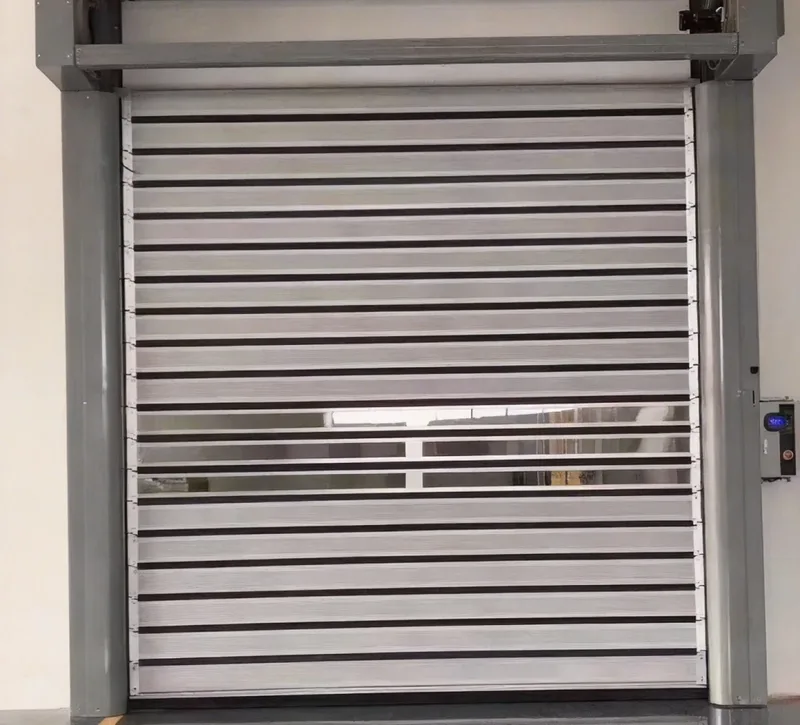
Fire-Rated High-Speed Door
What Is Tested — A fire rating belongs to a tested assembly, not a product. What a fire-rated fast door requires, how release works, and what cannot be claimed.
- Door leaf
- Double-wall aluminium slats, approx. 40 mm, insulated core (typical)
- Winding system
- Spiral / turbine guide; slats wind without touching each other
- Opening speed
- 1.0-2.0 m/s, VFD adjustable (indicative)
- Closing speed
- 0.5-1.0 m/s, VFD adjustable (indicative)
A rating is a property of an assembly
A fire-rated high-speed door is a fast door arranged to close on a fire signal and to hold a compartment boundary for a stated period. The important word is stated: the period comes from a test on a specific assembly, and it does not transfer to a door of different size, different hardware or different closing mechanism.
This is not a technicality. In a fire strategy submission, the door is accepted on the basis of a test report that names the construction, the size tested and the components that were part of the test. A door that looks the same and is built to a different detail is a different assembly, and the report does not cover it.
What the door has to do, and in what order
The duty of a fire door is not "close quickly". It is: be open in normal service, close reliably on a signal, and stay closed for the rated period. Speed is a secondary benefit that makes the door usable at a traffic opening; it is not what the rating tests.
That ordering matters when a project asks for a fast door because the opening has high traffic. A fire door that closes in three seconds but does not latch is worse than one that closes in eight and does. The latch, the seals and the frame are what hold the compartment, and each of them is part of the tested assembly.
Holding open. A fire door on a traffic route is normally held open by the door's own control, and released by the fire alarm interface. The holding arrangement has to fail safe: loss of power or loss of the release signal must result in the door closing, not in the door staying open. This is the single most common failure in service, because a door that has been forced or disabled to keep traffic moving looks identical to one that is working.
Closing and latching. The closing mechanism is part of the tested assembly. Replacing a closers, a release device or a latch with a different model takes the door outside its report, even if the new part is a better component.
Staying closed. The seals at the perimeter and the meeting edge limit smoke and hot gas, and they are consumed or deformed by the fire test they were rated in. A door whose seals have been replaced with a different profile has an assembly nobody has tested.
| Element | Why it is part of the rating | What breaks the rating |
|---|---|---|
| Door leaf construction | Tested for the stated period at a stated size | Different panel, different core, larger size |
| Closing mechanism | Tested as part of the assembly | A different closer or release device |
| Seals | Tested for smoke and hot gas performance | Replacement with a different profile or material |
| Frame and fixings | Tested with the leaf | A different frame or fixing detail |
| Release interface | Determines fail-safe behaviour | Control changes without re-assessment |
The standard question
Which standard applies depends on the market, and the answer changes how the door is specified rather than how it looks.
In Europe, a fire door is assessed as a product under EN 16034, which sits alongside the industrial door product standard EN 13241-1; the safety of powered operation is EN 12453 regardless of the fire duty. A supplier who quotes a fire period without naming the standard, the report and the tested size has not given a specification.
In China, the product standard for fire doors is GB 12955, and the building code that decides where a compartment boundary is required is GB 50016. These are different documents with different roles: one is a product test, the other is a design requirement. A door cannot be justified by citing the building code, because the building code does not test products.
The practical consequence is that a project in an export market needs the report for that market's standard, and a report issued against a different framework is not interchangeable.
Why a fast door is a difficult fire door
There is a real tension, and it is worth stating plainly rather than resolving with marketing language.
A fire door has to be reliable in the closed position, and reliability favours simplicity: a heavier leaf, a positive latch, a mechanism with few failure modes. A fast door is optimised for the opposite: light leaf, high cycle rate, complex drive. Combining them is possible, and it is done, but the result is a door whose fire performance depends on a control system working exactly as designed on the one day it matters.
That is why the release logic and its testing deserve more attention than the opening speed. It is also why a fire-rated fast door is usually specified at a boundary where both requirements are genuine, and not as a default upgrade at every opening.
What cannot be claimed
Three statements that appear in the market and should not.
A fire period without a report. A door cannot be described as holding a boundary for a number of minutes unless a test on that assembly exists. A material's reaction to fire — DIN 4102-1 B2, for example — is a classification of the material, not a rating of the door, and the two are routinely confused.
A rating that transfers across sizes. A report covers the size tested and, within defined limits, smaller sizes of the same construction. A larger door is not covered by a smaller test.
A rating that survives unauthorised modification. A different closer, a different seal, a hole cut for a service — each of these removes the door from the tested assembly, and the person who made the change owns that.
What to ask for
The test report, with the standard it was issued against, the construction and size tested, and the components included. The release logic, described as a sequence: what signal closes the door, what happens on power failure, and how the fail-safe behaviour is verified at commissioning. And the maintenance requirement, because a fire door is only compliant while its mechanism is exercised and its seals are intact — the inspection questions are set out under reading a fire door test report.
Where the same opening also has a thermal duty, the two requirements have to be specified together rather than one after the other; the thermal side is covered under insulated lifting doors. Where the requirement is smoke control rather than compartmentation, the boundary arrangement belongs with the industry solutions under solutions.
Pricing and quotation
Every door is made to order. Because each unit is built to the actual clear opening, there is no fixed price list and no standard price range - the price changes with the opening width and height. It also depends on the panel or curtain specification, drive and control package, safety devices, fixing structure, site conditions and delivery location. Send the opening dimensions (width x height), the expected number of opening cycles per day and the installation address, and we will quote the exact configuration. Use the quote button above or the contact page to request a quotation.
Installed door photographs
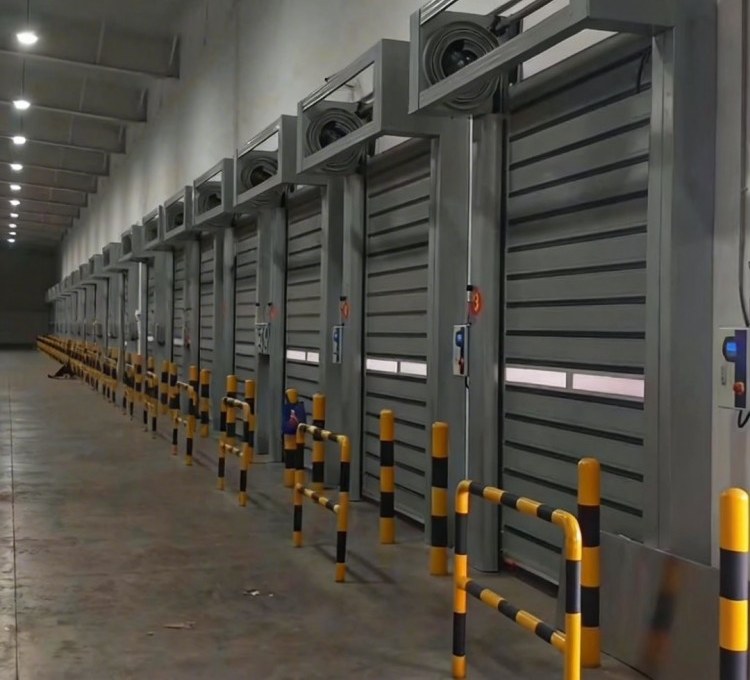
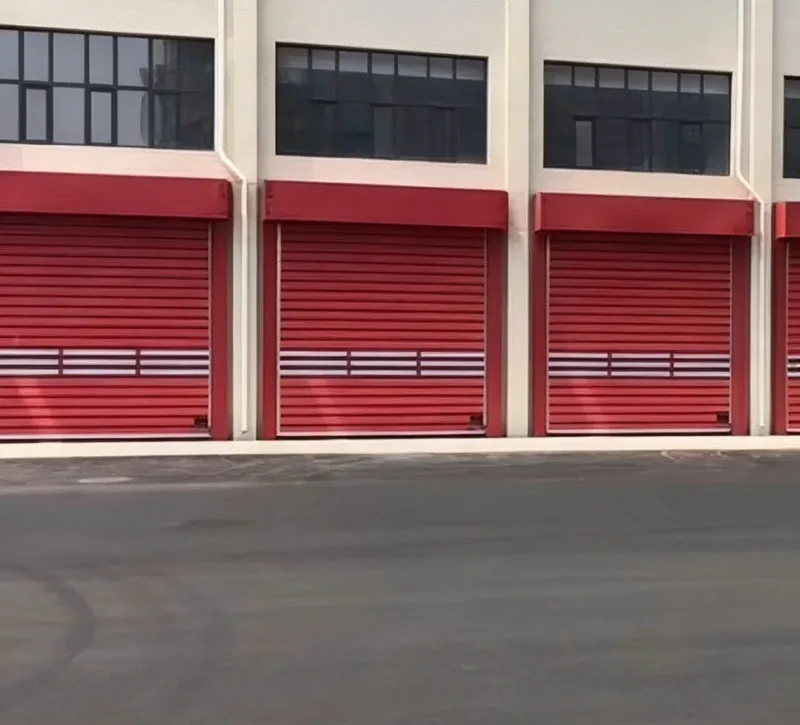
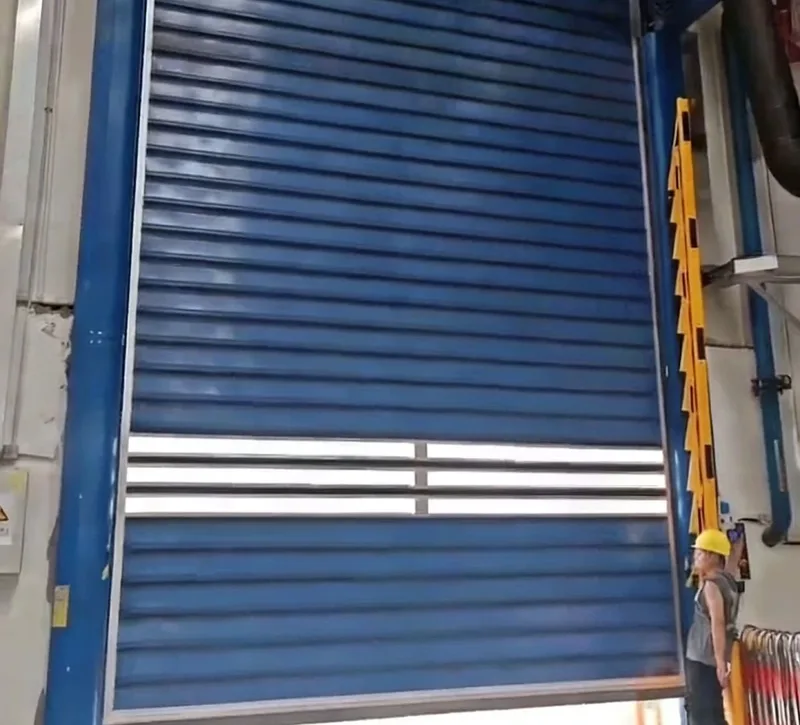
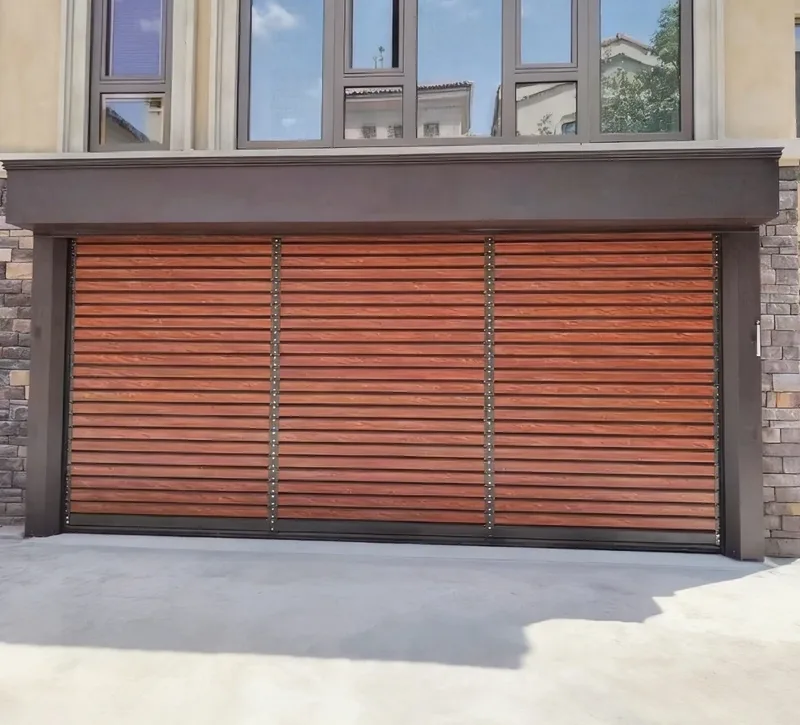
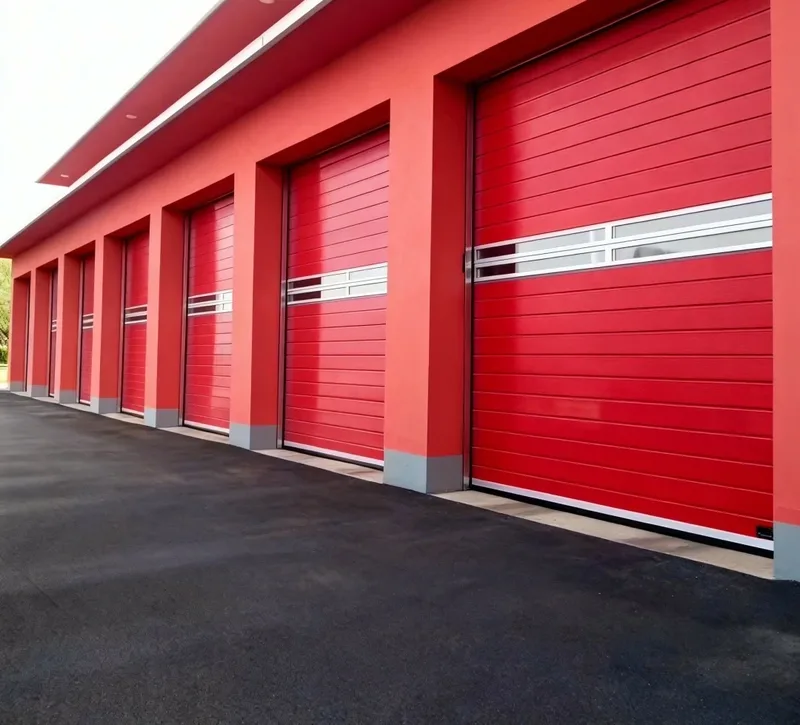
Photographs of this door family installed in industrial and logistics buildings. Door dimensions, panel colours, vision panels and track arrangements differ from project to project because every unit is made to measure.
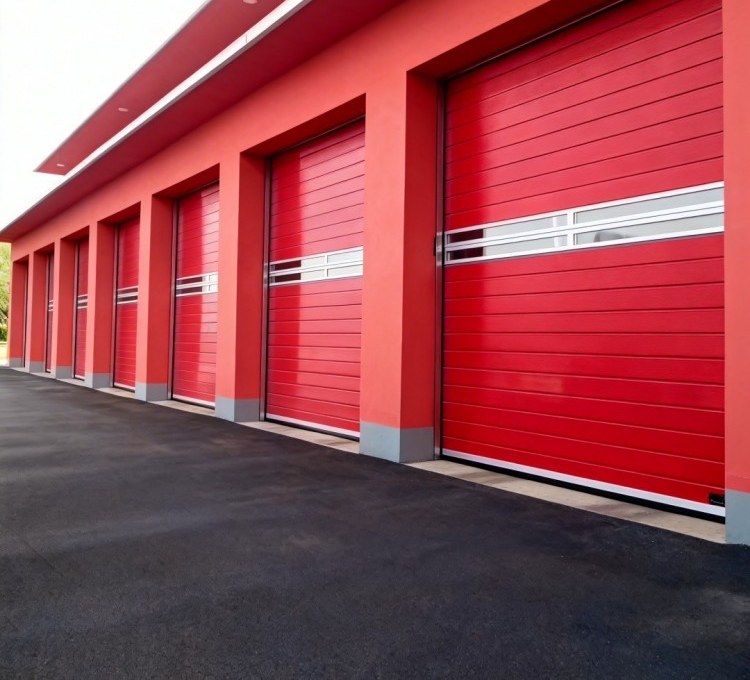
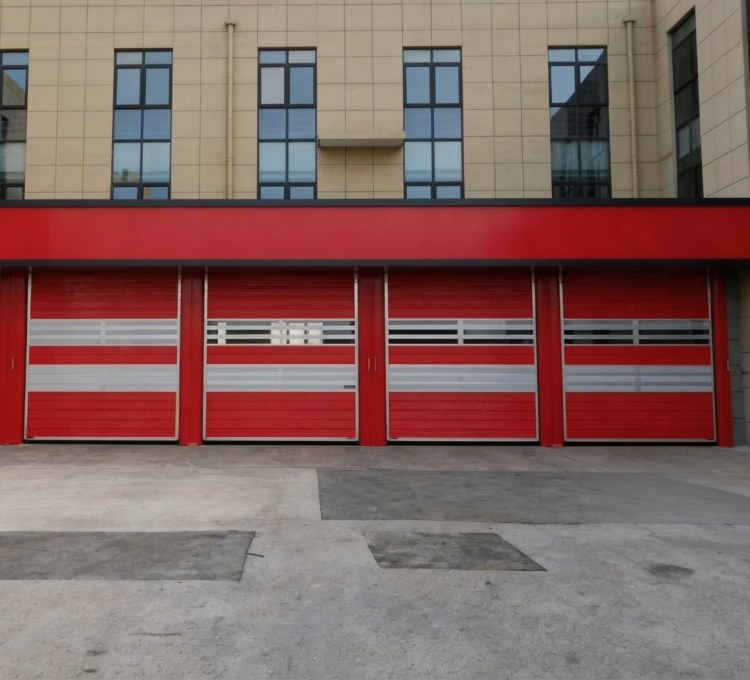
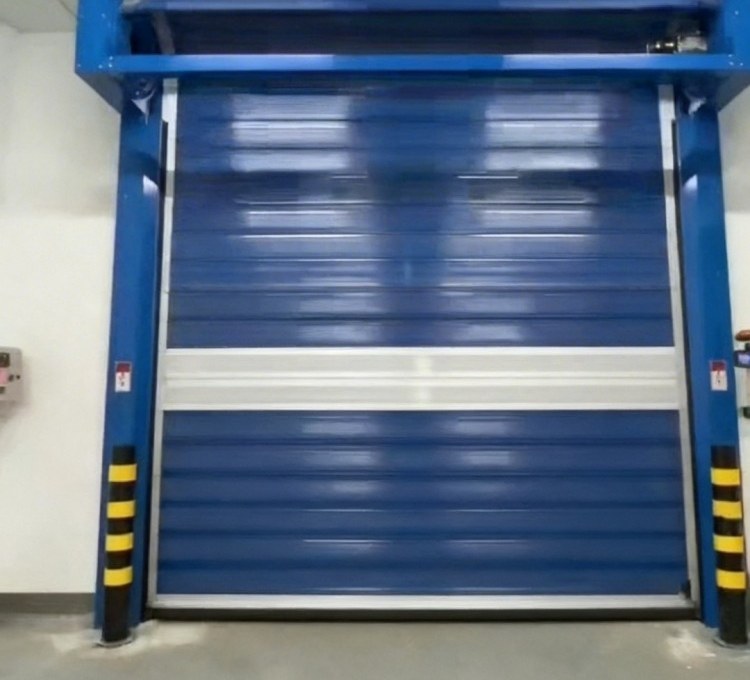
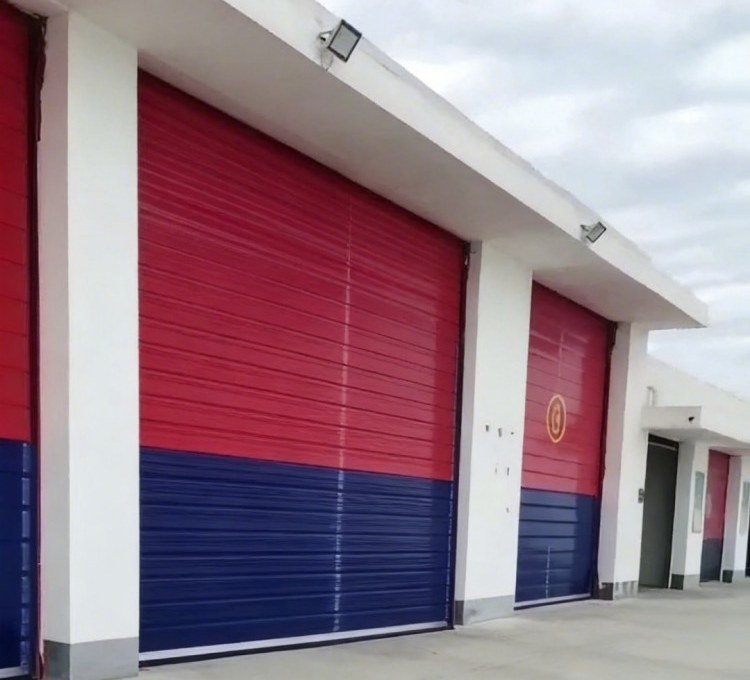
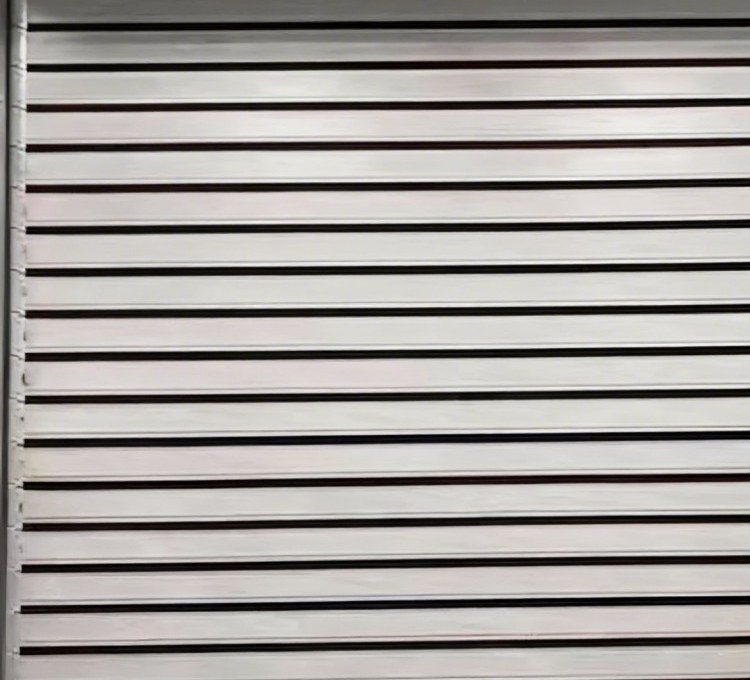
This section documents the engineering, service and compliance baseline for the Fire-Rated High-Speed Door.
Working principle and construction
Rigid high-speed slats are wound into a spiral (turbine) guide mounted above the opening. Unlike a conventional roller shutter, adjacent slats do not touch while winding, so the finish is not scraped and the leaf runs quietly at high cycle rates. A servo or geared motor with a variable-frequency drive and absolute encoder controls acceleration, open/close speed and the final position; the control package can interlock with traffic lights, access control or a conveyor. Safety devices - light curtain, wireless bottom edge and photocells - are specified to EN 12453. Detailed section drawings, fixing details and the opening schedule are prepared after the site survey; request them through the quotation button rather than scaling dimensions from a general illustration.
| Component | Function | Industry-typical configuration |
|---|---|---|
| Rigid aluminium slats | Door leaf | Approx. 40 mm double-wall with insulated core (typical) |
| Spiral / turbine guide | No-contact winding | Slats stay separated through the whole winding path |
| Servo + VFD + encoder | Speed and position | 1.0-2.0 m/s opening, adjustable (indicative) |
| Control interface | Traffic integration | Interlock, traffic light, access control, conveyor signal |
| Safety set | EN 12453 | Light curtain, wireless bottom edge, photocells, emergency stop |
Technical drawings (general arrangement, section details and opening schedule) are issued per project after the on-site survey. No downloadable CAD file is claimed for this door family on this page; use the quotation button to request the current drawing set.
Service, warranty and project support
The levels below are industry-typical service terms used as a working basis because Anbixin's own policy schedule has not yet been supplied. They are indicative and are confirmed or adjusted in the written quotation and service agreement for each project.
- Warranty: 24 months on the door leaf, drive unit and control package from handover; wear items (seals, brushes, curtain fabric, impact damage) are excluded. Extended warranty terms can be quoted.
- After-sales support: acknowledgement within one working day, remote diagnostics for control faults, on-site attendance subject to location and schedule; common wear parts are kept available for replacement.
- On-site survey: measurement of clear width and height, headroom, side room, fixing structure, power supply and traffic pattern, followed by project-specific shop drawings before fabrication.
- Preventive maintenance: scheduled service visits with counterbalance check, safety-device function test, seal inspection and lubrication; panel, slat or curtain replacement is available.
- Project and volume pricing: tiered pricing for project orders, contractors, partners and multi-unit purchases; applicable terms are stated in the quotation, not as a published discount rate.
Nothing on this page constitutes a binding service commitment. Confirm warranty duration, response times, survey coverage and project pricing with the sales team before including them in a tender, advertisement or contract.
Standards, safety and compliance
Design and safety references for this product family: EN 13241 (product standard for industrial, commercial and garage doors), EN 12453 and EN 12445 (safety in use of power-operated doors and the related test methods), EN 12604 (mechanical requirements), EN 12424 and EN 12444 (wind-load classification and test), EN ISO 13849-1 (safety-related parts of control systems) and EN 60204-1 (electrical equipment of machines). These are design and test references, not a claim of certification: compliance, test reports and any third-party certificate are confirmed per project in the technical submittal. Fire-rated roller shutters belong to a separate product family selected to the fire-compartment requirements, where EN 13501-1 and EN 1634-1 apply; this page does not claim a fire rating.
Vietnamese market terminology
In Vietnam this door family is searched with the local Vietnamese terms listed below; they are kept untranslated here and used in headings, FAQs and metadata. 'Turbo rigid high-speed door' and 'spiral high-speed door' describe the same winding principle. Fire-rated rolling shutters are a different product family and this page does not claim a fire rating.
- cửa cuốn nhanh xoắn ốc — spiral high-speed door
- cửa cuốn nhanh kim loại — metal high-speed door
- cửa cuốn nhanh tuabin — turbo high-speed door
- cửa cuốn nhanh hợp kim nhôm — aluminium alloy high-speed door
- cửa cuốn chống cháy — fire-rated rolling shutter (different product family)
Typical applications in the Vietnamese market
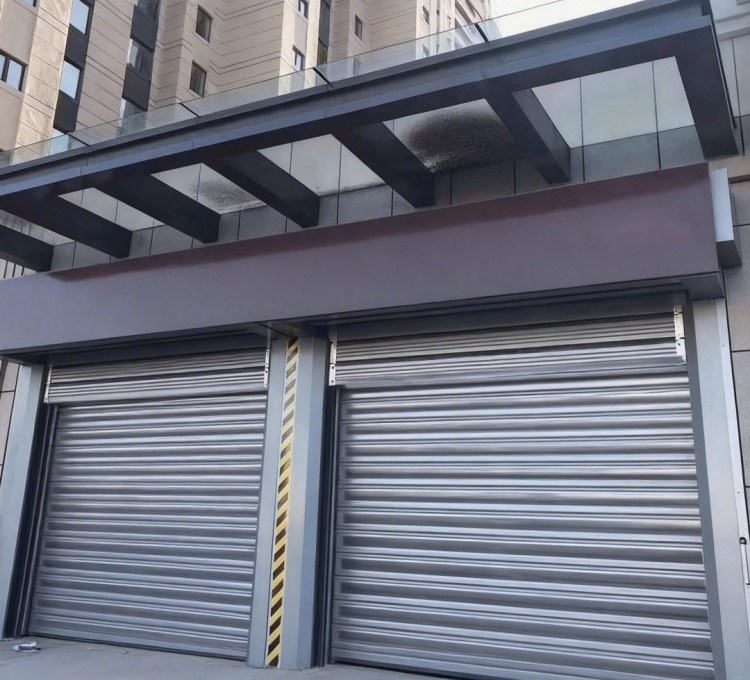
Spiral high-speed door · dock face
High-cycle transfer opening between production and warehouse; the spiral track keeps the clear opening free of a horizontal track.
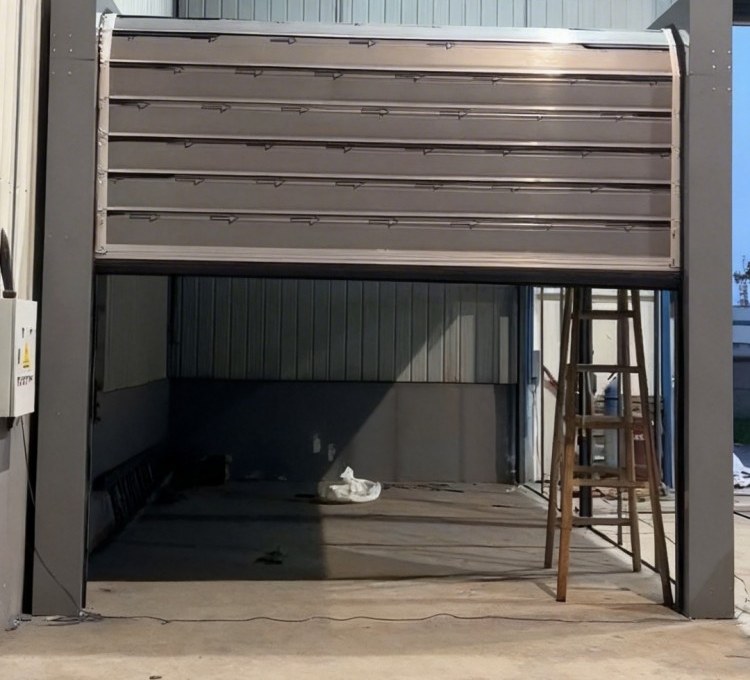
Spiral high-speed door · clean passage
Clean passage with dust sealing and vision panels for two-way visibility; typical clear width 3-6 m.
Turbo rigid high-speed door · high-cycle transfer
External opening on the dock face, specified for wind load resistance and fast closing to hold the temperature zone.
Photographs below are from installations of this door family in Vietnam. Customer names are withheld; project details are available on request.
Frequently asked questions
Is a B2 material classification a fire rating?No. B2 under DIN 4102-1 describes how a material reacts when exposed to fire. A door's fire resistance is a property of a tested assembly and is expressed in minutes, with a report behind it.
Yes, and it is done, provided the assembly has been tested and the release logic is fail-safe. The difficulty is that a fast door optimises for the opposite of what a fire door needs, so the control system carries more of the duty.
It closes it. A door held open in normal service is released on the fire signal so that it closes and latches. It must also close on power failure, which is a separate test at commissioning.
Only with a component covered by the same test report. A different model, even a better one, takes the door outside the tested assembly.
The construction, the size tested, the closing mechanism, the seals and the frame detail — the whole assembly as tested. Anything changed from that is outside the report.
Pain Points Solved
In emergency situations such as fires, traditional doors cannot close quickly, leading to the spread of fire and smoke, threatening personnel safety.
Key Features
- Linked to the fire alarm; the signal triggers closing
- Fire rating requires the corresponding type test report
- Rubber seals block smoke
- Manual release for evacuation
Technical Specifications
| Door leaf | Double-wall aluminium slats, approx. 40 mm, insulated core (typical) |
|---|---|
| Winding system | Spiral / turbine guide; slats wind without touching each other |
| Opening speed | 1.0-2.0 m/s, VFD adjustable (indicative) |
| Closing speed | 0.5-1.0 m/s, VFD adjustable (indicative) |
| Max. clear opening | Up to approx. 6000 x 6000 mm; larger sizes engineered to order |
| Wind load resistance | EN 12424 class 3-4, approx. 700-1000 Pa (indicative) |
| Thermal transmittance | Approx. 1.0-1.5 W/(m²·K) for insulated slats (indicative) |
| Drive | Servo / geared motor with VFD and absolute encoder; 3-phase 380-415 V / 50 Hz |
| Control | PLC with position feedback; interlock, traffic light and access-control interface |
| Safety (EN 12453) | Safety light curtain, wireless bottom safety edge, photocells, emergency stop |
| Cycle rate | Up to 800-1000 cycles/day (indicative, duty-dependent) |
| Sealing | Perimeter brush and EPDM seals; optional bottom airbag |
| Operating noise | Approx. ≤70 dB(A) (indicative) |
| Emergency operation | Manual release; optional UPS for one open cycle |
| Product focus | High-speed rigid leaf only; a fire rating is NOT claimed - fire shutters are a separate family (see Standards) |
Gallery
Need a Reliable Solution for Your Project?
Tell us about your application and requirements — our team will help you specify the right product.