
The comparison people get wrong
At a given opening, the choice between a sectional door and a high-speed door is usually presented as a price comparison. It is not, because the two products fail at different things. A sectional door is better at holding a boundary and worse at opening quickly; a high-speed door is the reverse. Which of those matters depends on the traffic, and the traffic is a property of the building rather than of the door.
The comparison that works is open time against conduction. Everything else follows.
What each product is actually good at
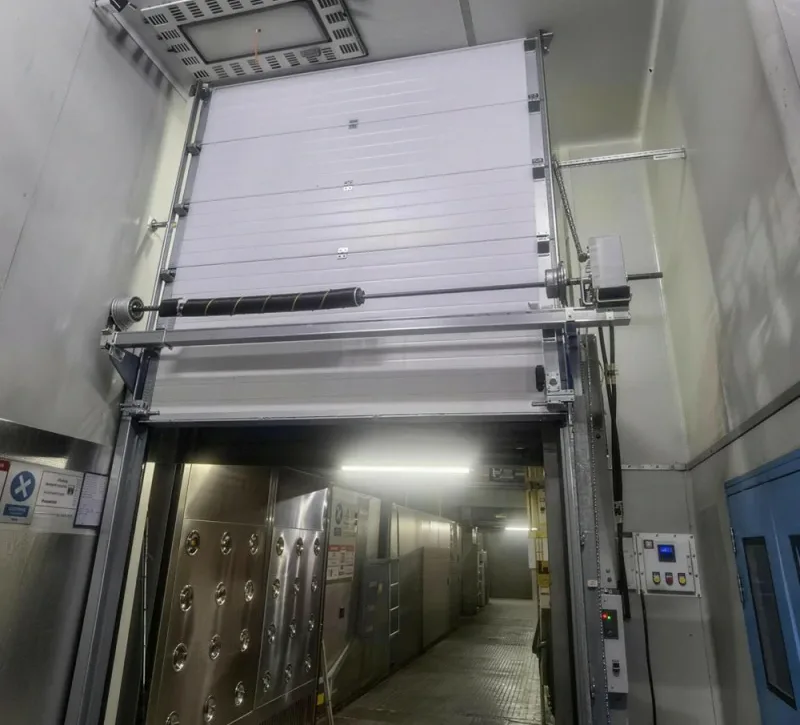
A sectional door is a rigid insulated leaf, typically 40 mm of polyurethane core between steel skins, with a panel U-value of 0.84 W/(m²·K) and 0.4 W/(m²·K) between panels. It resists wind at 450 N/m², seals with four perimeter seals plus a joint seal at every panel, and moves at 0.25-0.3 m/s. It is the best available answer for a boundary that has to hold.
A high-speed door is a lighter leaf — a flexible curtain on a roll-up type, or a rigid panel on a spiral or turbine type — moving at roughly 0.8 to 1.5 m/s or more. It opens in a second or two rather than twenty. Its insulation is thinner and its wind resistance lower, because both are consequences of a lighter, thinner leaf.
Neither is a better product. They are optimised for different terms in the same equation.
| Term | Sectional door | High-speed door |
|---|---|---|
| Time to clear a 6 m opening | Around 20 s | A few seconds |
| Panel insulation | 0.84 W/(m²·K) panel, 0.4 between panels | Thinner leaf, lower performance |
| Wind resistance | 450 N/m² (Beaufort 10) | Lower; flexible curtains deflect |
| Sealing | Perimeter plus every joint | Perimeter; curtain types seal less well |
| Impact behaviour | Panel deforms, repairable | Curtain tolerates minor impact; rigid leaf does not |
| Best at | Holding a boundary | Minimising open time |
The equation that decides it
Conduction loss is the U-value multiplied by the area and the temperature difference, integrated over the time the door is closed. Open-time loss is the air exchange through the opening multiplied by the time it is open. Both are real, and the question is which is larger for the duty in front of you.
At thirty cycles a shift, a sectional door is open for perhaps ten minutes a day. The rest of the day it is closed, holding the boundary, and its insulation is doing the work it was bought for. A high-speed door in the same position opens in a third of the time and insulates a third as well; over a whole day the sectional door loses less.
At three hundred cycles, the same sectional door is open for over an hour and a half a day. During that time its insulation is irrelevant because the opening is a hole. A fast door that is open for twenty seconds a cycle is open for a fraction of that, and it wins despite the thinner panel.
That crossover is the entire argument, and it is not a fixed number — it moves with the temperature differential and the cost of energy on site. What does not move is the method: count the cycles, multiply by the open time each product would have, and compare against the conduction loss over the same period.
When neither is right
There is a third case, and it is common. Where an opening needs both a tight boundary and high traffic, no single door gives both, and the usual resolution is two doors in series: an insulated sectional door at the outer wall that stays closed, and a fast door on the inner partition carrying the traffic. Each is then optimised for what it actually does, and the space between them acts as an airlock.
This is more expensive than one door, and it is the honest answer for a cold store dock or a busy cleanroom corridor. Asking one leaf to hold a large differential and open several hundred times a shift produces a door that does neither well — either a slow door that loses the boundary every time it opens, or a thin door that cannot hold it.
The arrangement is described under cold chain door solutions; the sectional product itself on the standard-lift sectional door page, and the fast alternative on the PVC high-speed roll-up door page.
What to measure before deciding
Three numbers, all of which the building owner has or can get.
The real cycle count. Not the design intent — what the door actually does. A door specified for a few movements a shift and used continuously is the most common source of a wrong choice.
The temperature or pressure differential. A large differential makes the open time expensive; a small one makes it unimportant.
The cost of energy or of conditioned air on site. This converts the comparison from a technical exercise into a financial one, which is what the decision actually is.
With those three, the product choice follows. Without them, any comparison is a guess dressed as an analysis.
Frequently asked questions
Can a high-speed door be insulated to match a sectional door?
Not to the same level, because insulation requires thickness and mass, and speed requires the opposite. A thicker high-speed leaf is a heavier high-speed leaf, and the speed advantage narrows.
Which is more reliable?
A high-speed door has more cycles per hour, so its wear items reach replacement sooner in calendar time. A sectional door has fewer moving parts but heavier ones. Reliability depends more on the maintenance schedule than on the product type.
What if the door is only used seasonally?
Then the open time is small for most of the year and the insulated door wins. Seasonal peaks do not justify a product that is wrong for the other ten months.
Does the answer change for an internal wall?
Yes. Across an internal partition the differential is smaller, so the open time matters less and the insulation matters less — which usually makes a fast door the better value even at moderate traffic.
Is two doors in series always better?
It is better where both requirements are real. Where one of them is marginal, a single correctly specified door is cheaper and simpler.