
Three mechanisms, not one number
When a door is described as thermally efficient, the figure quoted is almost always the panel U-value. That number describes one of three paths by which an opening loses heat, and on most industrial doors it is not the largest of the three. The other two — leakage through the perimeter and the air exchange while the door is open — are frequently larger, and neither appears on a datasheet.
Separating the three is the only way to decide where money should go. Insulating a panel that is already adequate while the perimeter seal is worn is a common and expensive mistake, because the panel was never the limiting path.
Path one: conduction through the panel
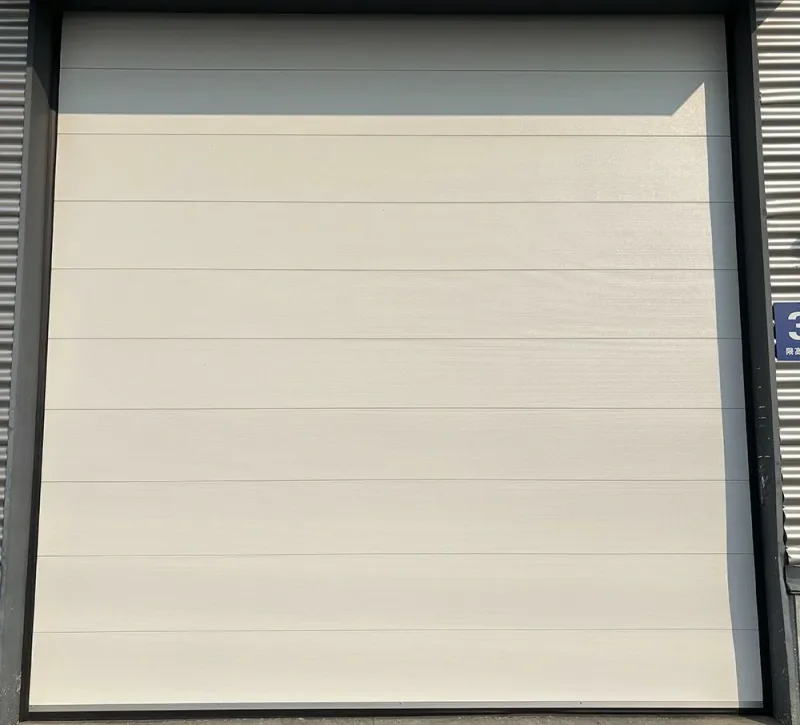
This is the path the U-value describes. Heat flow is the U-value multiplied by the panel area and the temperature difference. For a 40 mm polyurethane-cored insulated panel the figure is 0.84 W/(m²·K), and 0.4 W/(m²·K) at the joint between panels, because two compressed panels present a thicker path than one panel through its thickness.
Two things limit what improving this path can achieve. The first is that the panel is only part of the opening's area — the frame, the track and the threshold are not insulated to the same standard, and they are where the cold bridges are. The second is that the calculation uses the whole panel area, while the parts that actually matter in service are the edges.
So conduction is a real path, and a better panel reduces it. But the return diminishes quickly, because the remaining area is small relative to the paths below.
Path two: leakage through the perimeter
Every door has a perimeter seal: bottom, sides and top, plus a compression seal at each joint on a sectional leaf. Air passes through whatever gap remains, and the flow is driven by the pressure difference across the door — which on a cold store boundary or a cleanroom is a designed pressure, not a small one.
Leakage is measured in a way that makes it comparable to conduction: as a linear thermal transmittance per metre of joint, usually written as Ψ. The practical point is that it is expressed per metre, so a door with a long perimeter has more of it, and a worn seal turns a small linear figure into a large one.
Two failure modes dominate. A bottom seal that no longer compresses against an uneven floor leaves a gap running the full width of the opening. Side seals that have worn in the track leave gaps running the full height on both sides. Neither is visible during operation, and both are continuous.
This is why perimeter condition, not panel specification, is the first thing to check when a cold store cannot hold temperature. It is also the cheapest thing to fix.
Path three: air exchange while open
When the door is open, the two sides are connected and air moves between them. The volume involved is the opening area multiplied by the time it stays open, and it is usually the largest of the three paths on any door that is used regularly.
The reason it is ignored is that it does not appear in any product specification — it depends on how the building is used, not on what was bought. But it is the path that decides whether a fast door or an insulated door is the right purchase, and getting it wrong is the most expensive error in this list.
Reading a U-value in isolation is where most of these comparisons go wrong. The comparison is straightforward once the numbers are on the table. Take the number of cycles per shift, multiply by the open time each door type would have, and you have the open duration per day. Compare that against the conduction loss through the panel over the same period. On a door used thirty times a shift the conduction path usually dominates; on one used three hundred times, the open time does.
That crossover is the whole argument for high-speed doors, and it is also the argument against specifying one where the traffic does not justify it.
The three paths side by side
| Path | Driven by | On a datasheet? | Where to act |
|---|---|---|---|
| Conduction through the panel | U-value, panel area, temperature difference | Yes | Panel specification |
| Leakage at the perimeter | Seal condition, perimeter length, pressure difference | No | Seal replacement and frame detail |
| Air exchange while open | Opening area, open duration, cycle count | No | Product choice and operating discipline |
Only the first column appears in a product specification. That is why a quote that lists a U-value and nothing else is not a thermal specification of the opening — it is a specification of one component.
Which path to fix first
The order that produces the best return is almost always the same.
First, the perimeter. Replace worn seals before considering a better panel. It is the cheapest intervention and it removes a continuous loss. On a cold store door, check the perimeter before anything else.
Second, the open time. If the calculation shows the door is open for a significant part of the day, the answer is not a better panel but a faster door, or a discipline about when it opens. This may be a change of product rather than a change of specification.
Third, the panel. Once the perimeter is sound and the open time is controlled, a better panel reduces the remaining conduction loss. On a door that is closed most of the day, this is where the money goes; on one that is open most of the day, it is the last place to spend it.
What this means when specifying
Ask for three things rather than one. The panel U-value, with the test report behind it. The perimeter detail, specifically how the seals are compressed and what happens at the threshold. And an honest statement of the cycle count the door is expected to see, because that, not the U-value, decides whether a sectional door is the right product at all.
The door described across this site carries a panel U-value of 0.84 W/(m²·K) and 0.4 W/(m²·K) between panels, with a core density of 44 kg/m³ measured on the panel and a thermal conductivity of 0.023 W/(m·K). Those are the conduction path. The other two paths are decided by the seals, the installation and the way the building is used.
Frequently asked questions
Is a lower U-value always worth paying for?
Only up to the point where the panel stops being the limiting path. Once the perimeter and the open time dominate, a better panel changes little in service.
How do I know if my seals are leaking?
Not by looking. A pressure or temperature reading with the door closed shows it; a worn seal is invisible during operation because nothing is visibly broken.
What is Ψ and why does it matter?
It is the linear thermal transmittance of a joint, expressed per metre. It makes perimeter leakage comparable with panel conduction, and it explains why a long perimeter loses more than a short one with the same seal.
Can I estimate the open-time loss myself?
Yes. Count the cycles per shift, multiply by the open time each door type would have, and compare the result against the conduction loss over the same period. That comparison is what decides the product.
Does a better panel help a cold store door?
It helps, but the perimeter and the rail detail matter more. A cold store door that ices up usually has a perimeter or a track problem, not a panel problem.