
Two things GMP asks of a door
Pharmaceutical facilities impose a different specification pattern from other clean environments, and the difference is not the particle count. GMP asks two things of a door: that it performs as part of the classified boundary, and that its performance can be documented. A door that works but cannot be evidenced is a finding in an inspection, not a pass.
The first requirement drives the physical specification — leakage, cleanability, pressure step. The second drives what the project needs from the supplier: drawings, material statements, and a traceable link between what was specified and what was installed. Both are part of the scope.
From grade to door requirement
Cleanroom grades differ in the particle and microbial limits they hold, and the door's requirements follow from which grade boundary it sits on rather than from the grade of the room in general.
| Boundary | What governs the door | Consequence for specification |
|---|---|---|
| Unclassified to grade D | Envelope integrity, cleaning access | Insulated door with tight seals; cleanable frame |
| Grade D to grade C | Pressure step, short open time | Fast door with tested leakage; controlled activation |
| Grade C to grade B | Pressure step, low particle shedding | Fast door, smooth surfaces, sealed track profile |
| Grade B to grade A (critical zone) | Tight control of the interface | Door is normally not the interface: a pass-through or an airlock carries the transfer |
The bottom row is the one worth pausing on. At the cleanest boundaries a door is usually the wrong device, because a door is a large moving object with seals and a drive, and the transfer of material is better handled by a smaller, dedicated interface. Where a door is still required, it is normally separated from the critical zone by an airlock rather than opening directly into it.
The pressure cascade is a chain with the door as a link
A GMP facility holds a cascade of pressures so that air moves from clean to less clean. The door is where the step occurs, and it has to hold that step in both states.
Closed, the door must not leak the step away. The seals are the working part, and the frame and track detail decide whether the seal can do its job — a seal compressed against a frame with a gap behind it does nothing.
Open, the door connects the two zones and the cascade is bypassed for as long as the opening lasts. This is why open time, not insulation, is the governing parameter at an internal grade boundary, and why a fast door is specified even where the temperature requirement is modest.
The activation method belongs to this question too. A door that opens on a wide radar field stays open for every passing person; a door opened by a deliberate action stays open only for the transfer. In a GMP environment the second behaviour is usually what the validation assumes, and the door should be specified to match it.
Cleanability is a geometry question
A pharmaceutical cleaning validation looks at surfaces that can be reached, and the door is assessed the same way as any other equipment in the room. Three features decide whether it passes.
Surface finish. Smooth, non-porous and non-shedding. A profiled panel traps material in the profile; a smooth face can be wiped.
Frame and track geometry. Open box sections, exposed fixings and open track profiles all create places that cannot be cleaned effectively. Closed profiles and concealed fixings are the alternative.
Joints. Every joint between panels is a line that has to be cleaned and, on a sectional door, compressed. Fewer joints is a cleaning advantage; a single-piece leaf has none but cannot span a large opening.
The drive and controls matter too, because a control box mounted at the opening is equipment in the controlled area. Where the room classification requires it, the control is located outside the boundary and operated remotely.
What validation asks the supplier for
A pharmaceutical project will normally request a documentation set with the door, and it is worth knowing what that contains before quoting rather than after.
Drawings and material statements. What the door is made of, including seals and finishes, so that the cleaning and compatibility assessment can be done.
Performance evidence. Leakage, and where relevant the fire classification. A material classification such as DIN 4102-1 B2 for the panel is not a fire rating of the door, and the distinction matters in a submission.
Installation record. What was installed, where, and with which settings — because the validated state is the installed state, not the catalogue state.
Maintenance requirements. Seal replacement intervals and the checks that keep the door within its specified condition. A door that drifts out of adjustment is out of its validated condition.
The physical door underneath
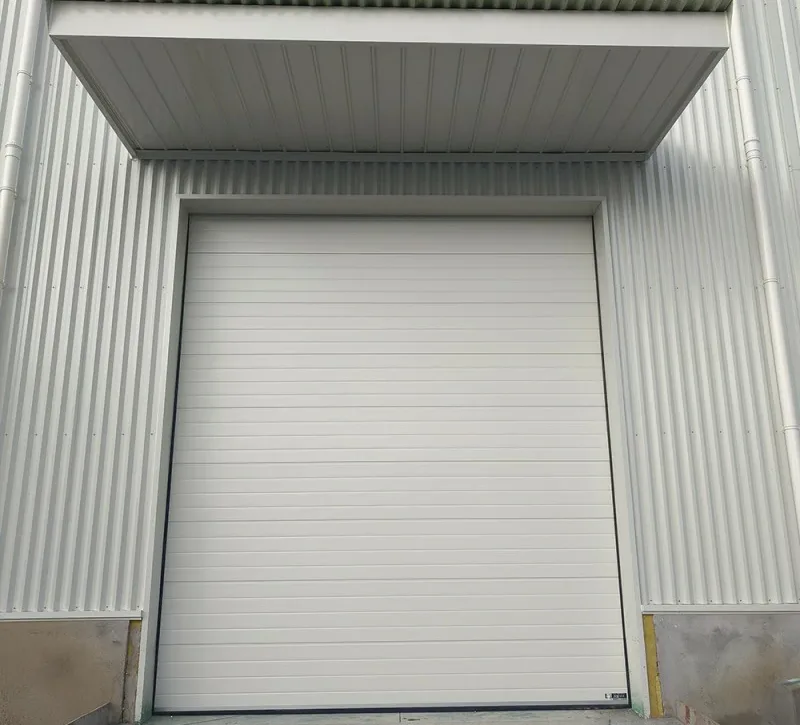
None of this changes the base construction: a 40 mm panel of two hot-dip galvanised steel skins on a polyurethane core with a measured density of 44 kg/m³ and thermal conductivity of 0.023 W/(m·K), giving a panel U-value of 0.84 W/(m²·K) and 0.4 W/(m²·K) between panels. Reaction to fire is DIN 4102-1 B2, wind load resistance 450 N/m² with the supplied anchoring, and the balance is external torsion springs rated over 50,000 cycles.
A driven door falls under EN 12453 with obstruction detection and limited closing force. Manual opening force stays within 150 N. Where the boundary is thermal rather than classified, the insulated lifting door is the fit; for the fast internal boundary, PVC high-speed roll-up doors; for the fire compartment case, the fire-rated lifting door.
Frequently asked questions
Does a GMP door need a certificate?
Not a product certificate in the consumer sense. It needs documented properties — leakage, materials, finishes, fire classification where relevant — and an installation record showing those properties are what was installed.
Can a standard industrial door be used in a GMP area?
Only where its geometry and finish meet the cleaning requirement. A door with open track profiles and exposed fixings will not pass a cleaning assessment regardless of how well it seals.
Why is open time more important than insulation here?
Because at an internal grade boundary the loss is the pressure step and the air exchange while the door is open, not heat through the panel. Insulation matters at the external envelope.
Should the door open into a grade A zone?
Normally no. Transfer into a critical zone is handled by a pass-through or an airlock, with the door separated from it rather than opening directly into it.
What maintenance does the validated state require?
Seal replacement on a schedule, counterbalance and limit switch checks, and confirmation that the activation behaviour matches what the validation assumed. A door out of adjustment is out of its validated condition.