
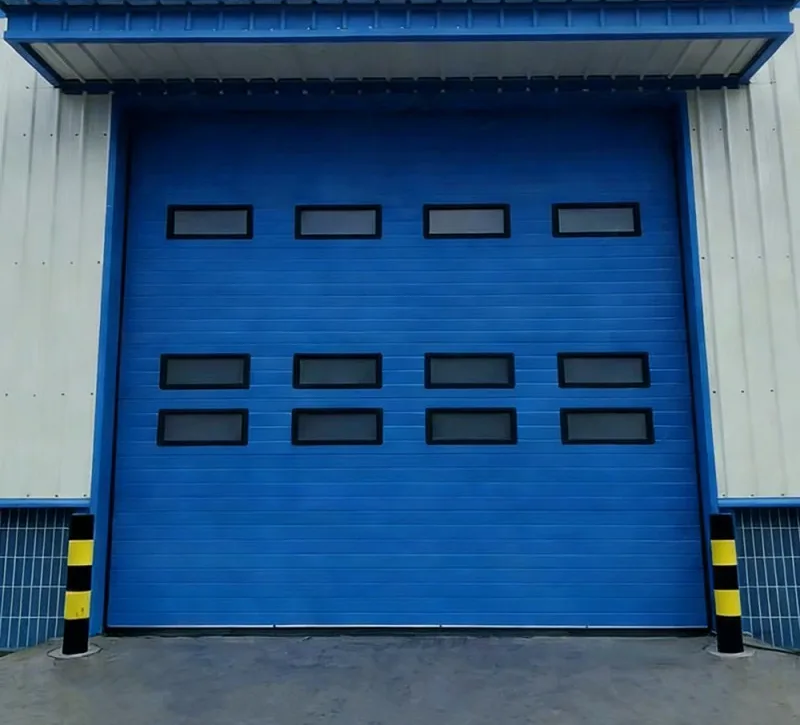
A loading bay retrofit in a parts plant is a project on the interface between a building and a vehicle, and the door is only one of six components that have to work together. The other five — leveller, shelter, seal, vehicle restraint and signal — determine whether the door is ever in a position to do its job, and a bay that replaces the door while leaving the rest untouched usually produces the same complaints it started with.
A note on what this page is. Client names, sites and measured results are withheld under confidentiality, and no throughput or safety-incident figure is claimed here. What the page sets out is the scope of a bay project, the order the components are decided in, and what the work involves while the plant keeps shipping.
The six components and what each one does
The leveller bridges the height difference between the dock floor and the vehicle bed. It carries the load, so its rating is a structural decision rather than a convenience. The shelter closes the gap around the vehicle's rear. The seal closes the gap between the shelter and the vehicle body. The door closes the opening when no vehicle is present. The restraint holds the vehicle against the dock while it is being loaded. The signal tells the driver and the loader what state the bay is in.
They fail as a system. A well-sealed door in a bay with a torn shelter leaks at the shelter, and the leak is larger than the door's own because the perimeter around a vehicle is long and irregular.
Load rating is the first decision
The rating is set by the heaviest combination the bay will handle: vehicle, handling equipment and load together, not the vehicle alone. Standard ratings of 6000, 8000 and 10000 kg cover most fleets, and non-standard builds go up to 20000 kg. The figure has to come from the plant's actual fleet and handling equipment, and it should include the possibility that a laden forklift crosses the leveller at an angle, which concentrates load on one side.
Getting this wrong is expensive in a way that is invisible until it is not: an under-rated leveller works for years and then fails with a vehicle on it.
Why the shelter is often the real gap
A trailer is not a flat wall. It has ribs, a bumper, a tail-lift, sometimes a refrigeration unit, and it arrives at slightly different heights and angles every time. The gap between the shelter and the body is therefore variable, and it is the largest single opening in the bay during loading — larger, in most cases, than the leakage through a closed door.
This is why a bay project that starts with the door and stops there under-delivers. The shelter and its seals are the components that actually close the envelope during the operation, and their condition decides whether the bay holds its temperature or its pressure.
Component, function and common failure
| Component | Function | Common failure | What the failure looks like |
|---|---|---|---|
| Leveller | Bridges dock to vehicle bed | Under-rated for the fleet; lip worn | Hydraulic drift, lip not fully extended |
| Shelter | Closes the gap around the vehicle | Torn fabric, collapsed frame | Daylight visible around the trailer |
| Seal | Closes shelter to body | Hardened or missing sections | Draught at the top corners |
| Door | Closes the opening when idle | Seals worn, bottom seal torn | Ice or condensation at the threshold |
| Restraint | Holds vehicle during loading | Not interlocked with the door or the signal | Vehicle moves during loading |
| Signal | Communicates bay state | Overridden or ignored | Door operated with a vehicle unrestrained |
Two rows deserve emphasis. The restraint that is not interlocked provides a false sense of safety: it holds the vehicle only if the driver has engaged it and only if nobody releases it early. And the signal that is routinely overridden is worse than no signal, because the habit of ignoring it spreads.
Keeping the bay in service during the work
A parts plant usually cannot lose a bay for long. The work is therefore phased bay by bay, with the dispatch plan built around the reduced capacity rather than the installation built around the plan. Realistic sequencing is: one bay out, complete it including commissioning, bring it back, then start the next.
What makes phasing work is agreeing the traffic arrangement in advance: which vehicles go where, whether a temporary ramp is needed, and who on the plant side has authority to redirect a driver. The installation itself is usually the predictable part; the traffic is where the delays come from.
Commissioning a bay
A bay is commissioned as a system, not as six deliveries. The leveller's level position and lip extension, the fall-safe behaviour, the shelter's fit against a representative vehicle, the door's closing force and safety edge, and the interlock logic between restraint, door and signal all have to be checked together.
The relevant standards split along the same lines: EN 1398 covers dock levellers, EN 12453 the safety of power-operated doors, and EN ISO 13849-1 the safety-related parts of the control system where an interlock is part of the protection. A vehicle restraint that participates in the safety function is a control-system component and should be assessed as one.
What goes wrong, in order of frequency
The door is replaced and the shelter is left, so the draught continues. The leveller is rated on the nominal vehicle weight and not on the laden handling equipment. The restraint is installed but not interlocked, and the bay relies on a driver's habit. And the signal is placed where the loader cannot see it, so it is ignored from the first week.
Questions that come up in scoping
Can a dock door be used without a shelter?
It can, and in mild climates it often is. The shelter exists to close the gap around the vehicle, so where that gap does not matter — no temperature control, no pressure control, no weather exposure — it is optional. Where any of those apply, the shelter is doing more work than the door.
What load rating should be specified?
The heaviest realistic combination, with margin for the way a laden forklift actually crosses the plate. The standard ratings of 6000, 8000 and 10000 kg exist because fleets cluster around them; a plant with heavy handling equipment should be looking at the upper end or at a non-standard build rather than at the nominal vehicle weight.
Does the door need to interlock with the leveller?
It needs to interlock with whatever the bay's operating logic requires to be safe. The common arrangement is restraint engaged, then door open, then leveller deployed; reversing that order or allowing a step to be skipped is what the interlock exists to prevent. How that logic is built and verified is the subject of connecting a door to an automation system.
How is a bay's air leakage actually assessed?
By looking at it with a vehicle in place. The door is testable with a standard method; the shelter-to-vehicle gap is not, because it varies with every vehicle. A practical assessment is a visual survey with a representative trailer at the dock, checking for daylight and draught at the top corners and along the sides.
What is the maintenance that matters most?
Seals and shelters, in that order, because they are the components that degrade fastest and are replaced least often. A bay with a well-maintained shelter and an ordinary door outperforms one with a good door and a torn shelter. The door side of the same argument is in what completes a loading bay.
Related reading
The product context for this sector is in automotive plant door solutions. For the door types at a dock, see steel lifting doors and standard-lift sectional doors.