
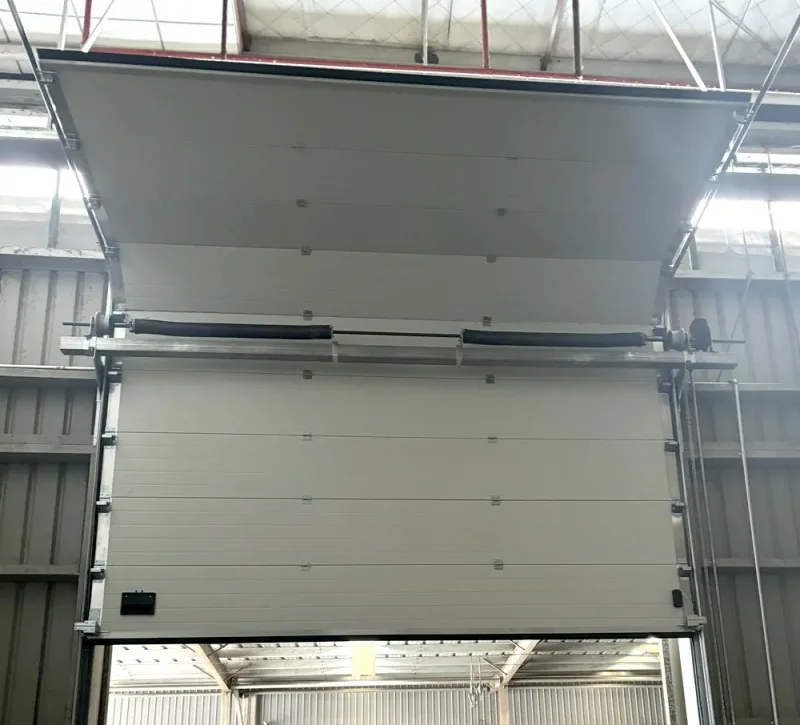
A door on a takt line is not a door
In a plant organised around takt time, every element is measured by whether it supports the beat. A door that takes twenty seconds to open is not slow — it is a buffer that does not exist, and the material handler builds the wait into their route. Multiply that by the number of crossings on a shift and the door becomes a constraint on the line rather than an access point.
This is why automotive facilities specify doors differently from warehouses. The size of the opening is rarely the problem. What matters is how many times the door has to move, how reliably it moves, and what happens to production when it stops.
Cycle count decides the product
The threshold is not a fixed number, because it depends on the differential across the door and the cost of the energy on site — but the shape of the decision is consistent. Up to a few dozen cycles a shift, a sectional door's insulation is worth more than its cycle time. Beyond a few hundred, the open time dominates and the door has to be fast.
| Duty | Typical door | Why |
|---|---|---|
| Exterior wall, a few movements a shift | Insulated sectional door | Closed most of the day; envelope performance matters |
| Internal boundary, continuous flow | Fast roll-up door | Open time dominates; insulation across an internal wall is a smaller loss |
| Between production and staging | Rigid high-speed door | High cycle count and wind or pressure difference across the opening |
| Dock opening with vehicle traffic | Sectional door plus dock leveller and shelter | The dock equipment closes the gap the door cannot |
The mistake to avoid is applying the exterior-wall specification to an internal boundary. An insulated sectional door between two production halls buys insulation where the differential is small, and pays for it every cycle in time lost.
What a stoppage actually costs
This is the number that justifies a higher door price, and it is usually calculated badly or not at all. A door that fails on a takt line does not cost the door repair — it costs the line, for as long as the material cannot pass.
Three consequences follow for the specification.
Component quality is a production decision. A cheaper roller or hinge that fails at 300,000 cycles rather than 500,000 is not a saving if the failure stops a line. The counterbalance rating in cycles is therefore a commercial figure, not a technical one.
Fault visibility matters as much as reliability. A door that fails visibly is repaired; a door that drifts out of adjustment and begins to fault intermittently is a maintenance argument that runs for weeks. Reporting door state to a monitoring point turns that into a task.
Manual operation has to be genuinely possible. On a leaf that cannot be lifted by hand during a power failure, the recovery time is whatever it takes to get a service technician on site. A manual opening force within 150 N is what makes the door recoverable by the shift supervisor.
The doors that are not about cycle time
Two openings in an automotive plant are specified for something other than speed.
Paint shop and clean areas. Here the requirement is containment: the door has to hold a pressure or a cleanliness class, and the open time matters because it breaks the containment. This is a cleanroom problem in a factory setting, and the approach is the one used under electronics cleanroom doors.
Fire compartment boundaries. A door that is a normal route in service and a barrier in a fire needs to be a tested assembly, not a door with a fire-resistant panel. That distinction is set out under the fire-rated lifting door page.
Dock equipment is part of the opening
At a vehicle dock the door is only one of four components, and it is rarely the one that leaks. The leveller bridges the height difference, the shelter closes the gap around the vehicle body, and the seal closes the gap between the shelter and the door. A well-specified door on a dock with no shelter leaves an opening the size of a lorry body.
The specification question at a dock is therefore not "which door" but "what closes the opening when a vehicle is against it". Those components are described under loading dock equipment, and the automotive case adds one requirement to the general one: with a dock in continuous use, the shelter takes repeated contact from vehicle bodies and has to be replaceable as a wear item.
What the door has to be anyway
The base construction does not change with the industry. A 40 mm panel of two hot-dip galvanised steel skins on a polyurethane core, measured density 44 kg/m³, thermal conductivity 0.023 W/(m·K), panel U-value 0.84 W/(m²·K) and 0.4 W/(m²·K) between panels. Reaction to fire is DIN 4102-1 B2, and wind load resistance is 450 N/m² with the anchoring supplied.
The balance is external torsion springs rated over 50,000 cycles, and a driven door falls under EN 12453 with obstruction detection and limited closing force. Where the traffic is continuous, the practical specification is a fast lifting door or a rigid high-speed door rather than the standard-lift version; where the boundary is thermal, the insulated lifting door.
Frequently asked questions
How many cycles a shift before a fast door pays?
A few hundred. The calculation is cycles multiplied by the open time each door type would have, compared against the cost of the energy on site. Below that, insulation is worth more than speed.
Is a fast door less reliable?
It has more cycles per hour, so its wear parts reach replacement sooner in calendar time. The counterbalance, rollers and seals need a schedule rather than a repair-on-failure approach.
What happens if the door fails during a shift?
On a takt line the cost is the line, not the door. That is the argument for a manual opening force within 150 N so the door can be recovered locally, and for fault reporting so the failure is visible before it stops traffic.
Does the dock shelter really matter?
It is often the largest uncontrolled opening at the dock. A door that seals perfectly against its frame does nothing about the gap between the building and a lorry body, which is what the shelter is for.
Can one door type serve the whole plant?
Usually not. Exterior walls want insulation, internal high-traffic boundaries want speed, and clean areas want containment. Specifying by boundary rather than by plant is the approach that works.