
A door is part of the cleanroom, not a hole in it
In an electronics plant the door is usually specified as access, and treated as a hole in the wall that happens to open. That framing is wrong in a way that shows up in the particle counts. A cleanroom door is a controlled opening: it is the largest movable element in the envelope, it is the part that leaks when closed, and it is the part that generates particles when it moves.
Three properties follow from this, and they are the ones that decide the specification: how much air leaks past the door when it is closed, how the door sits on the pressure cascade between zones, and what the door's own movement contributes to the particle load. Each is addressed by a different part of the door.
Leakage when closed sets the air change rate
A cleanroom is held at a positive pressure relative to its surroundings, and the air supplied has to exceed the air that leaves. The air leaves through the extract, through the fabric, and through every opening — including the door. A door with worn perimeter seals is an uncontrolled extract path, and the room compensates by supplying more air, which is the single largest operating cost in a cleanroom.
The practical consequence is that door seals are an energy item rather than a hygiene item in this industry. A bottom seal that no longer compresses against the floor, or side seals that have worn in the track, will each pass air continuously, and neither is visible during operation. The check is a pressure reading with the door closed, not a visual inspection.
This is why the specification should state the leakage requirement with the door closed, and why the seal detail matters more than the panel U-value here. Cleanroom air is conditioned for temperature and humidity; losing it through a door seal costs more than losing heat through the panel.
Where the door sits on the pressure cascade
Cleanrooms are arranged as a cascade: the cleanest zone is at the highest pressure, and each less-clean zone is stepped down. The door is the point where the step happens, and it has two states to consider.
Closed. The door must not short-circuit the cascade. If the seals leak, the pressure difference across the door collapses and the airflow reverses through the opening rather than through the intended path.
Open. The door must be open for as short a time as possible, because while it is open the two zones are connected and the cascade is bypassed. This is the argument for a fast door at an internal cleanroom boundary, and it is a stronger argument than insulation.
| Zone relationship | What the door must do | Door type normally used |
|---|---|---|
| Outdoor to clean corridor | Hold the envelope, resist weather and impact | Insulated sectional door |
| Clean corridor to production | Minimise open time, seal when closed | Fast roll-up door |
| Production to critical process | Very short open time, tight seal, low particle shedding | Fast roll-up or rigid fast door |
| Between two clean zones at different grades | Hold the pressure step without leakage | Door with tested air leakage and a controlled opening |
Particles generated by the door itself
A moving door produces particles: the seals rub, the hinges articulate, the drive gear meshes, and the panel surfaces shed whatever is on them. In a cleanroom the door is therefore a source, not only a barrier, and the specification should reduce the source rather than filter it afterwards.
Three details matter. Smooth, non-porous surfaces on the leaf and frame shed less and clean more easily. A drive that does not use exposed sliding contact produces less wear debris. And a seal material that stays soft rather than hardening with age keeps its own wear low — a hardened seal does not merely leak, it abrades.
The cleaning regime follows the same logic. What collects is the frame profile, the track, and the joint between panels. An open track profile is a particle trap that no cleaning schedule will keep up with, which is why closed profiles are preferred at a critical boundary.
Static in the areas where it matters
Electronics plants contain areas where static discharge damages product, and the door is one of the few large surfaces in the room that is not part of the controlled ESD system unless it is specified to be. A door that is not bonded to the earthing system can build a charge as air moves over it, and the discharge happens at whatever touches it next.
The practical specification is not a special door but a set of details: a conductive or dissipative finish where the zone requires it, bonding of metal parts to the building earth, and no isolated metal component in the opening. The door supplier's part is to state what the door can be bonded to and what finish it carries; the earthing design belongs to the electrical package.
What the door has to be anyway
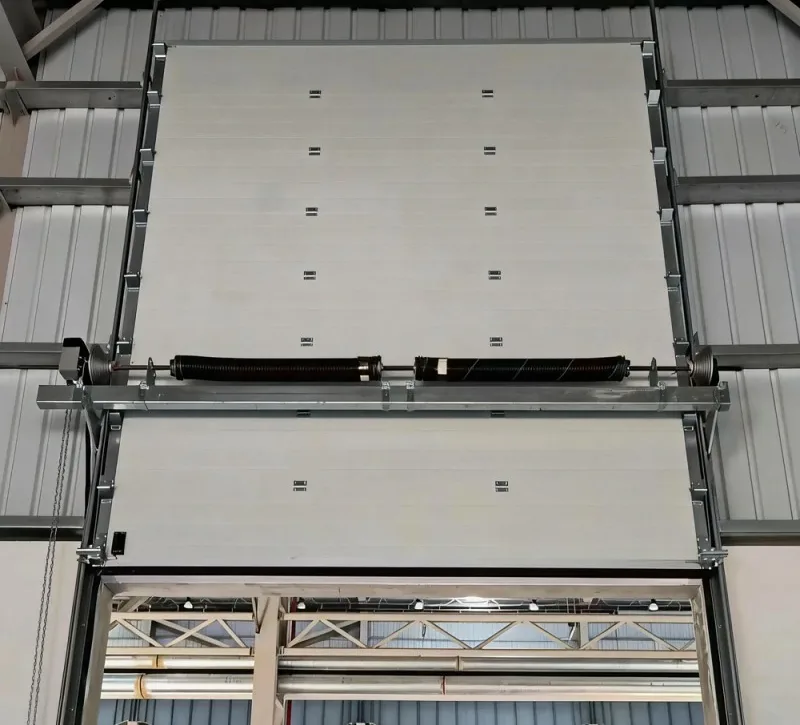
Whatever the cleanroom requirement, the door is still an industrial door and carries the same base specification. The panel is 40 mm, two hot-dip galvanised steel skins on a polyurethane core with a measured density of 44 kg/m³ and thermal conductivity of 0.023 W/(m·K). Panel U-value is 0.84 W/(m²·K) and 0.4 W/(m²·K) between panels; reaction to fire is DIN 4102-1 B2; wind load resistance is 450 N/m² with the anchoring supplied.
A driven door falls under EN 12453, with obstruction detection and limited closing force required, and the manual opening force stays within 150 N so the door can be operated during a power failure without breaking the pressure discipline any longer than necessary.
Where the boundary is an internal cleanroom rather than an external wall, the fast roll-up construction described under PVC high-speed roll-up doors is the usual choice, because open time dominates the specification. Where it is the outer envelope, an insulated sectional door holds the fabric side. The boundary mapping approach used in food plants transfers directly and is set out under food industry door solutions.
Frequently asked questions
Does the door need a special cleanroom certification?
There is no single certification for a cleanroom door. What is specified instead is a set of measurable properties: leakage with the door closed, surface finish and cleanability, particle shedding of the seals, and where relevant the ability to bond metal parts to earth.
Which matters more, panel insulation or door sealing?
In a cleanroom, sealing. The air is conditioned for temperature and humidity, and losing it through a worn seal costs more than heat passing through the panel. The panel matters at an external wall, not at an internal grade boundary.
Should the door be fast or insulated?
Fast at an internal boundary where open time defeats the pressure cascade; insulated at an external wall where the fabric has to hold. Where both are needed, two doors in series usually beats one door compromised on both.
How is static handled?
By bonding the metal parts to the building earth and using a dissipative finish where the zone requires it, not by choosing a different door. The earthing design belongs with the electrical package, and the door supplier states what can be bonded.
How often should seals be checked?
On a schedule rather than on failure, because a leaking seal is invisible while the room compensates by supplying more air. A pressure reading with the door closed is the check that shows it.