
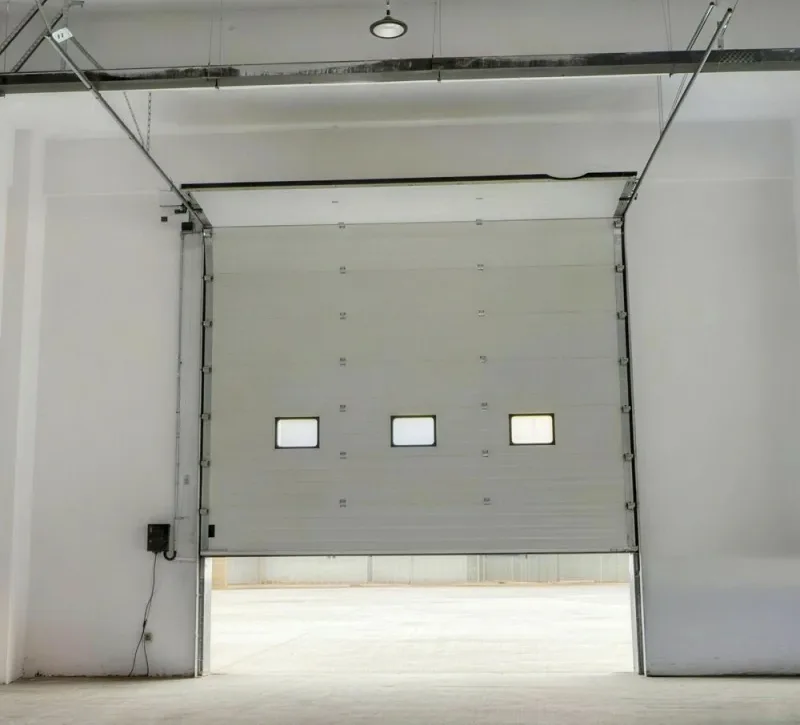
A cold store door retrofit is an intervention at a thermal boundary, and the boundary — not the door — is what has to work afterwards. The distinction matters because a replacement door that is better insulated but wrongly positioned, or correctly positioned but installed without a thermal break, can leave the store with the same problem it started with: ice at the threshold, water on the floor, and a refrigeration load that never settles.
A note on what this page is. Client names, sites and measured results are withheld under confidentiality, and no energy saving or temperature stability figure is claimed here. What follows is the method: which number drives the specification, where the failure actually occurs, and what the work involves in a store that has to keep its temperature throughout.
The temperature step is the design input
The figure that decides the specification is the difference between the two sides of the door, not the nominal temperature of the store. A door between a freezer at deep frozen conditions and an ambient dock is working across a much larger step than a door between a chilled room and a packing hall, and the two need different answers even though both are "cold store doors".
Three consequences follow from the step. Larger steps make the warm face colder, which brings condensation and then ice. Larger steps make every opening more expensive, because the air that enters has further to be cooled. And larger steps make the airlock more valuable, because the buffer volume does more work when the difference is greater.
Why condensation appears on the warm side
Condensation forms when a surface is colder than the dew point of the air around it. At a cold store door that surface is not the panel's middle — the panel is insulated and its warm face stays close to ambient — it is the edge, the frame and the track, where the insulation stops and metal conducts.
This is the single most misdiagnosed problem in cold store doors. Adding insulation to the panel does not fix it, because the panel was never the problem. What fixes it is a thermal break at the frame and track, plus heating where the geometry cannot be broken. The calculation of whether a given surface will fall below the dew point follows the method in EN ISO 13788, and it is worth doing before the door is ordered rather than after the first winter.
The visible symptom is water on the floor and ice at the threshold; the underlying cause is a continuous metal path from the cold side to the warm side, which is exactly what an unbroken track provides.
What an airlock does, and what it does not
An airlock limits infiltration by giving the warm air somewhere to stop. When the outer door opens, cold air spills into the buffer rather than into the store; when the inner door opens, the buffer is already cold. Its effectiveness comes from its volume and from the discipline of not opening both doors at once.
What an airlock does not do is compensate for a door that leaks when closed. If the closed seal is passing air continuously, the buffer is a permanently cold room with a continuous load, and the infiltration during openings is added on top. Fixing the seal is always the first step, and it is far cheaper than adding buffer volume.
Step, product and failure mode
| Boundary | Step | What the door needs | Failure seen in service |
|---|---|---|---|
| Chilled room to packing hall | Moderate | Insulated leaf, good seals, fast cycle | Seals worn by traffic, ice in humid weather |
| Chilled to ambient dock | Moderate to large | Insulated leaf plus frame thermal break | Condensation on the frame, wet floor |
| Freezer to chilled ante-room | Large | Thermal break, heated threshold, airlock | Ice at the threshold and on the track |
| Freezer to ambient | Very large | All of the above plus heated frame | Ice forming within hours of a defrost |
The last row is where projects most often under-specify, because the door looks adequate on paper and the problem only appears in operation, at which point the remedy — heating, thermal breaks, a different frame — is an invasive retrofit rather than a factory option.
Retrofitting a store that stays cold
Freezer work is a different job from chilled work, and a schedule built on chilled productivity will slip. Inside a freezer the working time is limited, PPE is heavier, ice has to be removed before anything can be fixed, and every opening of the store during the work is a load on the refrigeration plant. Permits, a two-person rule and a time limit inside are normal.
The practical sequence is: prepare the new door and frame outside, take the opening out of service for the shortest possible window, install, seal, heat and test, then bring the boundary back before the store temperature drifts beyond its tolerance. Temporary screening during the window is standard, and it has to be planned rather than improvised.
Defrost water has to go somewhere
Heat at a threshold produces water, and water that cannot leave becomes ice. Drainage is part of the door specification in freezer work, not part of the building's afterthought. A heated threshold with no drain, or a drain that runs uphill, or a drain line that freezes in the plant room, all produce the same outcome as no heating at all.
The check is simple and rarely done: during commissioning, confirm where the melt water goes and that the path stays clear at the lowest expected plant-room temperature.
What goes wrong, in order of frequency
The door is specified by store temperature rather than by temperature step. The frame has no thermal break, so the panel is fine and the edge is wet. The airlock is used for storage, which removes the buffer without anyone deciding to. And the maintenance regime checks the door's operation but not its seals, so the closed leak grows slowly and is only noticed when the refrigeration plant cannot hold temperature on a hot day.
Questions that come up in scoping
Is a lower U-value always better?
Only up to the point where the panel stops being the dominant path. On a cold store door the panel is usually the best-performing part of the assembly already, and the joints, frame and track are worse. Improving the panel from a good figure to a better one changes little; breaking the thermal bridge changes a great deal. The reasoning is set out in how to read a U-value.
Does the door need heating if the store is only slightly below zero?
It depends on the humidity of the warm side and the temperature of the surfaces. A small step in a dry climate may need nothing; a small step in a humid packing hall can produce condensation on an unbroken frame. The calculation is the same either way, and it is cheap to do before ordering.
Can a high-speed door be used at a freezer boundary?
Only where the product is designed for it. A fast door is a curtain or a light leaf, and its thermal performance is modest; used at a large step it becomes a condensation surface and often an ice trap. Where speed is the dominant problem, the answer is usually an airlock with a fast inner door rather than a fast door at the boundary itself.
How often should seals be replaced?
On a schedule set by the traffic the door sees, not by the calendar. A dock door with continuous vehicle traffic wears its bottom seal far faster than a personnel door. The seal schedule produced at handover should name an inspection interval, and the inspection should happen on that interval rather than after a failure.
What standards apply?
Thermal transmittance is calculated under EN 12428, wind load classification under EN 12424, air permeability under EN 12426, and the safety of a power-operated door under EN 12453. Condensation risk on surfaces follows EN ISO 13788. None of these is a cold store standard; they are the tools used to specify a door at a cold boundary. The boundary logic itself is covered under cold chain door solutions.
Related reading
For the product side, see insulated lifting doors and standard-lift sectional doors for moderate steps at large openings. The six mechanisms behind ice at a cold store door are set out in why cold store doors ice up.