
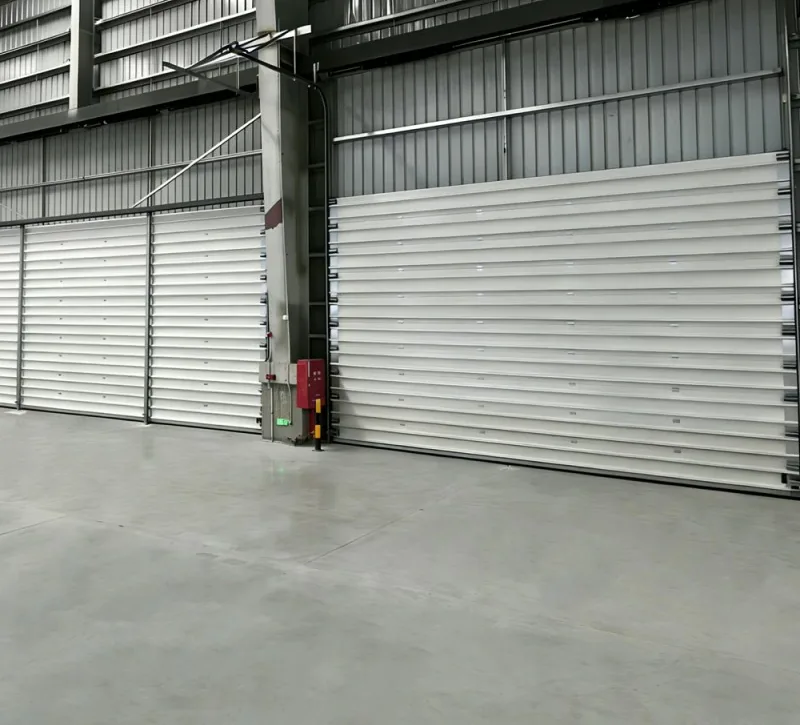
A cleanroom door retrofit in an electronics plant is a change to the pressure envelope of a classified space, and it is judged by whether the space still holds its classification afterwards. The door itself is a controlled leak in that envelope: it is the largest single opening in the boundary and the only one that is deliberately opened during production, which is why its behaviour matters more than its appearance.
A note on what this page is. Client names, locations and measured results are withheld under confidentiality, and no particle count, pressure figure or yield improvement is claimed here. What the page sets out is the method: how the door is placed on the pressure cascade, what a cycle admits, and what the work involves in a plant running at full output.
The door is a leak, and the cascade is what matters
A cleanroom is held at a pressure above its neighbours so that air moves outward through every imperfection rather than inward. That pressure difference is maintained by the air handling system, and the system was balanced against the leakage that existed when it was commissioned — including the doors that were there at the time.
Replace a door with one that leaks differently and the balance changes. This is the single most common oversight in these projects: a door is treated as a component swap when it is in fact a change to the envelope that the HVAC system was tuned to. A door with better sealing raises the differential across it; a door with worse sealing drops the differential in the adjacent space and pulls unfiltered air in through every other gap in that room.
The practical consequence is that a door retrofit has to be followed by a pressure re-balance and a particle test, not just a functional check of the door.
What a door cycle actually admits
While a door is open, two things happen at once. Air moves through the opening because of the pressure difference, and the movement of the leaf and of people through the doorway disturbs the air on both sides. The volume admitted is roughly the opening area multiplied by the time it is open, multiplied by a velocity that depends on the differential — which is why cycle time is the variable worth attacking, and why opening area matters as much as seal quality.
This is also why a door that seals perfectly when closed can still be the wrong choice. If it takes a long time to open and close, most of the ingress happens during the cycle, not through the closed seal.
Where static changes the specification
Static control is the requirement that most distinguishes an electronics cleanroom from a pharmaceutical one. A metal door leaf is a conductor, and a conductor near a sensitive product is either a grounding path or an antenna depending on how it is connected. Powder-coated surfaces are insulators, so a coated leaf does not ground through its face; the grounding path has to be designed deliberately, through the frame and the track, and verified.
The practical questions are whether the door frame is bonded to the building's earthing system, whether any plastic components in the operator's path can accumulate charge, and whether the control panel and its wiring are placed where a technician can service them without breaking gowning discipline.
Space, differential and door property
| Space | Pressure relative to corridor | Door property that decides | What failure looks like |
|---|---|---|---|
| Gowning room | Lower | Durability under high traffic | Worn seals, visible gaps at the jamb |
| Transfer airlock | Intermediate | Interlocked operation, cycle time | Both doors open at once, cascade lost |
| Production area | Higher | Sealing and cleanable geometry | Pressure differential drifts down over months |
| Service corridor | Lower | Access control and closing force | Door propped open by maintenance |
The third row is the one that quietly degrades. Seals compress permanently over time, and a differential that was correct at commissioning drifts down without anyone noticing until a monitoring point alarms. A seal schedule with a replacement interval is cheaper than the investigation that follows an excursion.
Retrofitting without stopping the line
The work divides into dirty work and clean work, and the two must not overlap in space. Cutting, drilling and moving a large leaf belong outside the classified area or behind a temporary screen with local extraction. Assembly, sealing and adjustment belong inside, by technicians who are gowned and who have been briefed on the room's discipline — including what they may not bring in, which usually includes their own tools and their phone.
The sequence that works is: build and prepare outside, install during a window, seal and adjust, then clean, then test. Testing before cleaning is wasted, because construction dust will fail a particle count on its own.
Commissioning after a door change
Four checks settle whether the retrofit succeeded. Differential pressure at each boundary, measured with the door closed and during a cycle. Airflow at the transfer points, to confirm the cascade direction has not reversed. A particle count at the classified space under the conditions the room is normally used in. And a functional check of every interlock, because an interlock that lets both doors of an airlock open simultaneously defeats the whole arrangement.
The applicable test methods are set out in ISO 14644-3, and the classification itself follows ISO 14644-1. The door's air permeability, where it is quoted at all, follows EN 12426, and the safety of a power-operated door falls under EN 12453; for control-system safety functions, EN ISO 13849-1 is the reference a machinery safety assessor will use.
What goes wrong, in order of frequency
The door is chosen before the differential is measured, so the balance is wrong from the first day. The interlock is omitted because two doors "are never open at the same time in practice", which is true until a pallet jams. The grounding path is assumed rather than verified, because the frame is metal and metal is assumed to be earthed. And the door is installed to the drawing instead of the opening, leaving a gap that is sealed with mastic — which is not a seal, it is a place for particles to collect.
Questions that come up in scoping
Does a cleanroom door need a special classification?
No door standard carries a cleanroom class. What a project specifies is a set of properties — air permeability, cleanable surface, particle shedding, corrosion resistance — and the classification of the room is achieved by the boundary as a whole. A supplier claiming a door "is ISO Class 5" is describing a test condition, not a product property.
How much does door leakage affect air change rate?
It depends on the total leakage of the room. In a well-built room the door is a significant share of it, and in a poorly built one it is a small part of a large total. This is why the honest answer requires a leakage survey rather than a rule of thumb, and why replacing the door alone sometimes changes very little.
Can a fast door replace an airlock?
No. A fast door shortens the open period, which reduces ingress per cycle, but it does not provide the buffer volume that an airlock gives when both sides are in use. They solve different parts of the same problem and are usually specified together.
What does ESD grounding require of a door?
A deliberate, verifiable conductive path from the leaf and frame to the building earth, checked after installation and re-checked after any work that disturbs the frame. The reference for an ESD control programme is EN 61340-5-1, which treats grounding as a system requirement rather than a product feature.
How long does a retrofit take?
It depends on whether the opening can be taken out of service and for how long. A single personnel door can be replaced in a shift if the frame is reused; a vehicle door with a new frame is a multi-day job that has to be planned around production. The schedule risk is almost always the building, not the door.
Related reading
The boundary logic for this sector is covered in electronics cleanroom door solutions. For the door types involved, see insulated lifting doors at vehicle openings and electric lifting doors for control and activation. How a door is wired into a building management system is set out in connecting a door to an automation system.