
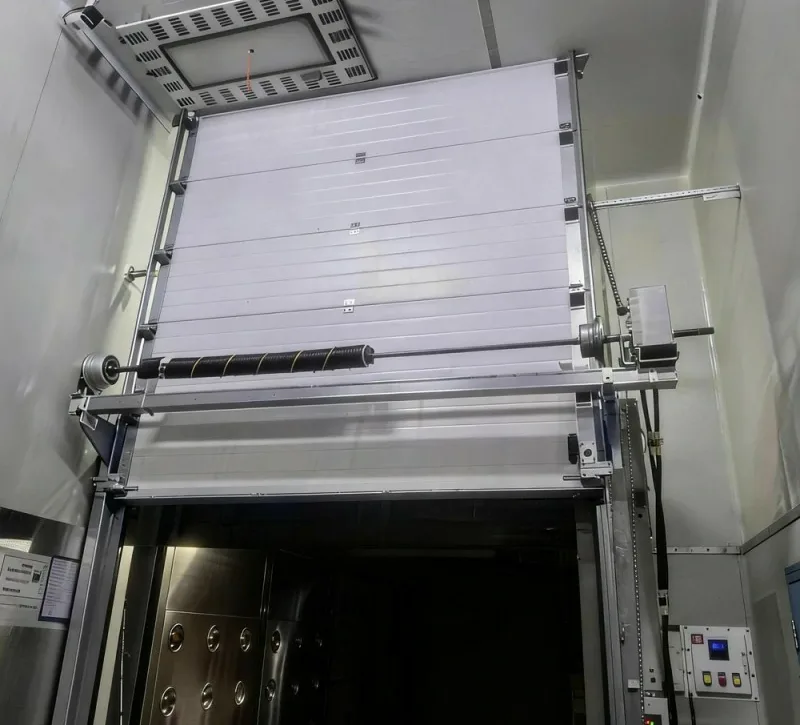
A GMP cleanroom door retrofit in a pharmaceutical plant is a change to a validated facility, and it is managed as such: the door is the physical object, but the project is a documentation exercise with an installation attached. That framing is not bureaucratic decoration. Replacing an opening changes a boundary that the site has declared, in writing, to hold a pressure differential and a cleanliness grade, and the site has to be able to show that it still does afterwards.
A note on what this page is. Client names, sites and results are withheld under confidentiality, and no validation outcome, particle figure or inspection finding is claimed here. The page sets out the method a project of this type follows, and the documents that are normally asked for.
What GMP asks of a door, and what it does not
There is no GMP door standard. What exists is a facility requirement — maintain the differential pressure between zones, maintain the grade, allow cleaning, and do not become a source of contamination — and the door is one element that has to satisfy it. A door cannot be "GMP approved"; it can be appropriate for a particular boundary in a particular facility, with a documented basis for that judgement.
This distinction matters because suppliers sometimes present a certificate as if it settled the question. What settles it is whether the boundary holds its differential and its grade after installation, which is a site measurement.
From grade to door requirement
Grades A and B are the critical zones and are normally separated from lower grades by an airlock rather than a single door. The door's job at that boundary is to seal reliably, to be cleanable to the standard the room requires, and to fail in a way that does not leave the boundary open. Grade C and D areas see more traffic and more mechanical wear, and durability becomes as important as sealing.
The differential is the quantity that ties the door to the facility. A door specified for one pressure relationship and installed where the design differential is higher will leak more than assumed, and the cascade will need re-balancing — which is a change to the HVAC system, not to the door.
What cleanable geometry means in practice
Cleanable is not the same as smooth. A surface is cleanable when a defined cleaning procedure reliably removes residue from it, which requires no crevices, no horizontal ledges where material can sit, joints that are sealed rather than fitted, and materials that survive the cleaning agents used without degrading into a rougher surface.
The details that decide it are small: the junction between frame and wall, the way the bottom seal meets the floor, the fixings, and whether the track has a profile that can be wiped. A door with an excellent panel and a track full of recesses is not cleanable, whatever the panel's finish.
The documentation set
| Document | Issued by | Why it is asked for |
|---|---|---|
| User requirement specification | Site or its engineering contractor | Establishes what the boundary has to achieve, before a product is chosen |
| Approved drawing | Supplier, approved by site | Fixes dimensions, materials and interfaces so the installation can be inspected against it |
| Material certificates | Supplier | Shows the alloy and finish actually supplied, not the one in the brochure |
| Seal schedule | Supplier | Names each seal, its material and its replacement interval |
| Installation qualification | Installer, witnessed by site | Records that the door was installed as specified |
| Operational qualification | Site, with supplier support | Records that it performs as required in service conditions |
The two qualification documents are where most of the effort sits, and they are the reason these projects take longer than the installation itself suggests. They also create the maintenance baseline: a seal schedule that nobody records against is a document, not a control.
Change control is the real scope
Replacing a door in a validated facility is a change, and it goes through the site's change control procedure. The assessment is not a formality: it establishes whether the change is like-for-like or an improvement, what has to be re-qualified, and which other systems are affected. A door with a different control panel may change the interlock logic, which changes the airlock behaviour, which touches the facility's contamination control strategy.
Doing this assessment before the order is placed is what makes the schedule credible. Doing it afterwards turns a three-week installation into a three-month one, because the door is on site and cannot be energised until the paperwork catches up.
Working in a running plant
Pharmaceutical sites usually allow work during shutdowns or in a phased sequence zone by zone. The two constraints that catch installers out are gowning — technicians entering a classified area must be trained and gowned to the site's standard, which is a scheduled activity, not an improvised one — and cleaning after the work, which has to be done by the site's own procedure because the residue is a validated concern.
A temporary screen is normal, but it has to be agreed as part of the change, not erected on the day.
What goes wrong, in order of frequency
The door is ordered before the URS is written, so the specification describes a product rather than a requirement. The differential is taken from a design document that predates a plant modification. The seal schedule is delivered but never entered into the maintenance system, so replacement happens when a seal fails rather than before. And the qualification documents are completed retrospectively, which is the one thing an auditor will identify immediately.
Questions that come up in scoping
Does a door need to be qualified separately?
The door is normally qualified as part of the room or the boundary, not as a standalone item. What is recorded is the boundary's performance — differential, grade, cleanability — with the door included as one of its elements. Treating the door as a separate validation object is unusual and usually a sign that the change was not properly scoped.
Is stainless steel always required?
No. It is required where the cleaning regime would corrode a coated finish, which is common in sterile and washdown areas and less so in a dry storage zone. The deciding factor is the cleaning agent and its frequency, and the corrosion resistance classification under EN 1670 gives a way to state the requirement rather than name a material.
What is the pressure differential normally specified at?
It is a facility decision that follows from the contamination control strategy, not a figure that a door supplier sets. What the supplier has to do is state the differential the door is designed to seal against and confirm the seals are suitable for it, so that the facility's design number and the door's capability can be compared.
Can an existing door frame be reused?
Often, if the frame is sound, correctly fixed and its geometry matches the new leaf. Reusing the frame shortens the work and avoids cutting the wall, which is the dirtiest part of the job. The risk is that the old frame's seals are the part that failed, and reusing it reproduces the problem.
How is cleanliness of the door surface verified?
By the site's cleaning validation, using a defined procedure and a defined acceptance method — visual inspection, a wipe test, or both. The supplier's contribution is the geometry and the material; the verification belongs to the facility and follows the same logic as any other surface in the room. The general boundary logic is covered under pharmaceutical cleanroom door solutions.
Related reading
Door construction for these boundaries is covered under insulated lifting doors, and the control side under electric lifting doors. For the safety requirements that apply to any power-operated door regardless of sector, see reading a fire door test report and retrofitting a door into an existing building.