
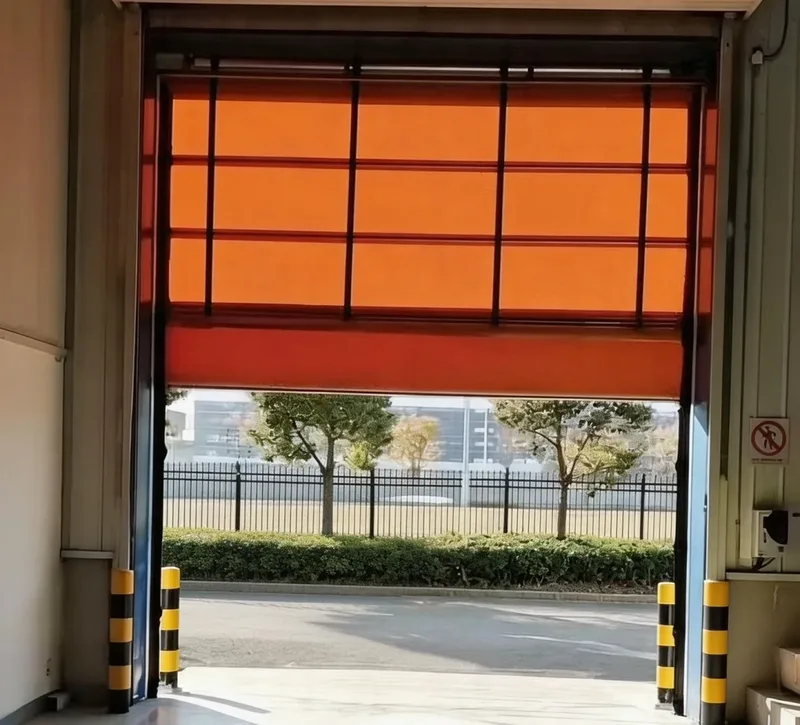
Stacking Door
Folding, Not Rolling — A stacking door folds its curtain upward in stages instead of winding it on a drum. Why that suits very large openings, and what it costs in sealing.
- Curtain construction
- PVC-coated polyester with horizontal aluminium wind bars
- Lifting method
- Vertical strap / belt lifting; curtain stacks above the opening (not wound)
- Opening speed
- 0.6-1.2 m/s, VFD adjustable (indicative)
- Max. clear opening
- Up to approx. 12000 x 8000 mm for large industrial openings
The third way to store a door
Every industrial door has to put its leaf somewhere when it opens, and there are only three arrangements. A sectional door runs panels back along a horizontal track. A roll-up door winds a curtain onto a drum. A stacking door folds the curtain upward in stages, each layer sitting above the one below it, until the opening is clear.
The stacking arrangement exists for one reason: it works where the other two stop. There is no track to run back into the room and no drum whose diameter grows with the leaf area. On an opening 10 m wide and 8 m high, those two constraints are what rule out the alternatives.
How the folding works
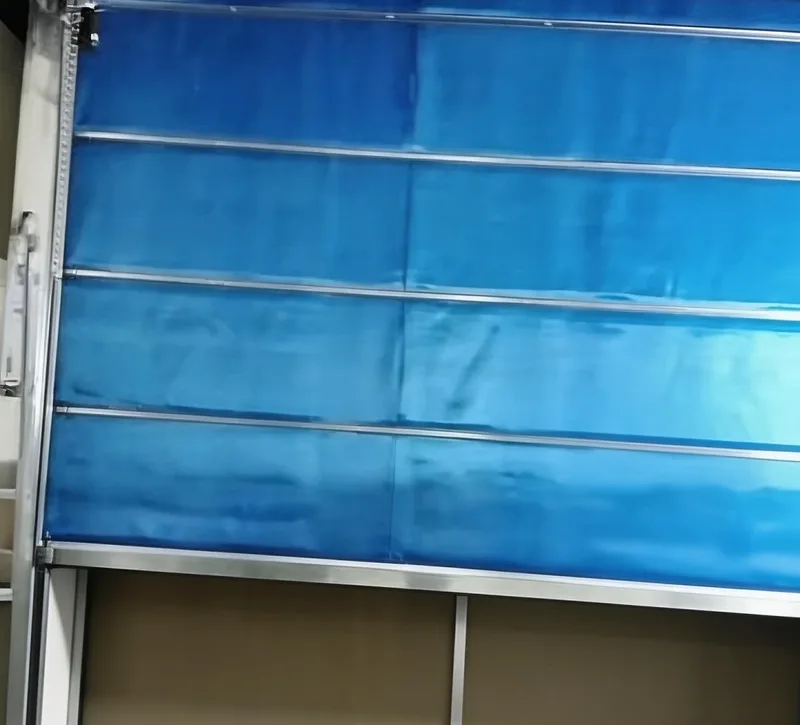
The curtain is divided into horizontal sections by folding profiles. When the door opens, the sections are drawn upward and each one folds against the next, so the whole curtain compresses into a stack above the opening rather than winding into a roll.
The drive can be electric or hydraulic. Hydraulic is used where the leaf is heavy and the movement needs to be controlled positively; electric with a variable-frequency drive is used where speed and repeatability matter more.
Three consequences follow from the geometry, and they are the whole specification.
The stack height grows with the leaf. A folded curtain has a finite compressed thickness per section, and the total stack is the sum. On a very tall opening the stack becomes a structure in its own right, and the headroom above the opening has to accommodate it.
Each fold is a joint. A stacking curtain has more joints per square metre than a roll-up curtain has per roll, and every joint is a place where air can pass and where the material flexes. That is the source of both the sealing limitation and the wear pattern.
The bottom edge stays horizontal. Because the curtain folds rather than winds, the leading edge descends evenly across the full width. On a wide opening this is an advantage: a roll-up curtain of the same width can bow, and the bottom seal then meets the floor unevenly.
Where sealing is honestly limited
A stacking door seals with a bottom airbag and seals at the guide rails. The joints between sections are a lap rather than a compression seal, so air passes between them.
On a large opening that is usually acceptable, because the opening is not a thermal boundary — it is a bay door on a shed, a hangar or a warehouse where the requirement is to close the weather out and keep the space secure. Where the opening is a thermal boundary, a stacking door is the wrong construction and an insulated sectional or a fast door is the right one.
What can be improved is the perimeter: the bottom airbag, the side guides and a top seal. What cannot be improved much is the joint leakage, because it is inherent in a curtain that folds in layers. A supplier who quotes a tight air leakage figure for a stacking door is describing a different product.
| Arrangement | Stores the leaf by | Works up to | Sealing character |
|---|---|---|---|
| Sectional | Horizontal track | Limited by track run and headroom | Perimeter plus every panel joint |
| Roll-up | Drum | Limited by drum diameter and wind area | Perimeter; curtain is continuous |
| Stacking | Folding in stages | Very large openings | Perimeter; joints are laps |
Speed, and why it is not the point
A stacking door is not a fast door, and buying one for speed is a category error. The folding motion takes time, the leaf is large, and the opening is usually one that is used for vehicles at a low cycle count rather than for continuous internal traffic.
What the door is bought for is the ability to clear a very large opening at all, and to do it without a track running into the building or a drum the size of a silo. Judged on that, the cycle time is a secondary property.
Wind and the large opening
A large opening is a large wind area, and a flexible curtain on a large frame deflects. On a stacking door the deflection is limited by the side guides and by the folding profiles, which act as stiffeners across the width.
That is why the profile spacing is a design parameter rather than a detail: closer spacing means a stiffer curtain and a taller stack. The trade is made at the drawing stage, and it has to be made against the actual wind exposure of the site rather than against a general claim.
Where it belongs
Aviation hangars, shipyard halls, large component workshops, and warehouse bays where the opening is sized by what goes through it rather than by a standard module. In each case the sizing is driven by an object — an aircraft, a hull section, a machine — and the door has to follow that size rather than the other way round. The scoping logic for that situation is set out under hangar and large opening solutions.
Where the opening is large but the boundary is also thermal, the construction has to change; the thermal case belongs with the insulated family under insulated lifting doors.
What to establish before ordering
The opening size, since it is the reason for the product. The headroom available for the stack, measured to the first obstruction. The wind exposure, because it sets the profile spacing. The cycle count, which is usually low but determines the drive and the wear items. And whether the opening is a thermal or pressure boundary, because if it is, this is the wrong construction.
The fast alternative for a large opening with high traffic is under high-speed doors, and the curtain-based large-opening variant under soft curtain stacking doors.
Pricing and quotation
Every door is made to order. Because each unit is built to the actual clear opening, there is no fixed price list and no standard price range - the price changes with the opening width and height. It also depends on the panel or curtain specification, drive and control package, safety devices, fixing structure, site conditions and delivery location. Send the opening dimensions (width x height), the expected number of opening cycles per day and the installation address, and we will quote the exact configuration. Use the quote button above or the contact page to request a quotation.
Installed door photographs
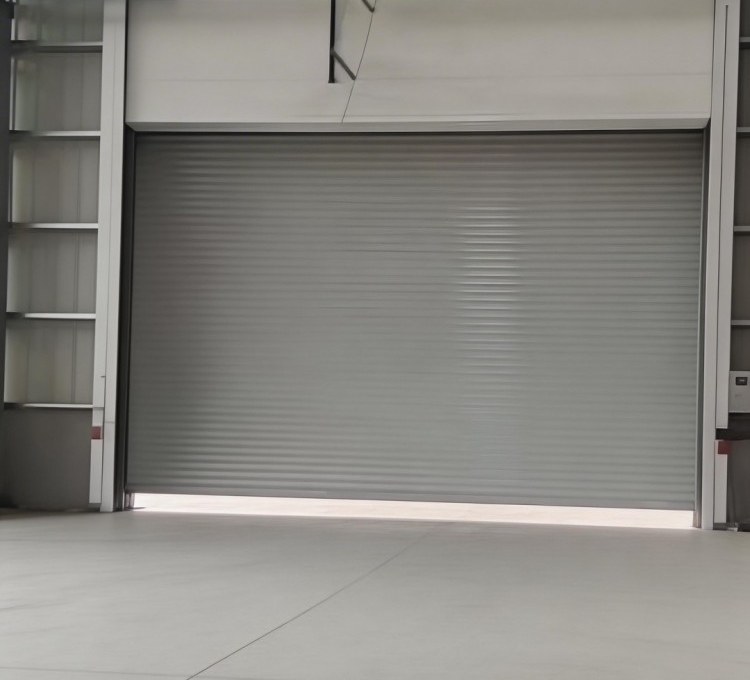
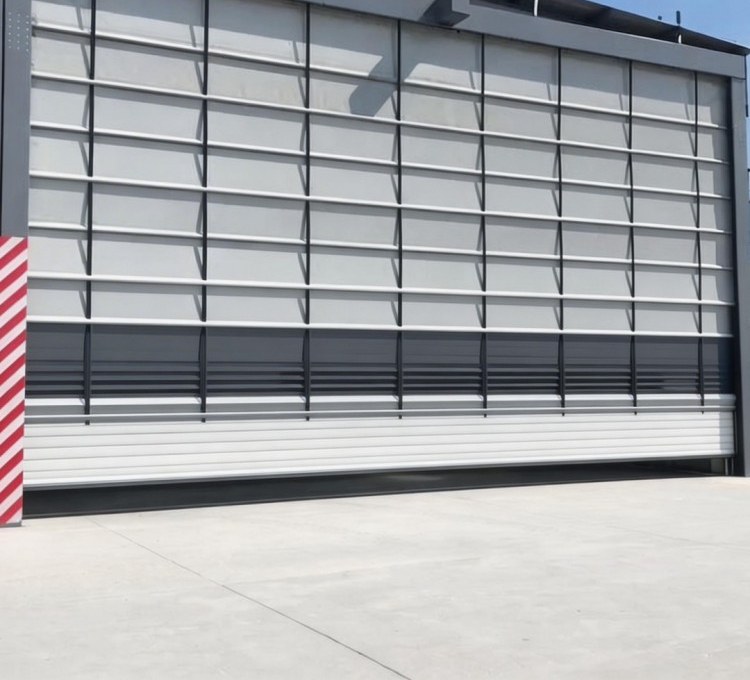
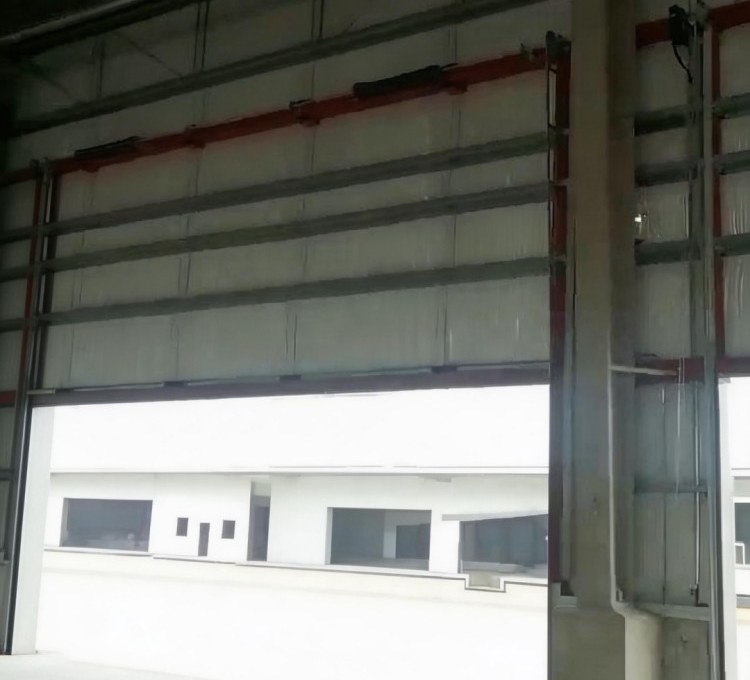
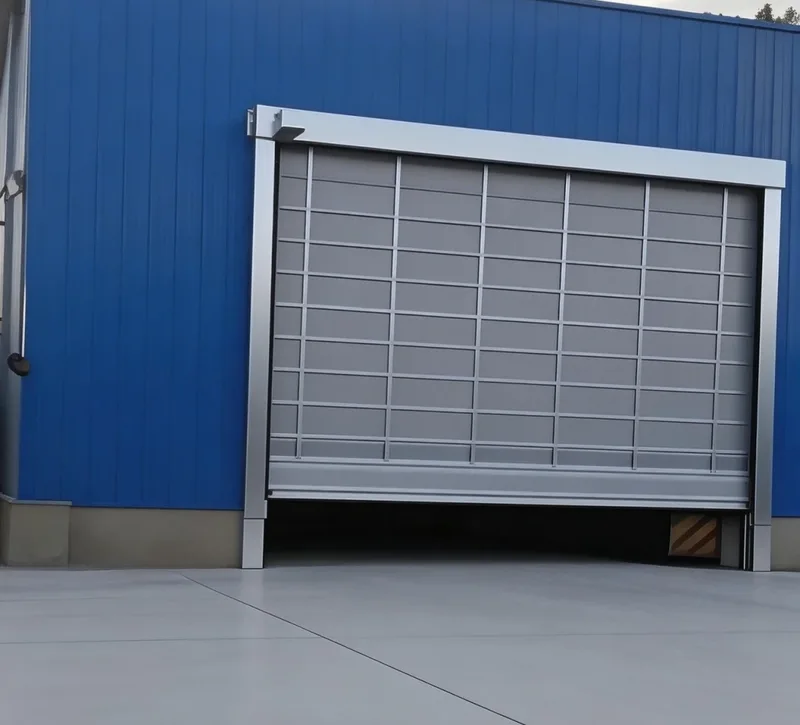
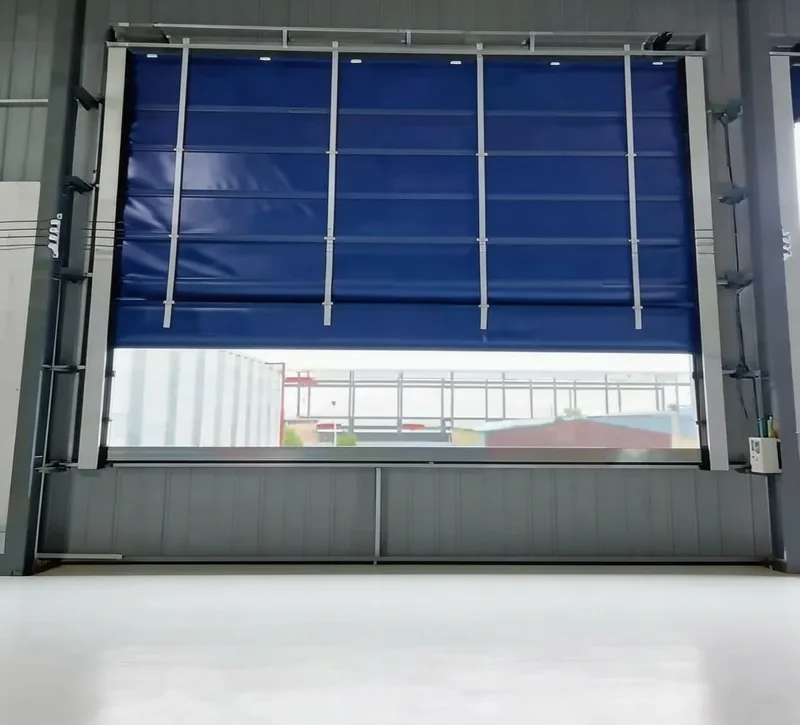
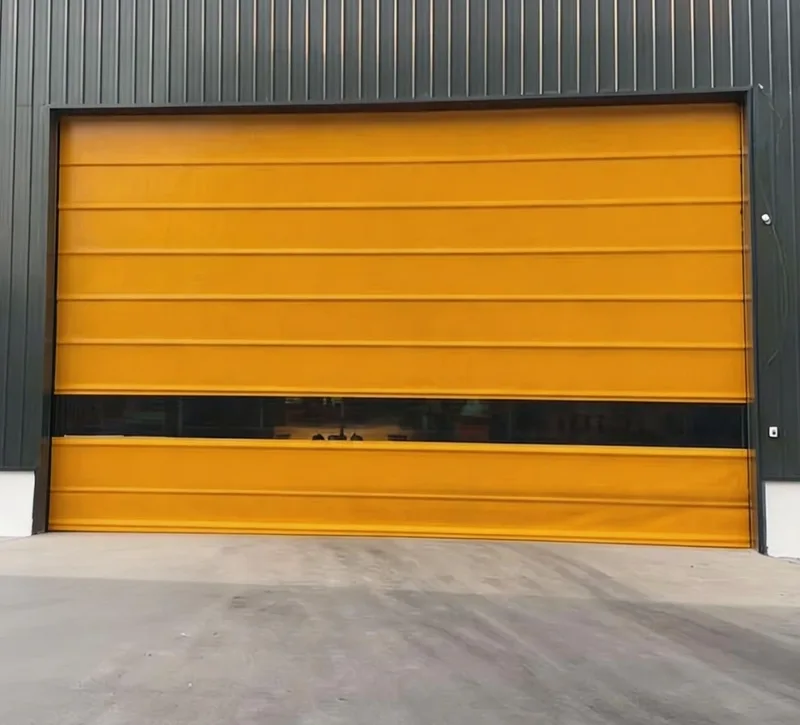
Photographs of this door family installed in industrial and logistics buildings. Door dimensions, panel colours, vision panels and track arrangements differ from project to project because every unit is made to measure.
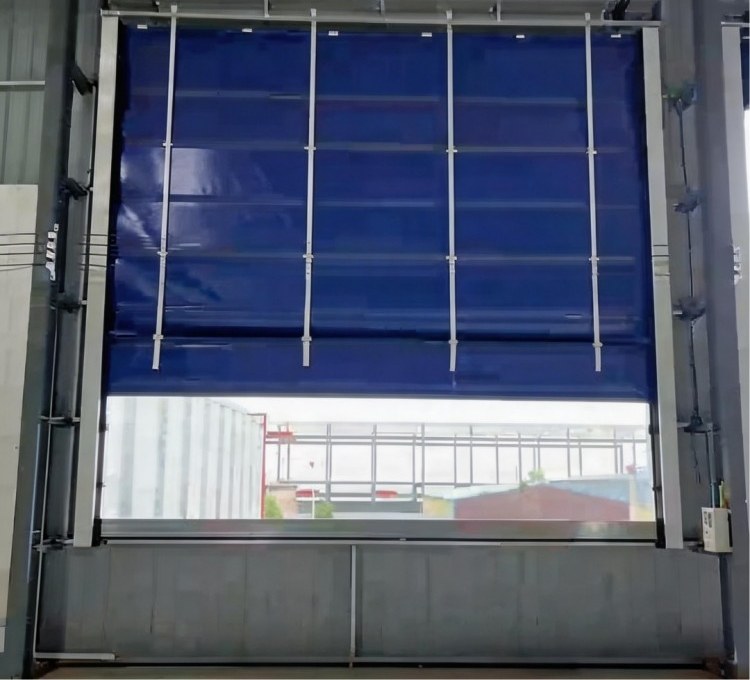
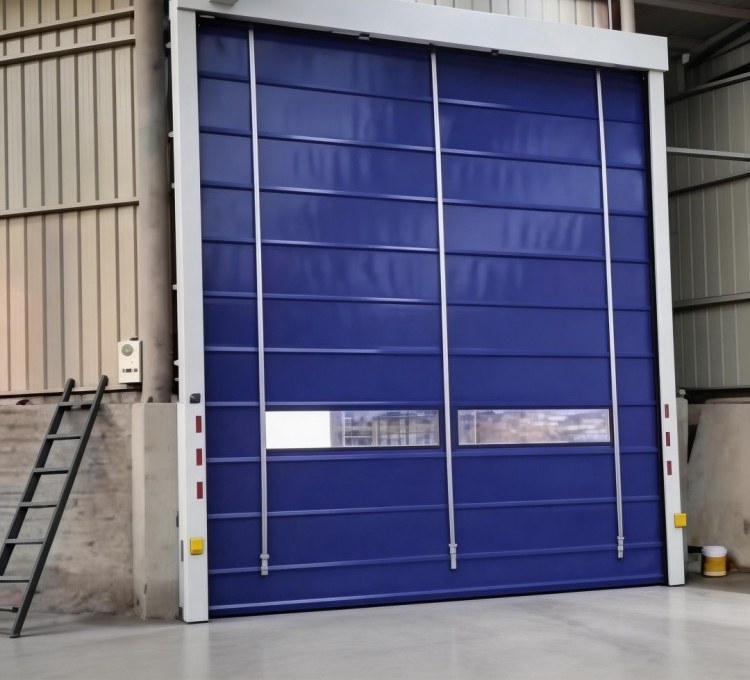
This section documents the engineering, service and compliance baseline for the Stacking Door.
Working principle and construction
A stacking door lifts a flexible PVC curtain with vertical straps rather than winding it onto a roll. Horizontal aluminium wind bars across the curtain transfer wind load into the side guides, and the fabric folds into a compact stack above the opening. This is why stacking doors are used on very large openings - hangars, workshop bays and logistics halls - where a single roll-up curtain would be too wide and too flexible. A braked motor with VFD control manages the lift; strap count, bar spacing and wind class are calculated from the opening width and site wind exposure. Bottom airbag, photocells and an emergency stop are fitted to EN 12453. Strap layout and anchor details are issued as project-specific shop drawings after the survey.
| Component | Function | Industry-typical configuration |
|---|---|---|
| PVC curtain + wind bars | Large flexible leaf | Horizontal aluminium bars transfer wind load into the guides |
| Strap lifting set | Fold, not roll | 2-4 vertical straps by opening width (indicative) |
| Braked VFD drive | Controlled lift | 0.6-1.2 m/s opening, adjustable (indicative) |
| Side guides + seals | Wind and sealing | Guide rails with brush seals and bottom airbag |
| Safety set | EN 12453 | Bottom airbag, photocells, emergency stop |
Technical drawings (general arrangement, section details and opening schedule) are issued per project after the on-site survey. No downloadable CAD file is claimed for this door family on this page; use the quotation button to request the current drawing set.
Service, warranty and project support
The levels below are industry-typical service terms used as a working basis because Anbixin's own policy schedule has not yet been supplied. They are indicative and are confirmed or adjusted in the written quotation and service agreement for each project.
- Warranty: 24 months on the door leaf, drive unit and control package from handover; wear items (seals, brushes, curtain fabric, impact damage) are excluded. Extended warranty terms can be quoted.
- After-sales support: acknowledgement within one working day, remote diagnostics for control faults, on-site attendance subject to location and schedule; common wear parts are kept available for replacement.
- On-site survey: measurement of clear width and height, headroom, side room, fixing structure, power supply and traffic pattern, followed by project-specific shop drawings before fabrication.
- Preventive maintenance: scheduled service visits with counterbalance check, safety-device function test, seal inspection and lubrication; panel, slat or curtain replacement is available.
- Project and volume pricing: tiered pricing for project orders, contractors, partners and multi-unit purchases; applicable terms are stated in the quotation, not as a published discount rate.
Nothing on this page constitutes a binding service commitment. Confirm warranty duration, response times, survey coverage and project pricing with the sales team before including them in a tender, advertisement or contract.
Standards, safety and compliance
Design and safety references for this product family: EN 13241 (product standard for industrial, commercial and garage doors), EN 12453 and EN 12445 (safety in use of power-operated doors and the related test methods), EN 12604 (mechanical requirements), EN 12424 and EN 12444 (wind-load classification and test), EN ISO 13849-1 (safety-related parts of control systems) and EN 60204-1 (electrical equipment of machines). These are design and test references, not a claim of certification: compliance, test reports and any third-party certificate are confirmed per project in the technical submittal. Fire-rated roller shutters belong to a separate product family selected to the fire-compartment requirements, where EN 13501-1 and EN 1634-1 apply; this page does not claim a fire rating.
Vietnamese market terminology
In Vietnam this door family is searched with the local Vietnamese terms listed below; they are kept untranslated here and used in headings, FAQs and metadata. The strap-reinforced variant is normally specified for very large openings.
- cửa xếp lớp — stacking door
- cửa cuốn nhanh xếp chồng — high-speed stacking door
- cửa rèm xếp — folding curtain door
- cửa dây đai / cửa băng tải nâng — strap-reinforced stacking door
Typical applications in the Vietnamese market
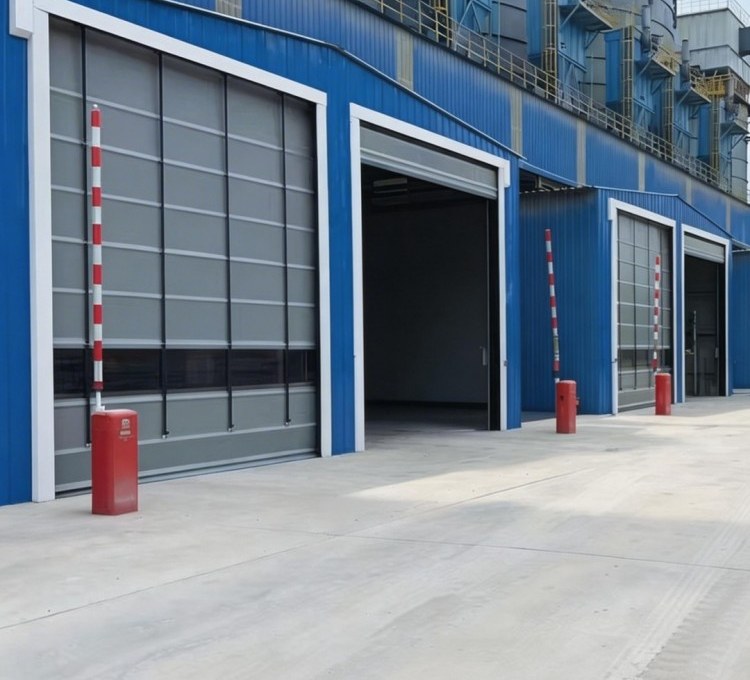
Stacking high-speed door · large external opening
Large external opening where headroom is limited; the curtain stacks upward instead of winding onto a drum.
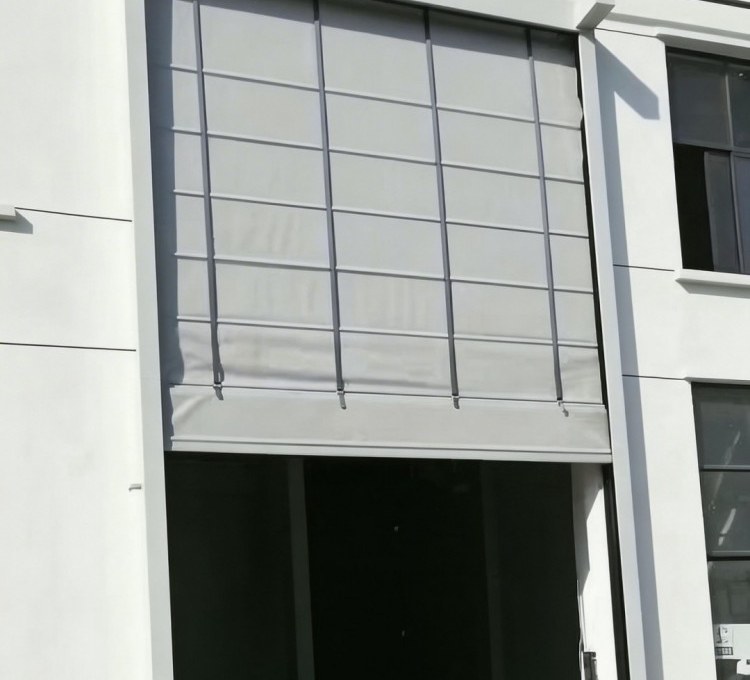
Stacking high-speed door · wide span
Wide-span opening with strap reinforcement for wind resistance on exposed facades.
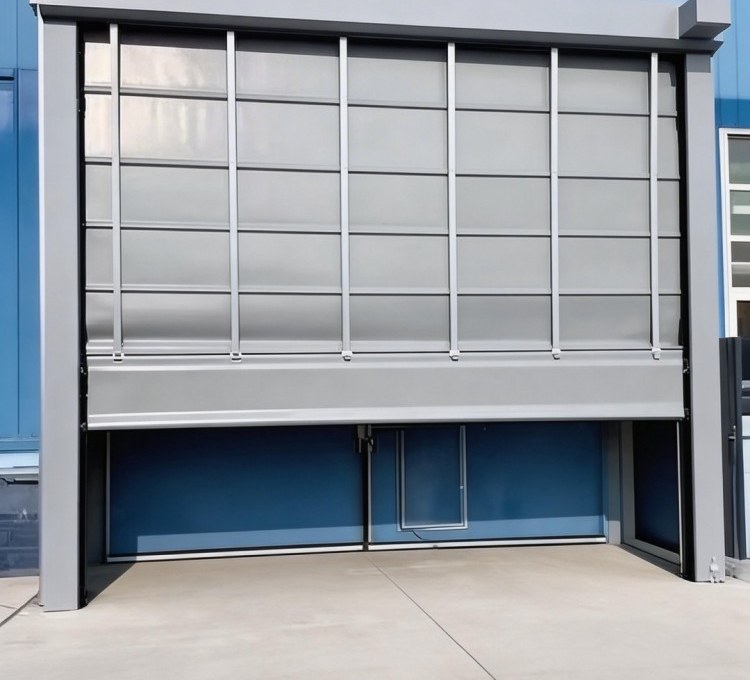
Stacking high-speed door · loading canopy
Transition opening between warehouse and loading canopy, opened in short cycles.
Photographs below are from installations of this door family in Vietnam. Customer names are withheld; project details are available on request.
Frequently asked questions
How is a stacking door different from a sectional door?A sectional door sends its panels back along a horizontal track into the room; a stacking door folds its curtain upward and stacks it above the opening. The stacking arrangement needs no horizontal run, which is what allows very large openings.
Not to the standard of an insulated panel door. The folded joints are laps rather than compression seals, so a stacking door is a weather and security closure rather than a thermal boundary.
It depends on the number of sections and the compressed thickness of each, so it grows with the opening height. It has to be measured against the available headroom before the door is ordered.
No. The folding motion and the leaf size make it a comparatively slow door, and it is specified for large openings rather than for cycle speed. Where speed matters, a different product applies.
Electric with a variable-frequency drive, or hydraulic where the leaf is heavy and positive control of the movement matters more than speed.
Pain Points Solved
Traditional stacker doors are prone to frosting in cold seasons, affecting door operation and sealing, leading to energy waste.
Key Features
- Sectional curtain folds upward in stages, clearing the opening
- For very large openings and hangar-type passages
- Electric or hydraulic drive
- Bottom airbag and guide rail seals
Technical Specifications
| Curtain construction | PVC-coated polyester with horizontal aluminium wind bars |
|---|---|
| Lifting method | Vertical strap / belt lifting; curtain stacks above the opening (not wound) |
| Opening speed | 0.6-1.2 m/s, VFD adjustable (indicative) |
| Max. clear opening | Up to approx. 12000 x 8000 mm for large industrial openings |
| Wind load resistance | EN 12424 class 2-3, approx. 500-700 Pa with wind bars (indicative) |
| Strap layout | 2-4 vertical straps depending on opening width (indicative) |
| Wind bar spacing | Set from opening width and site wind exposure (indicative) |
| Drive | Braked motor with VFD, 3-phase 380-415 V / 50 Hz |
| Control | PLC with interlock, access control and traffic-light interface |
| Safety (EN 12453) | Bottom airbag, photocells, safety light curtain, emergency stop |
| Cycle rate | Up to 300-500 cycles/day (indicative, duty-dependent) |
| Sealing | Side brush seals and weighted bottom airbag |
| Emergency operation | Manual release / chain hoist |
| Operating noise | Approx. ≤72 dB(A) (indicative) |
| Product focus | Standard stacking door for large workshop openings |
Gallery
Need a Reliable Solution for Your Project?
Tell us about your application and requirements — our team will help you specify the right product.