
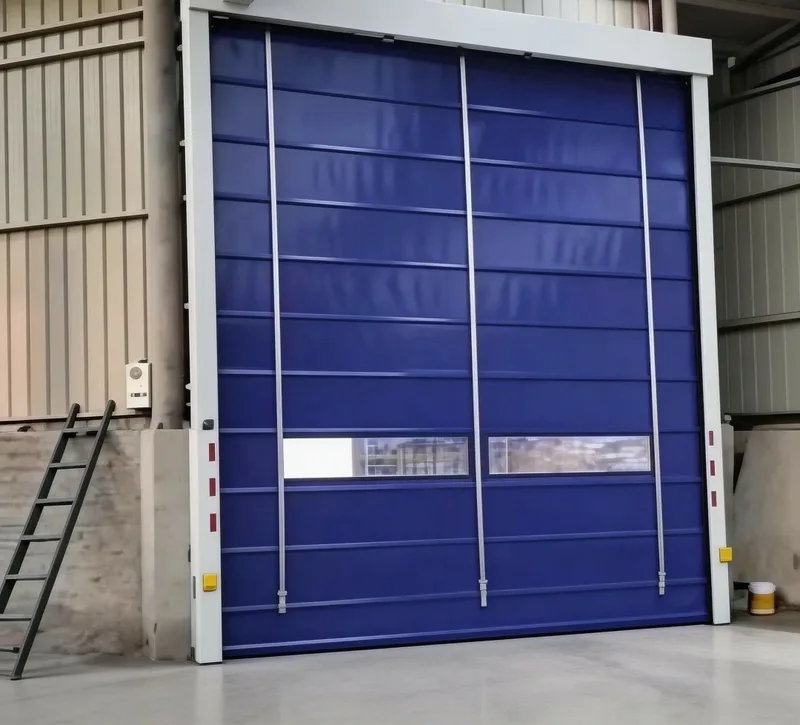
High-Speed Stacking Door
Speed in a Big Bay — A stacking door with a faster folding cycle. What the VFD changes, where speed stops helping, and why a big opening is still a big opening.
- Curtain construction
- PVC-coated polyester with horizontal aluminium wind bars
- Lifting method
- Vertical strap / belt lifting; curtain stacks above the opening (not wound)
- Opening speed
- 0.6-1.2 m/s, VFD adjustable (indicative)
- Max. clear opening
- Up to approx. 12000 x 8000 mm for large industrial openings
What is different from a standard stacking door
A high-speed stacking door is the same folding construction with a variable-frequency drive and a faster folding cycle, plus a fuller set of safety devices. The point of it is to reduce the time a large opening stands open, without changing the fact that the opening is large.
That last clause is the honest part. Speed reduces the duration of the loss; it does not reduce the rate. A 10 m by 6 m opening that is open for eight seconds instead of twenty still exchanges a large volume of air in those eight seconds, and understanding that difference decides whether the extra speed is worth paying for.
What the drive changes
Acceleration and deceleration profiles. A variable-frequency drive ramps the movement at each end rather than starting and stopping abruptly. On a heavy folding curtain that reduces the shock load through the folding profiles, which is where a stacking door wears.
Adjustable speed. The maximum is not always the right setting. A door that runs at full speed at a low-cycle bay is being worn out for no benefit, and the parameter should be set to the actual traffic.
Position control. The drive knows where the curtain is, which allows partial opening — a useful function at a large door where a person needs to pass and a vehicle does not.
Where the speed stops helping
Three situations, and they are common enough to be worth checking before specifying the faster version.
Low cycle counts. At ten movements a shift, the difference between eight seconds and twenty is a few minutes a day. The energy saved is trivial and the extra mechanism is not earning anything.
Openings where the vehicle dwell dominates. If a truck sits in the opening for two minutes while it manoeuvres, the door's cycle time is a rounding error. The open period is set by the operation, not by the door.
Openings that are not a boundary. If the space on both sides is at the same temperature and pressure, reducing the open time changes nothing that costs money.
| Situation | Does faster folding help? | Why |
|---|---|---|
| Heated bay, frequent vehicle movements | Yes | Open period is a real loss and it recurs |
| Low cycle count | No | Total open time is small either way |
| Long vehicle dwell | No | The door is not what sets the open period |
| Same-condition space both sides | No | There is no loss to reduce |
| Dust or fume control | Yes | Transfer happens during the open period |
Safety on a fast large leaf
A large folding curtain moving quickly has momentum, and the safety devices have to match. On this construction they are a safety light curtain, a safety edge at the closing line and an emergency stop, with the requirement coming from EN 12453.
Two aspects need more attention than on a smaller door. First, the width: a single beam across a 10 m opening leaves gaps a person can walk through, so multiple beams or a curtain-type detector are needed. Second, the closing speed: a heavy curtain descending at speed applies force quickly, and the devices have to detect and reverse before that force is applied — which is a test, not an assumption.
The commissioning test should cover the full width and both directions of approach, and the result should be recorded rather than described.
The stack, and what speed does to it
Faster folding does not change the stack height; that is set by the number of sections and their compressed thickness. What it does change is the dynamic load on the stack at the end of the opening travel, which is why the end stop and the ramp are part of the design rather than a setting. The same principle of matching the drive to the actual duty appears on the automatic PVC door page, where the trigger rather than the motor decides how the door behaves.
It also changes the inspection emphasis. A door that folds quickly wears its profiles and its guide engagement harder per cycle, so the inspection interval should be set from the cycle count and the speed setting together — not from a generic schedule.
Where it belongs
At a large bay where the opening is genuinely a boundary — a heated workshop, a dust-controlled process area, a chilled distribution hall — and where vehicles cross it often enough that the open period recurs many times a shift. In that situation the faster folding is doing real work.
At a hangar or a shipyard hall where the door opens a few times a day for a very large object, the standard version is adequate and the extra control is not justified; that case is the one described under stacking doors.
Where the opening is not large but the traffic is continuous, a fast door of the appropriate size is the better product, and the comparison is under high-speed doors.
What to establish before ordering
The opening size and the stack height it implies. The cycle count and the vehicle dwell time, because together they decide whether speed is worth anything. Whether the opening is a boundary in the thermal or contamination sense. The wind exposure, which still governs the profile spacing. And the safety device arrangement across the full width, which on a large door is a design decision rather than an accessory choice.
Pricing and quotation
Every door is made to order. Because each unit is built to the actual clear opening, there is no fixed price list and no standard price range - the price changes with the opening width and height. It also depends on the panel or curtain specification, drive and control package, safety devices, fixing structure, site conditions and delivery location. Send the opening dimensions (width x height), the expected number of opening cycles per day and the installation address, and we will quote the exact configuration. Use the quote button above or the contact page to request a quotation.
Installed door photographs
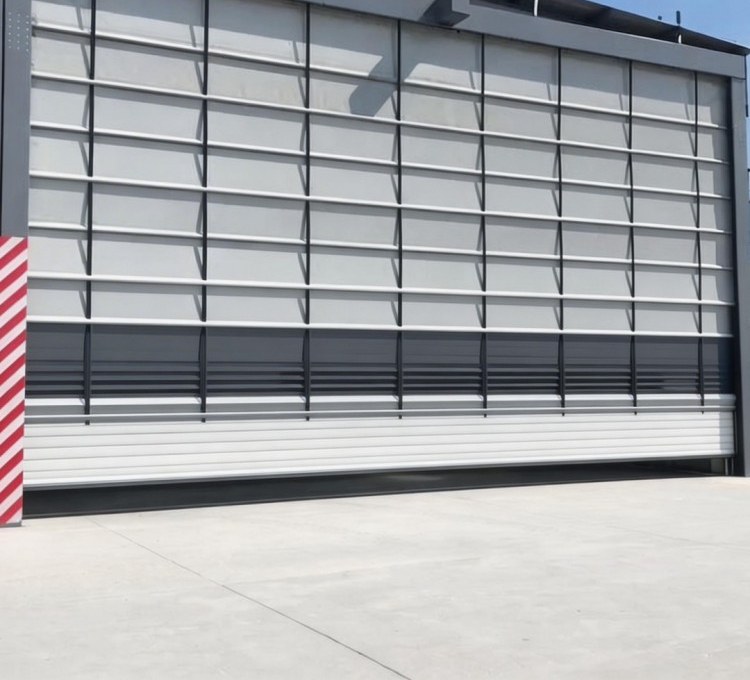
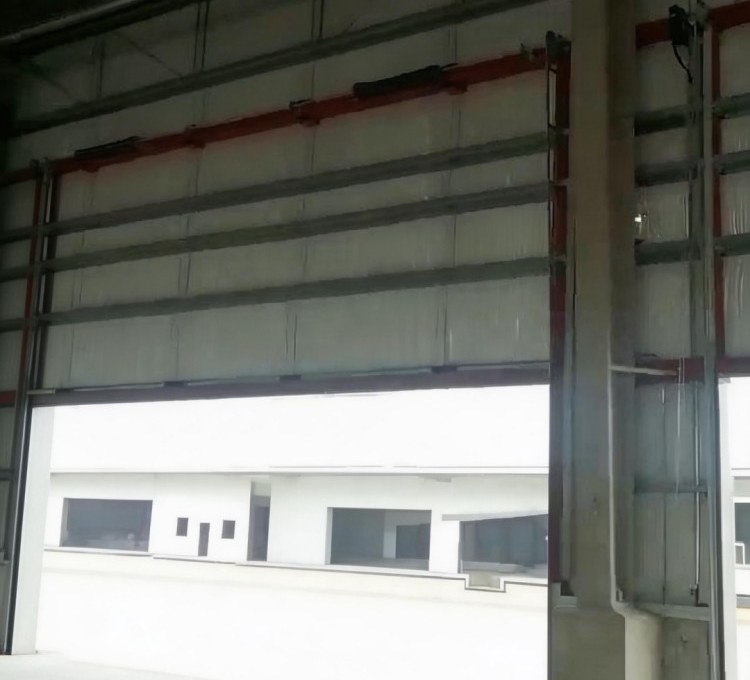
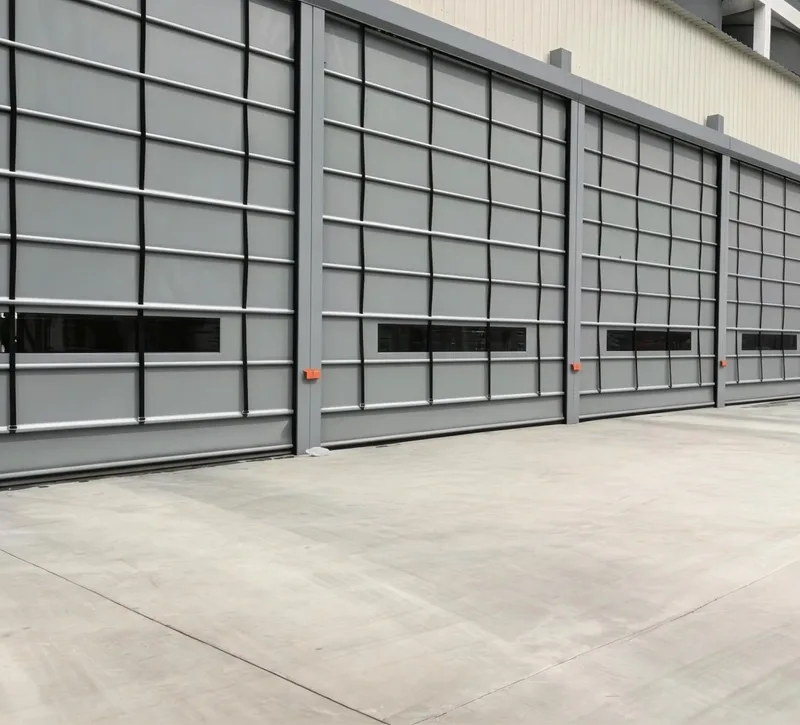
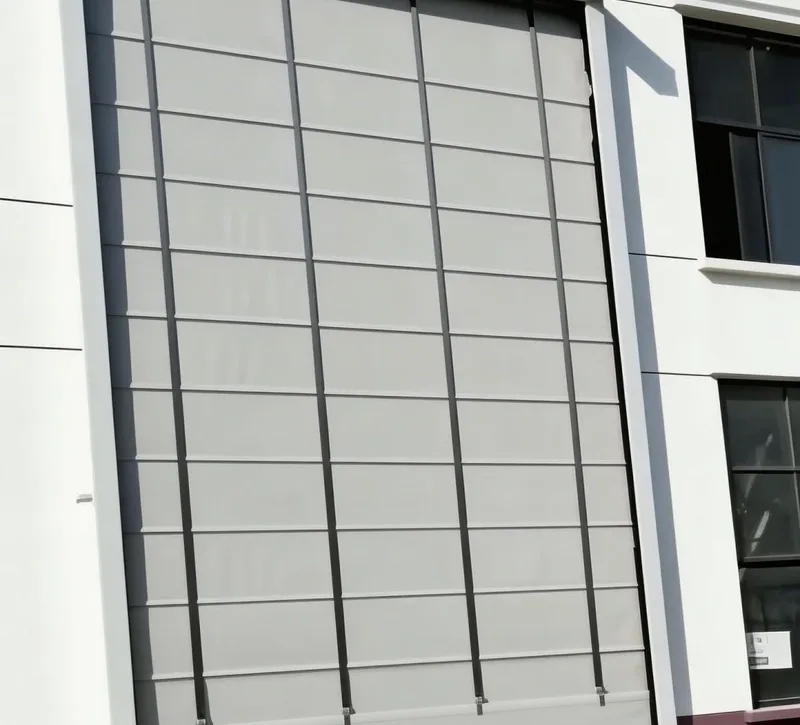
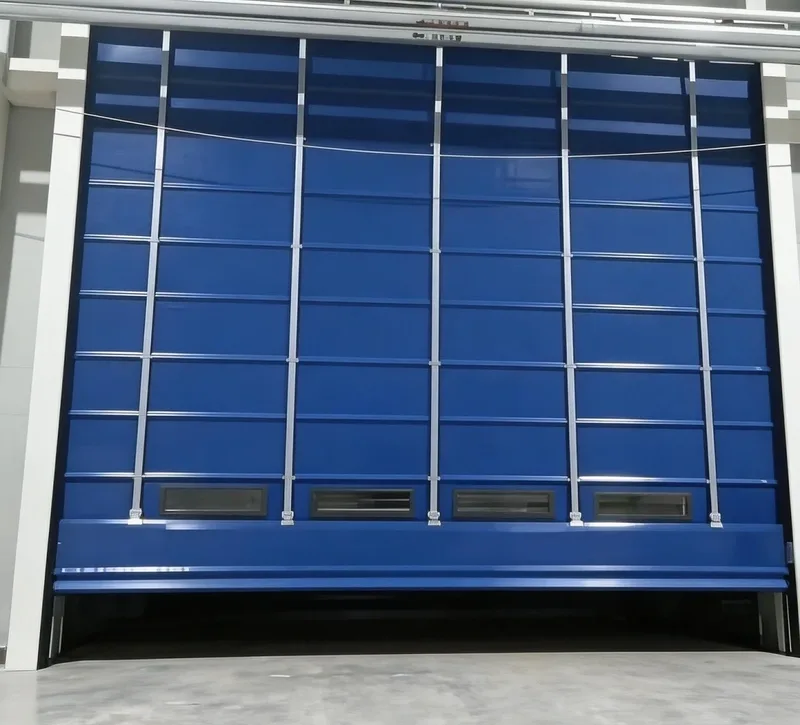
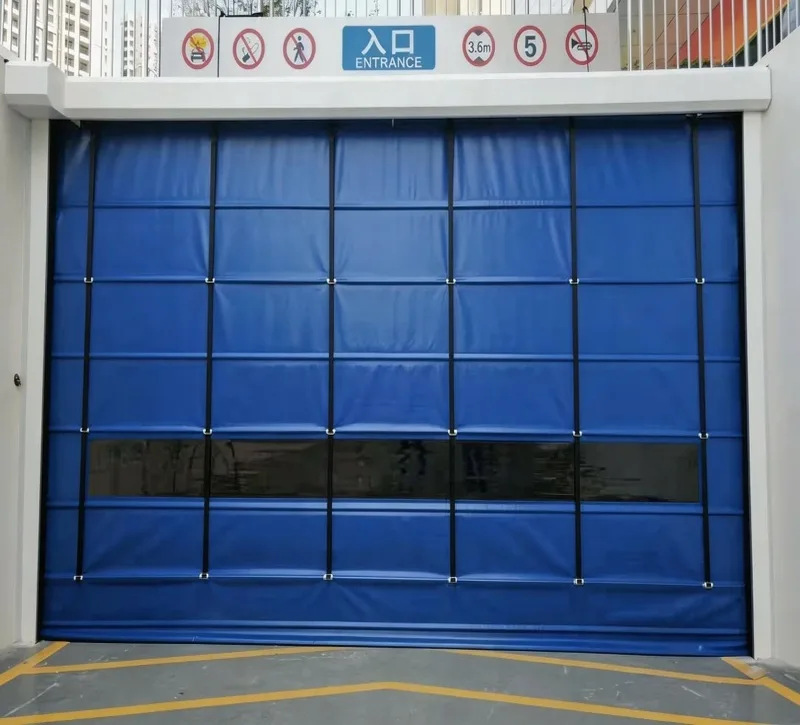
Photographs of this door family installed in industrial and logistics buildings. Door dimensions, panel colours, vision panels and track arrangements differ from project to project because every unit is made to measure.
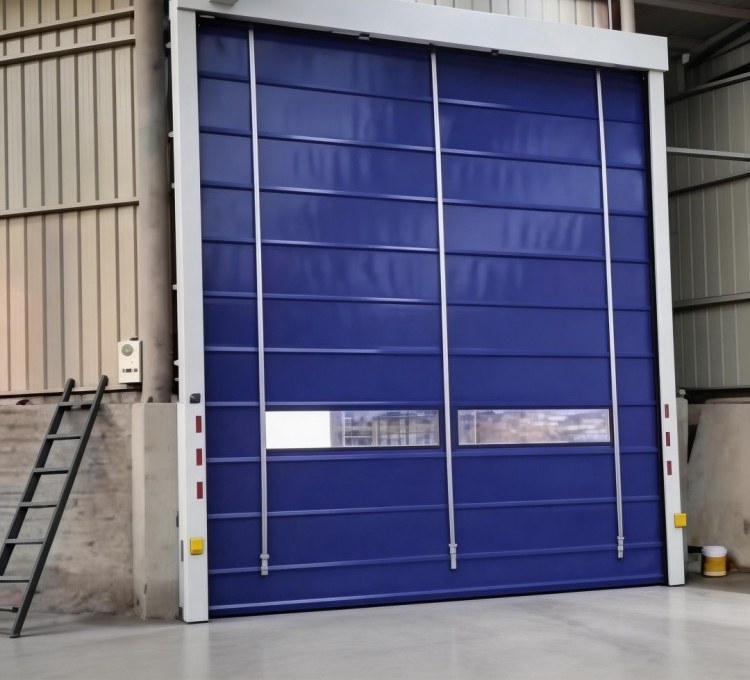
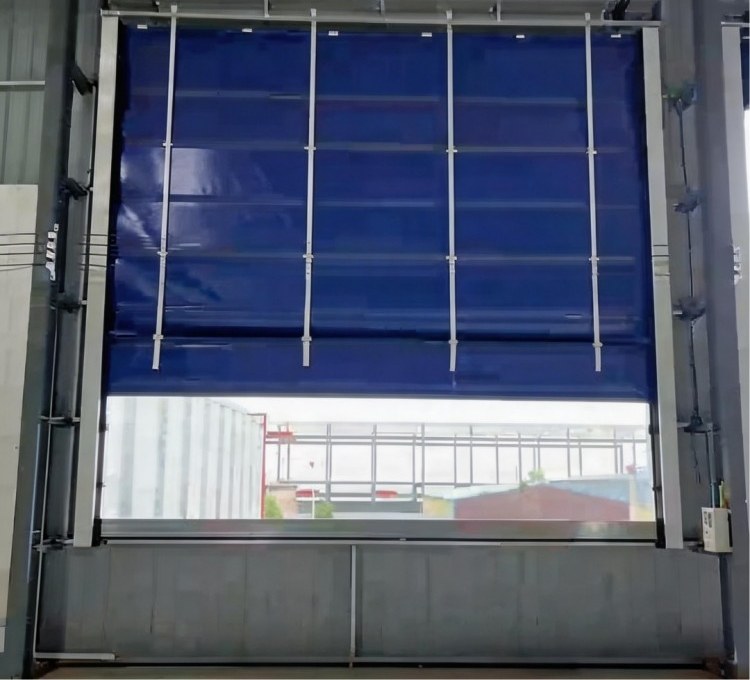
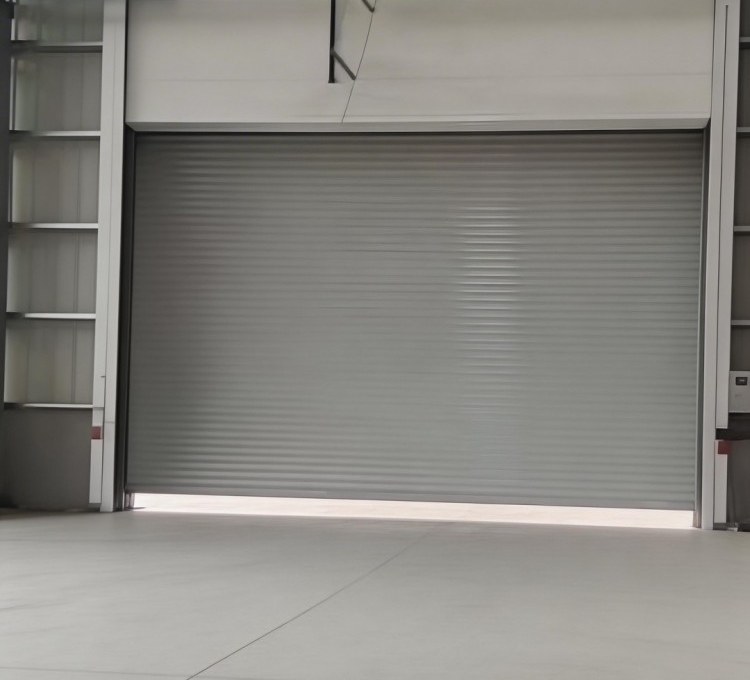
This section documents the engineering, service and compliance baseline for the High-Speed Stacking Door.
Working principle and construction
A stacking door lifts a flexible PVC curtain with vertical straps rather than winding it onto a roll. Horizontal aluminium wind bars across the curtain transfer wind load into the side guides, and the fabric folds into a compact stack above the opening. This is why stacking doors are used on very large openings - hangars, workshop bays and logistics halls - where a single roll-up curtain would be too wide and too flexible. A braked motor with VFD control manages the lift; strap count, bar spacing and wind class are calculated from the opening width and site wind exposure. Bottom airbag, photocells and an emergency stop are fitted to EN 12453. Strap layout and anchor details are issued as project-specific shop drawings after the survey.
| Component | Function | Industry-typical configuration |
|---|---|---|
| PVC curtain + wind bars | Large flexible leaf | Horizontal aluminium bars transfer wind load into the guides |
| Strap lifting set | Fold, not roll | 2-4 vertical straps by opening width (indicative) |
| Braked VFD drive | Controlled lift | 0.6-1.2 m/s opening, adjustable (indicative) |
| Side guides + seals | Wind and sealing | Guide rails with brush seals and bottom airbag |
| Safety set | EN 12453 | Bottom airbag, photocells, emergency stop |
Technical drawings (general arrangement, section details and opening schedule) are issued per project after the on-site survey. No downloadable CAD file is claimed for this door family on this page; use the quotation button to request the current drawing set.
Service, warranty and project support
The levels below are industry-typical service terms used as a working basis because Anbixin's own policy schedule has not yet been supplied. They are indicative and are confirmed or adjusted in the written quotation and service agreement for each project.
- Warranty: 24 months on the door leaf, drive unit and control package from handover; wear items (seals, brushes, curtain fabric, impact damage) are excluded. Extended warranty terms can be quoted.
- After-sales support: acknowledgement within one working day, remote diagnostics for control faults, on-site attendance subject to location and schedule; common wear parts are kept available for replacement.
- On-site survey: measurement of clear width and height, headroom, side room, fixing structure, power supply and traffic pattern, followed by project-specific shop drawings before fabrication.
- Preventive maintenance: scheduled service visits with counterbalance check, safety-device function test, seal inspection and lubrication; panel, slat or curtain replacement is available.
- Project and volume pricing: tiered pricing for project orders, contractors, partners and multi-unit purchases; applicable terms are stated in the quotation, not as a published discount rate.
Nothing on this page constitutes a binding service commitment. Confirm warranty duration, response times, survey coverage and project pricing with the sales team before including them in a tender, advertisement or contract.
Standards, safety and compliance
Design and safety references for this product family: EN 13241 (product standard for industrial, commercial and garage doors), EN 12453 and EN 12445 (safety in use of power-operated doors and the related test methods), EN 12604 (mechanical requirements), EN 12424 and EN 12444 (wind-load classification and test), EN ISO 13849-1 (safety-related parts of control systems) and EN 60204-1 (electrical equipment of machines). These are design and test references, not a claim of certification: compliance, test reports and any third-party certificate are confirmed per project in the technical submittal. Fire-rated roller shutters belong to a separate product family selected to the fire-compartment requirements, where EN 13501-1 and EN 1634-1 apply; this page does not claim a fire rating.
Vietnamese market terminology
In Vietnam this door family is searched with the local Vietnamese terms listed below; they are kept untranslated here and used in headings, FAQs and metadata. The strap-reinforced variant is normally specified for very large openings.
- cửa xếp lớp — stacking door
- cửa cuốn nhanh xếp chồng — high-speed stacking door
- cửa rèm xếp — folding curtain door
- cửa dây đai / cửa băng tải nâng — strap-reinforced stacking door
Typical applications in the Vietnamese market
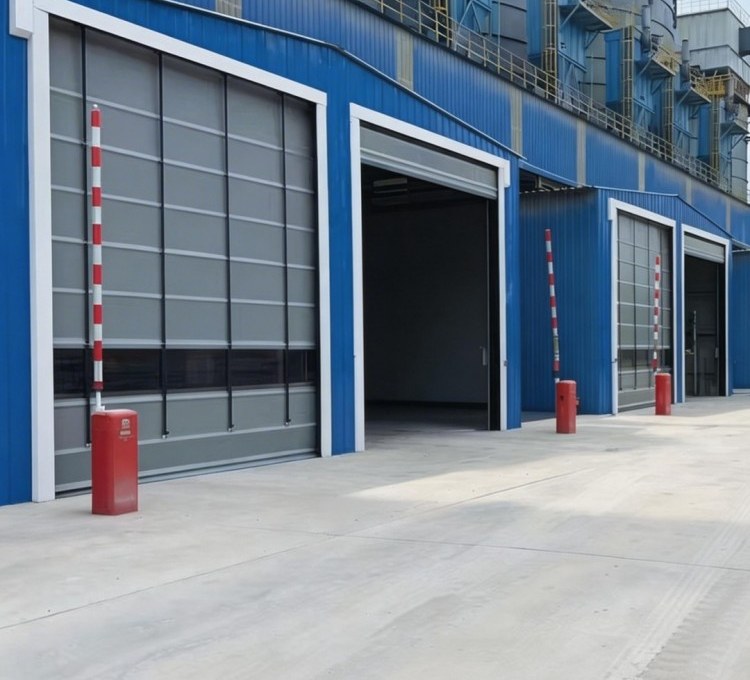
Stacking high-speed door · loading canopy
Transition opening between warehouse and loading canopy, opened in short cycles.
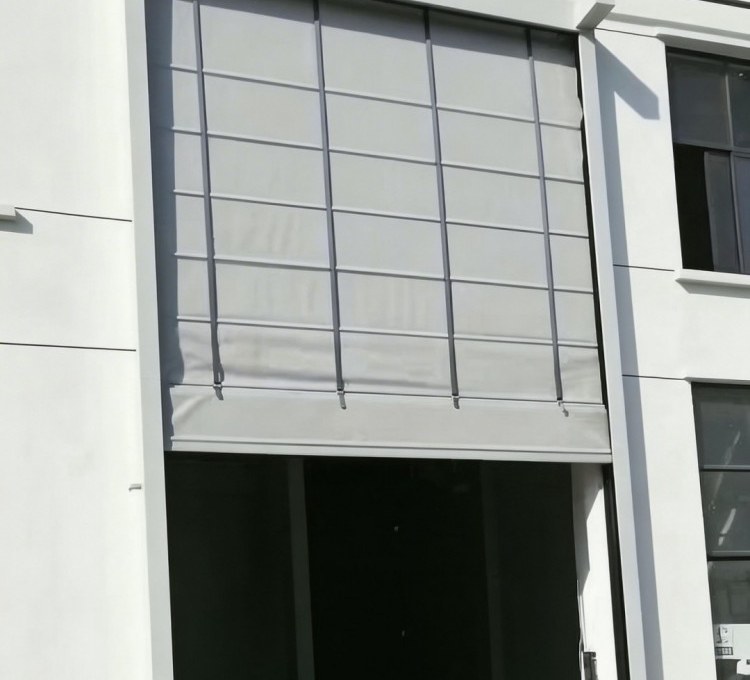
Stacking high-speed door · large external opening
Large external opening where headroom is limited; the curtain stacks upward instead of winding onto a drum.
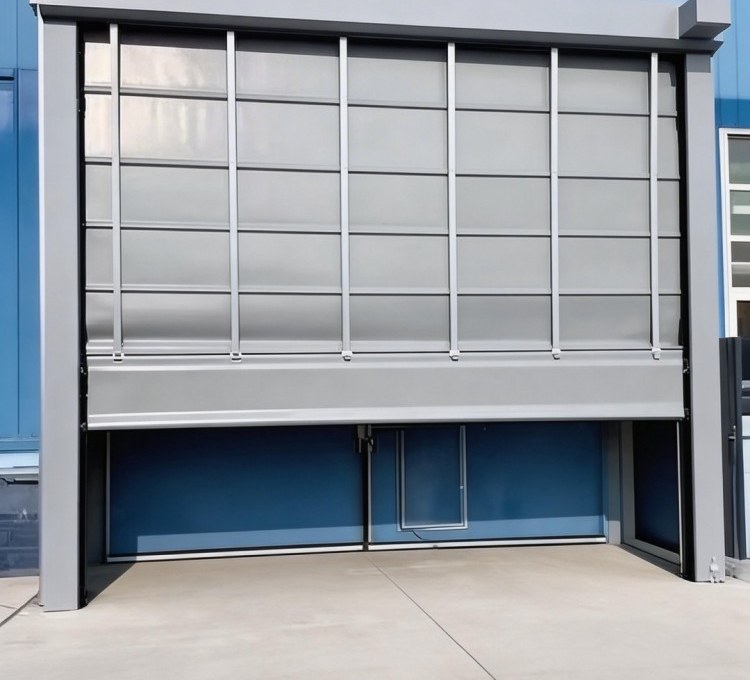
Stacking high-speed door · wide span
Wide-span opening with strap reinforcement for wind resistance on exposed facades.
Photographs below are from installations of this door family in Vietnam. Customer names are withheld; project details are available on request.
Frequently asked questions
How much faster is it than a standard stacking door?It depends on the size and the drive setting, and the honest answer is that the cycle time is a fraction of the open period at most real bays. The comparison should be made against the vehicle dwell, not against the other door.
It reduces the duration of the loss, not the rate. At a bay where the door stands open for a truck to manoeuvre, the door's speed is a minor part of the total.
It can, where the drive has position control. At a large door it is useful for pedestrian passage without clearing the full opening.
The folding profiles and the guide engagement, because they take the dynamic load at each end of the travel. The inspection interval should follow the cycle count and the speed setting.
No. A wider opening needs more coverage, not less, because a single beam leaves passable gaps. The requirement is the same; the implementation has to be scaled to the width.
Pain Points Solved
Factories or logistics centers suffer from energy waste due to frequent opening and closing of traditional doors and slow opening and closing speeds affecting production efficiency.
Key Features
- Sectional curtain with fast upward folding
- Quicker than the standard stacking door
- Safety light curtain, safety edge and emergency stop
- VFD drive for smooth start and stop
Technical Specifications
| Curtain construction | PVC-coated polyester with horizontal aluminium wind bars |
|---|---|
| Lifting method | Vertical strap / belt lifting; curtain stacks above the opening (not wound) |
| Opening speed | 0.6-1.2 m/s, VFD adjustable (indicative) |
| Max. clear opening | Up to approx. 12000 x 8000 mm for large industrial openings |
| Wind load resistance | EN 12424 class 2-3, approx. 500-700 Pa with wind bars (indicative) |
| Strap layout | 2-4 vertical straps depending on opening width (indicative) |
| Wind bar spacing | Set from opening width and site wind exposure (indicative) |
| Drive | Braked motor with VFD, 3-phase 380-415 V / 50 Hz |
| Control | PLC with interlock, access control and traffic-light interface |
| Safety (EN 12453) | Bottom airbag, photocells, safety light curtain, emergency stop |
| Cycle rate | Up to 300-500 cycles/day (indicative, duty-dependent) |
| Sealing | Side brush seals and weighted bottom airbag |
| Emergency operation | Manual release / chain hoist |
| Operating noise | Approx. ≤72 dB(A) (indicative) |
| Product focus | High-speed stacking variant for frequent large-opening traffic |
Gallery
Need a Reliable Solution for Your Project?
Tell us about your application and requirements — our team will help you specify the right product.