
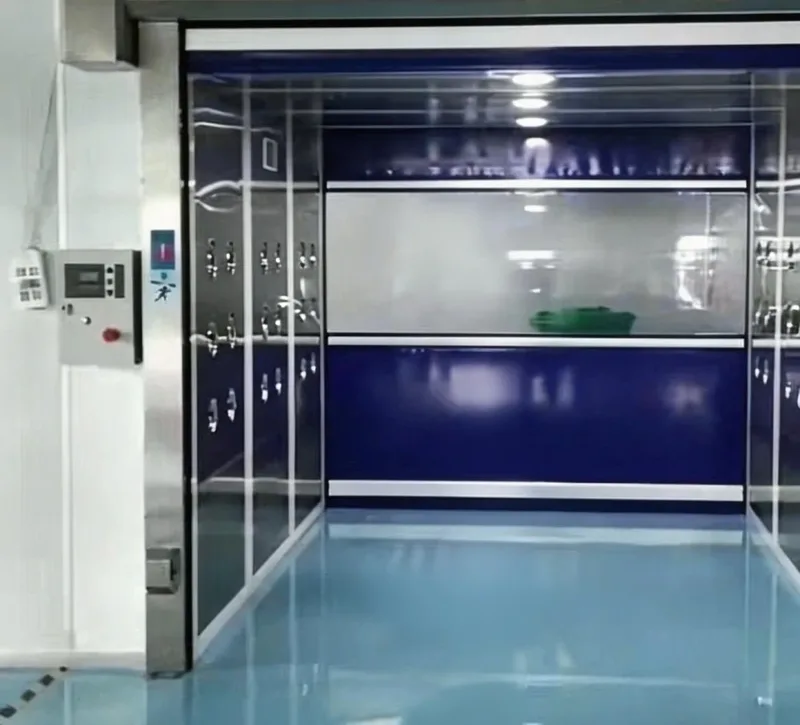
PVC Automatic High-Speed Door
Trigger and Control — An automatic PVC fast door opens on a detector, not a person. What each trigger type detects, and why that difference decides the layout.
- Curtain material
- PVC-coated polyester fabric, 0.8-1.2 mm, approx. 900-1300 g/m²
- Top roll and drive
- Tubular / external motor with VFD and encoder
- Opening speed
- 0.8-1.5 m/s, up to 2.0 m/s on smaller openings (indicative)
- Closing speed
- 0.5-1.0 m/s, VFD adjustable (indicative)
Automatic means somebody decided how it opens
An automatic PVC fast door is a curtain door whose operation is initiated by a detector instead of a person pressing a button. The door itself is the same product; what changes is the control logic, and the control logic is where most of the practical problems at an automatic opening come from.
The reason is simple. A button is pressed by a person who has looked at the opening. A detector only knows what it is designed to sense, and different detectors sense very different things. Matching the detector to the traffic is the design decision, and it is usually made later than it should be.
What each trigger type actually sees
Radar (microwave) motion detection. Detects movement in a field in front of the door. It is the most common choice at vehicle openings and the least reliable for a person standing still, because a stationary person produces no Doppler shift. A radar that opens for a moving forklift will not open for someone waiting.
Induction loop. A wire loop buried in the floor that detects metal above it. It is reliable for vehicles and blind to pedestrians, and it needs the floor to be cut and reinstated — a decision that is much easier before the slab is finished.
Push-button or pull-cord. A deliberate action by a person. Reliable and unambiguous, and the correct answer at an opening where a false trigger has a cost — a door that opens for nothing loses its thermal function every time.
Remote control. Convenient for a driver who stays in the cab. The limitation is that the remote opens the door for whoever holds it, regardless of what is in the opening, so it should never be the only activation at an opening shared with pedestrians.
Interlock with another door or a machine. The door opens because another element of the process has reached a state. This is the arrangement at airlocks and at automated lines, and it moves the design question from the door to the sequence.
| Trigger | Detects | Blind to | Suited to |
|---|---|---|---|
| Radar motion | Movement in a field | A person standing still | Vehicle traffic, one direction |
| Induction loop | Metal over the loop | Pedestrians, plastic pallets | Forklift and truck routes |
| Push-button / pull-cord | A deliberate action | Nothing, but requires the action | Mixed traffic, low cycle counts |
| Remote | The button pressed | Everything in the opening | A driver who stays in the cab |
| Interlock | Another element's state | Anything not in the sequence | Airlocks, automated lines |
The trigger is not the safety device
This is the point most often lost, and it is the one that matters. An activation detector opens the door. It does not protect a person who is already in the opening when the door closes. Those are two different functions with two different requirements, and the safety function comes from EN 12453 for any power-operated door.
A radar that opens the door for an approaching forklift does nothing for a pedestrian standing under the closing curtain. That is why the safety devices — a light curtain across the closing edge and anti-crush protection — are specified separately from the activation, and why a door with excellent activation can still be non-compliant.
The practical test at commissioning is to walk into the opening from the far side, from the side, and from below, and confirm the door reverses. Testing only the approach direction tests the activation, not the safety.
Brushless DC drive and what it changes
A brushless DC motor is the usual drive on an automatic curtain door. Compared with a brushed motor it has no brushes to wear, better torque at low speed and finer position control, which is what allows the door to stop at a repeatable position rather than running to a limit switch.
Two consequences matter in service.
Position control enables the anti-drop function. If the controller knows where the curtain is, it can detect an uncontrolled descent — a brake failure or a curtain running down under its own weight — and apply the brake or the holding torque. On a door that hangs over a traffic route, that is a safety function rather than a convenience.
Fewer wear items, but electronics instead. A brushless drive removes the brushes from the maintenance list and adds a controller whose parameters matter. A controller that has been re-set without a record is a door whose behaviour nobody can predict, which is why the parameter set should be part of the handover documentation.
Where an automatic door goes wrong
Three failure patterns are worth naming because they are design faults rather than product faults.
A detector chosen for the wrong traffic. A radar at an opening used by people walking. The door works, and it closes on people, and the site concludes the door is faulty.
Automatic opening with no interlock at a boundary. Two automatic doors facing each other across an airlock, each triggered independently, both open at once the first time two people arrive together. The airlock stops being an airlock; the interlock is the fix, and it belongs in the specification.
No manual override. A door that can only be opened by a detector is a door that cannot be opened when the detector fails or the power is out. A manual release is required, and it has to be accessible from the side a person would be on.
What to establish before ordering
Who and what uses the opening, and in which direction — that decides the trigger type. Whether pedestrians share the route with vehicles, since that decides whether a radar is acceptable at all. The cycle count, which sets the wear items and the drive duty. Whether the opening is part of an airlock or a sequence, because that adds an interlock. And where the manual release will be, which is a site question that is often answered after the door has arrived.
The curtain product itself is described under PVC high-speed doors, the wide-opening variant under PVC industrial doors, and the connection to a building or logistics system under connecting a door to an automation system.
Pricing and quotation
Every door is made to order. Because each unit is built to the actual clear opening, there is no fixed price list and no standard price range - the price changes with the opening width and height. It also depends on the panel or curtain specification, drive and control package, safety devices, fixing structure, site conditions and delivery location. Send the opening dimensions (width x height), the expected number of opening cycles per day and the installation address, and we will quote the exact configuration. Use the quote button above or the contact page to request a quotation.
Installed door photographs
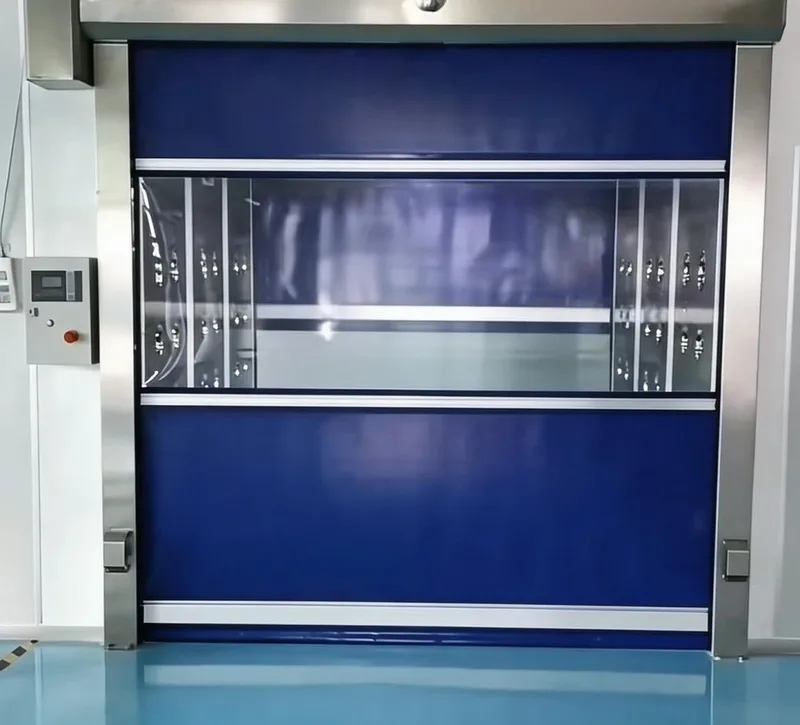
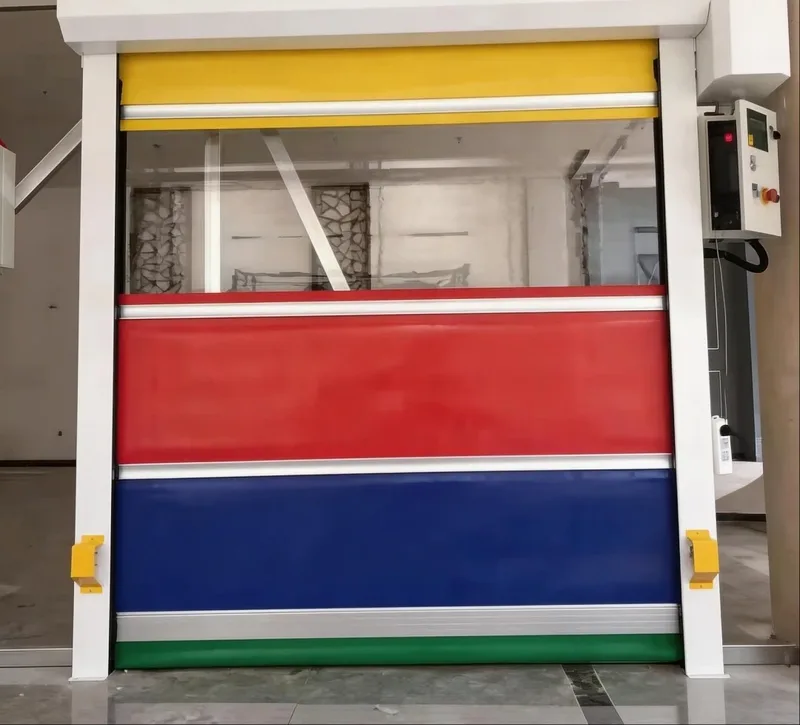
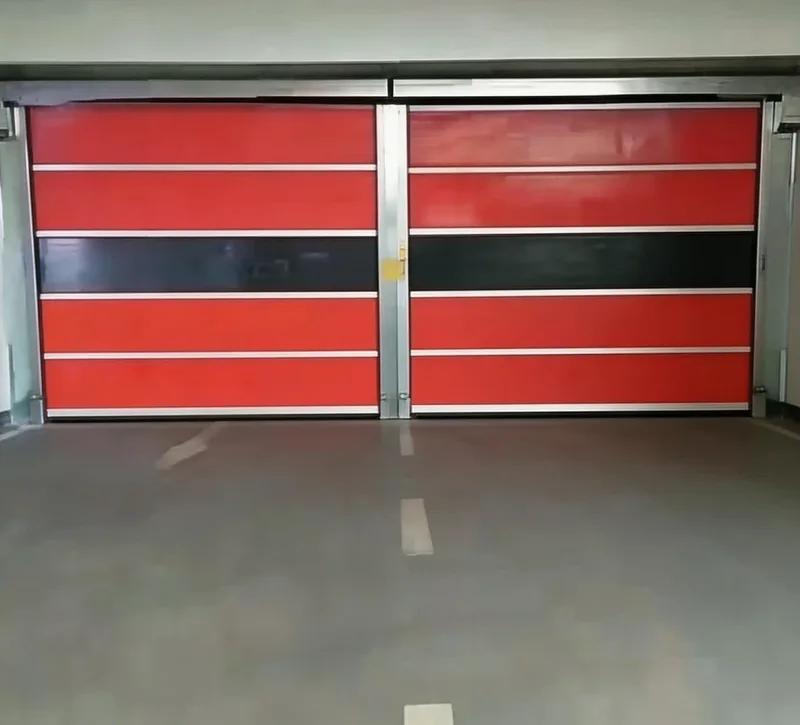
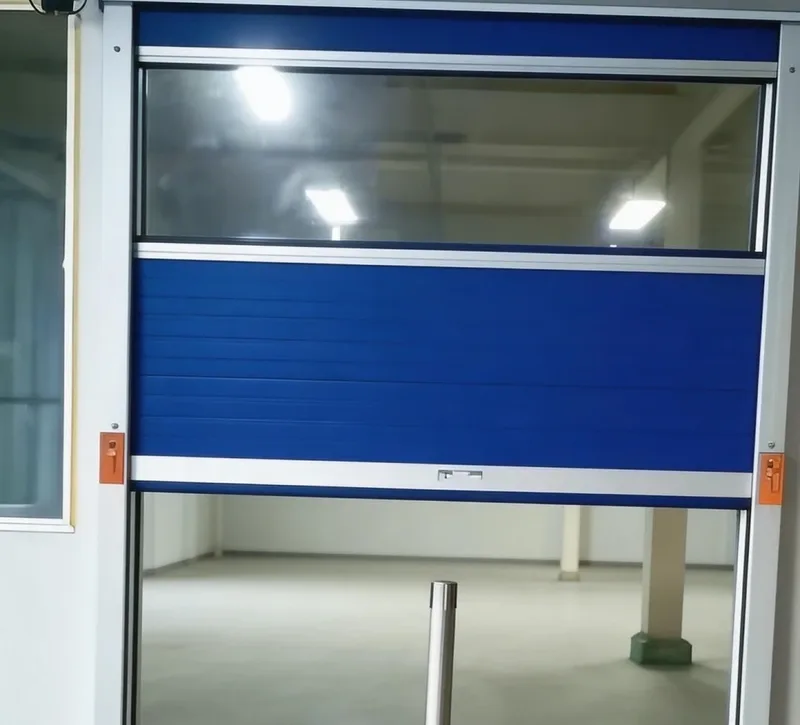
Photographs of this door family installed in industrial and logistics buildings. Door dimensions, panel colours, vision panels and track arrangements differ from project to project because every unit is made to measure.
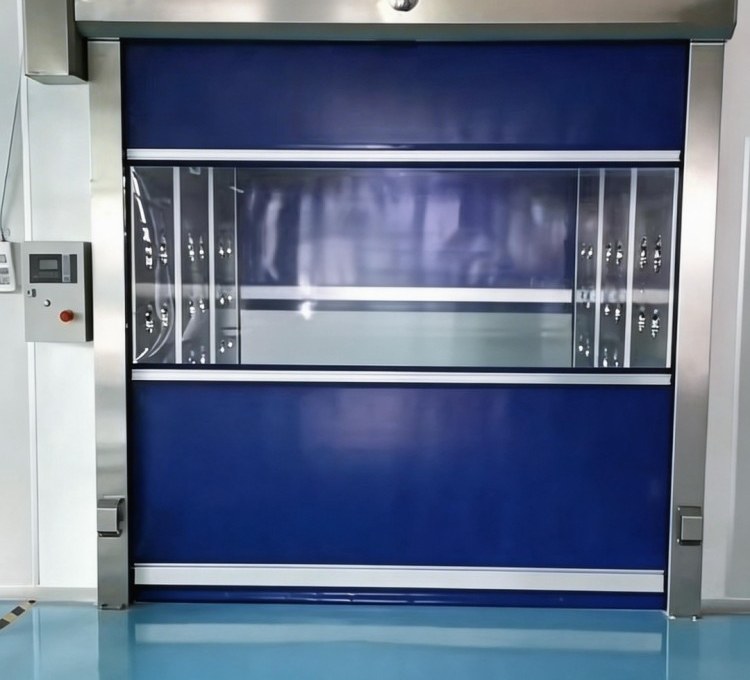
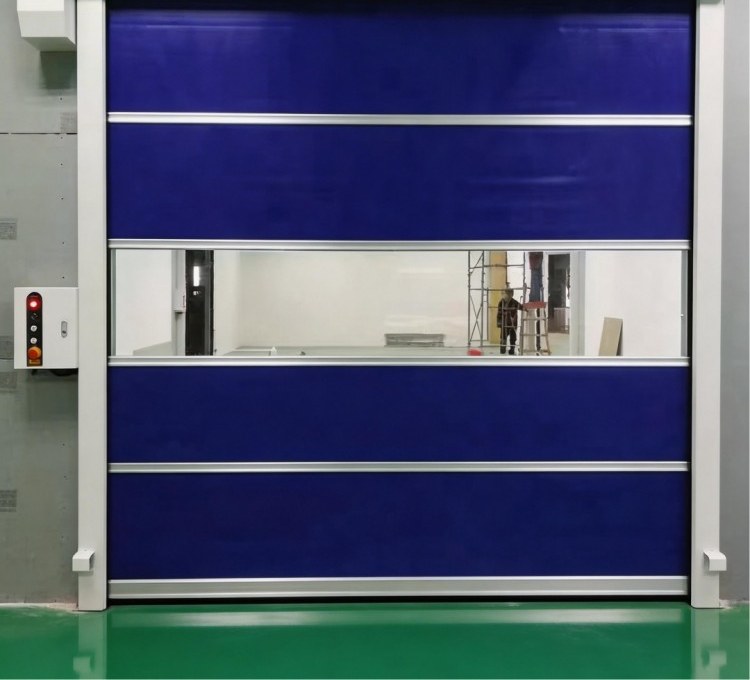
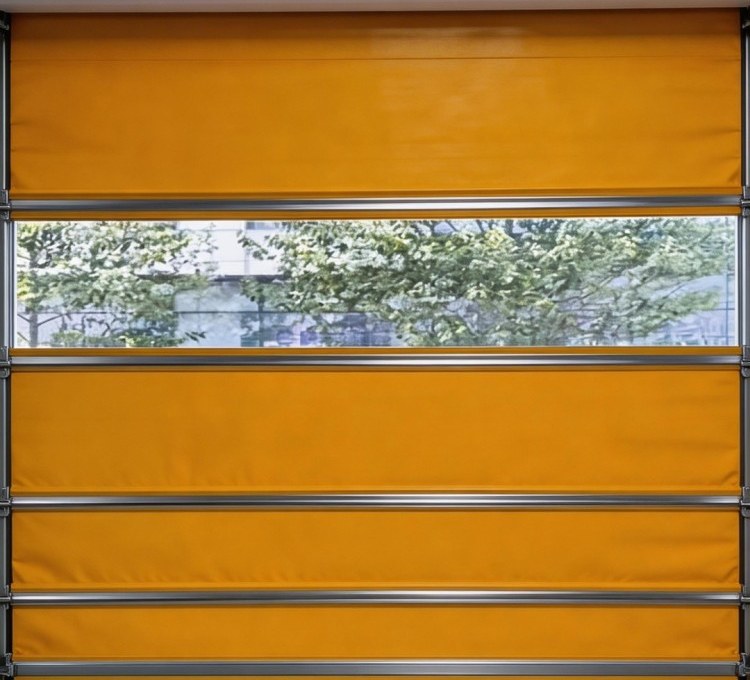
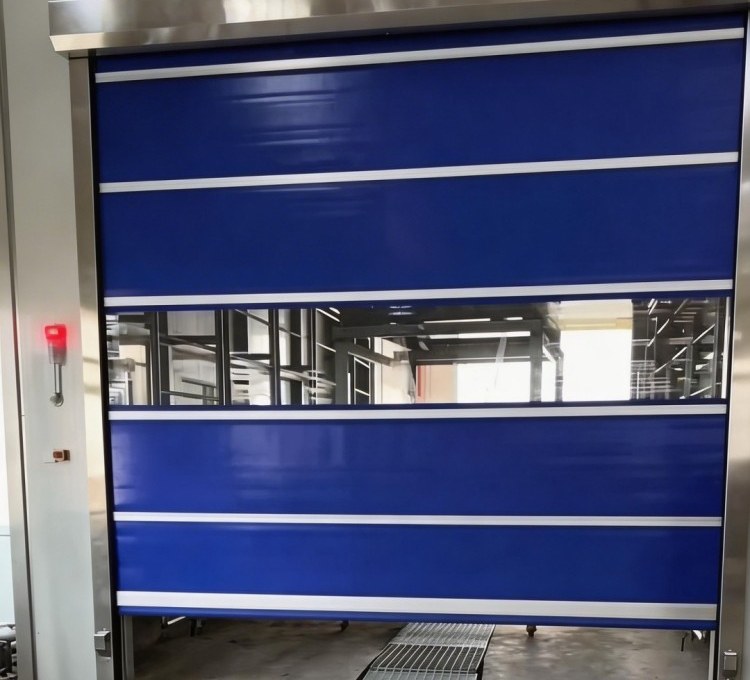
This section documents the engineering, service and compliance baseline for the PVC Automatic High-Speed Door.
Working principle and construction
A flexible PVC-coated polyester curtain winds onto a top roll. A weighted bottom bar with a wireless safety edge keeps the curtain taut; side brush seals or a zipper-type guide close the gap to the jambs and, on impact, let the curtain break out and be re-inserted without tools. A VFD drive sets opening and closing speed, and activation comes from radar, an induction loop, photocells, a pull cord, a push button or a remote, matched to the forklift and pedestrian traffic pattern. Cleanroom variants use a tighter seal package and interlocked airlock logic; the achievable pressure differential depends on the room design, not on the door alone. General arrangement drawings are issued per project after the survey.
| Component | Function | Industry-typical configuration |
|---|---|---|
| PVC curtain | Flexible leaf | 0.8-1.2 mm PVC-coated polyester, approx. 900-1300 g/m² |
| Top roll + VFD drive | Wind and unwind | 0.8-1.5 m/s opening, adjustable (indicative) |
| Side guides | Seal and break-out | Brush seals or zipper / self-reinserting guide |
| Bottom bar | Tension and safety | Weighted bar with wireless safety edge |
| Activation and safety | Trigger and protect | Radar / loop / photocell; light curtain (EN 12453) |
Technical drawings (general arrangement, section details and opening schedule) are issued per project after the on-site survey. No downloadable CAD file is claimed for this door family on this page; use the quotation button to request the current drawing set.
Service, warranty and project support
The levels below are industry-typical service terms used as a working basis because Anbixin's own policy schedule has not yet been supplied. They are indicative and are confirmed or adjusted in the written quotation and service agreement for each project.
- Warranty: 24 months on the door leaf, drive unit and control package from handover; wear items (seals, brushes, curtain fabric, impact damage) are excluded. Extended warranty terms can be quoted.
- After-sales support: acknowledgement within one working day, remote diagnostics for control faults, on-site attendance subject to location and schedule; common wear parts are kept available for replacement.
- On-site survey: measurement of clear width and height, headroom, side room, fixing structure, power supply and traffic pattern, followed by project-specific shop drawings before fabrication.
- Preventive maintenance: scheduled service visits with counterbalance check, safety-device function test, seal inspection and lubrication; panel, slat or curtain replacement is available.
- Project and volume pricing: tiered pricing for project orders, contractors, partners and multi-unit purchases; applicable terms are stated in the quotation, not as a published discount rate.
Nothing on this page constitutes a binding service commitment. Confirm warranty duration, response times, survey coverage and project pricing with the sales team before including them in a tender, advertisement or contract.
Standards, safety and compliance
Design and safety references for this product family: EN 13241 (product standard for industrial, commercial and garage doors), EN 12453 and EN 12445 (safety in use of power-operated doors and the related test methods), EN 12604 (mechanical requirements), EN 12424 and EN 12444 (wind-load classification and test), EN ISO 13849-1 (safety-related parts of control systems) and EN 60204-1 (electrical equipment of machines). These are design and test references, not a claim of certification: compliance, test reports and any third-party certificate are confirmed per project in the technical submittal. Fire-rated roller shutters belong to a separate product family selected to the fire-compartment requirements, where EN 13501-1 and EN 1634-1 apply; this page does not claim a fire rating.
Vietnamese market terminology
In Vietnam this door family is searched with the local Vietnamese terms listed below; they are kept untranslated here and used in headings, FAQs and metadata. 'Soft curtain high-speed door' is a literal translation, while the local term is the one used in searches and advertising. Cleanroom applications are usually searched together with the local term for a cleanroom door.
- cửa cuốn nhanh PVC — PVC high-speed door
- cửa rèm nhanh — fast curtain door
- cửa cuốn nhanh rèm mềm — soft-curtain high-speed door
- cửa cuốn nhanh tự động — automatic high-speed door
- cửa phòng sạch — cleanroom door
Typical applications in the Vietnamese market
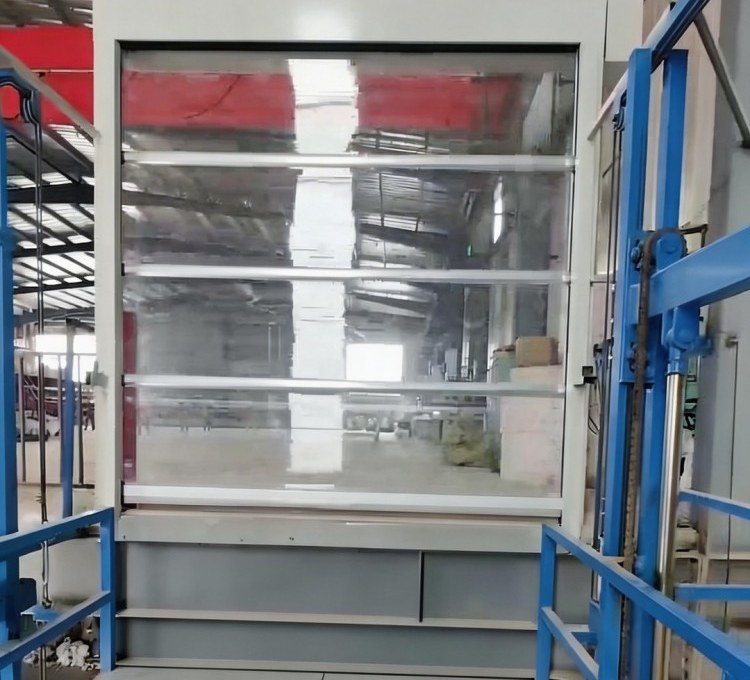
PVC high-speed door · external opening
External door with a transparent vision panel for safe two-way movement of forklifts and pedestrians.
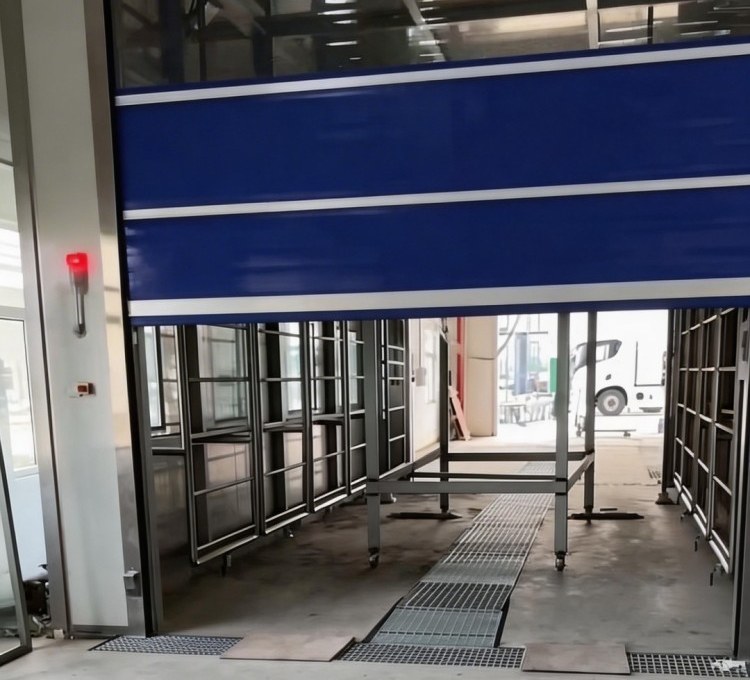
PVC high-speed door · internal partition
Internal partition between production zones with frequent forklift traffic; flexible curtain with a safety bottom edge.
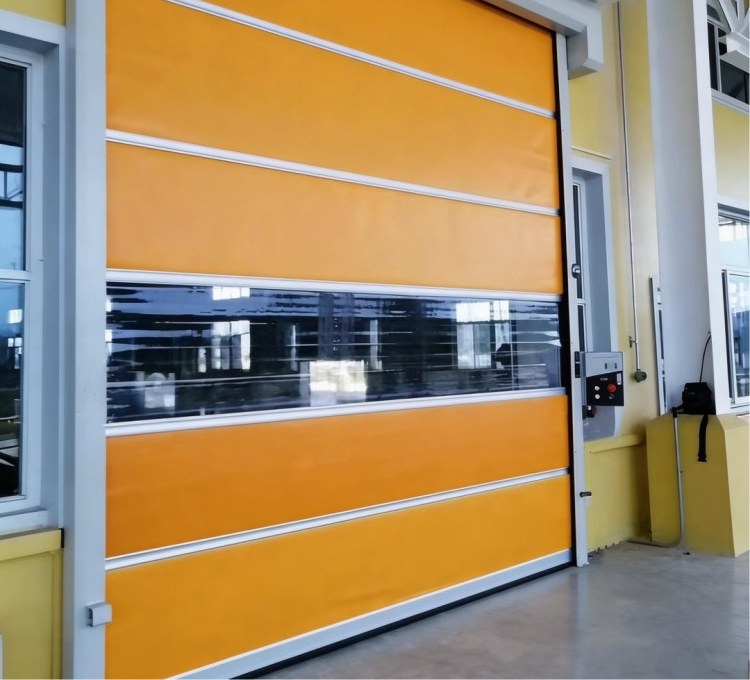
PVC high-speed door · low-temperature buffer
Buffer passage at low temperature, fast opening to limit cold-air loss; typical clear width 2-4 m.
Photographs below are from installations of this door family in Vietnam. Customer names are withheld; project details are available on request.
Frequently asked questions
Can one detector serve vehicles and pedestrians?Not reliably. Radar responds to movement and misses a stationary person; a loop responds to metal and misses a pedestrian entirely. Where both use the opening, a combination or a deliberate action is the honest answer.
No. Activation opens the door; the safety device protects a person already in the opening. The two functions come from different requirements, and EN 12453 applies to the second.
It detects an uncontrolled descent of the curtain and stops it. On a door over a traffic route that is a safety function, and it depends on the controller knowing the curtain position.
The door should fail to a safe state and must have a manual release. Where the opening is an escape route, the behaviour on power loss is a design decision that has to be stated, not assumed.
Yes, and the useful signals are the door position, the fault state and the command input. What that link does when it fails is the question to settle first.
Pain Points Solved
Factories or warehouses need a door that opens and closes quickly, but traditional manual doors are inefficient, affecting production rhythm; or they want to reduce energy consumption and lower long-term operational costs.
Key Features
- Brushless DC motor drive
- Several activation methods for different environments
- Anti-crush detection and drop protection
- Can be connected to remote monitoring
Technical Specifications
| Curtain material | PVC-coated polyester fabric, 0.8-1.2 mm, approx. 900-1300 g/m² |
|---|---|
| Top roll and drive | Tubular / external motor with VFD and encoder |
| Opening speed | 0.8-1.5 m/s, up to 2.0 m/s on smaller openings (indicative) |
| Closing speed | 0.5-1.0 m/s, VFD adjustable (indicative) |
| Max. clear opening | Up to approx. 5000 x 5000 mm; larger sizes reviewed per project |
| Wind load resistance | EN 12424 class 1-2, approx. 300-500 Pa; wind bars optional (indicative) |
| Side guides | Brush seals or zipper-type self-reinserting guide after impact |
| Bottom bar | Weighted bar with wireless safety edge / soft airbag |
| Vision panel | Transparent PVC window strip, optional |
| Activation | Radar, induction loop, photocell, pull cord, push button, remote |
| Safety (EN 12453) | Wireless bottom edge, safety light curtain, anti-crush protection |
| Cycle rate | Up to 500-800 cycles/day (indicative, duty-dependent) |
| Temperature range | Approx. -10 to +50 °C; low-temperature curtain optional (indicative) |
| Emergency operation | Manual release / crank; optional UPS |
| Product focus | Automatic activation package (radar / loop / remote) for forklift traffic |
Gallery
Need a Reliable Solution for Your Project?
Tell us about your application and requirements — our team will help you specify the right product.