
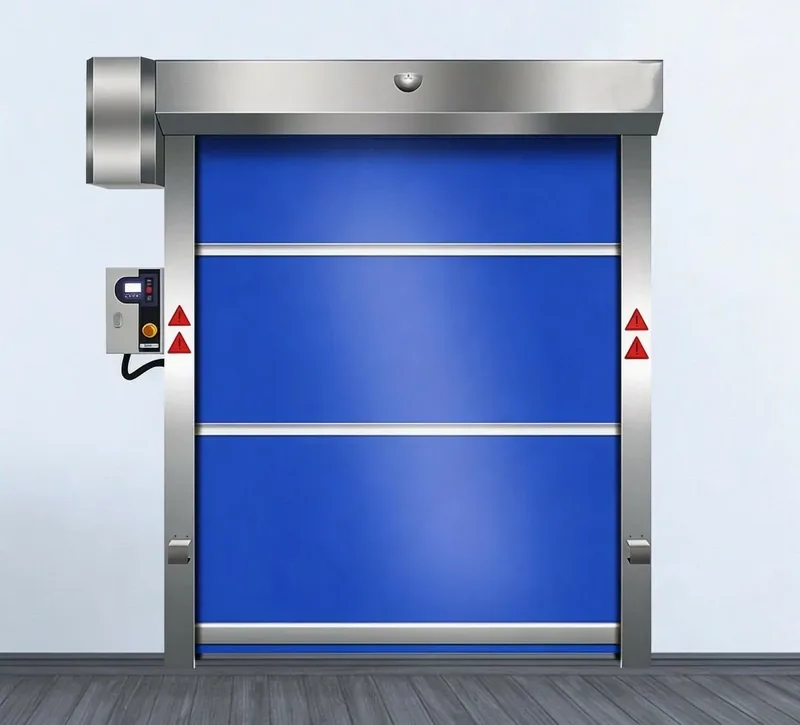
PVC High-Speed Door
Why the Curtain Works — A PVC fast door uses a flexible curtain, not a rigid leaf. What that changes about impact, wind, sealing and cycle life, and where it stops being enough.
- Curtain material
- PVC-coated polyester fabric, 0.8-1.2 mm, approx. 900-1300 g/m²
- Top roll and drive
- Tubular / external motor with VFD and encoder
- Opening speed
- 0.8-1.5 m/s, up to 2.0 m/s on smaller openings (indicative)
- Closing speed
- 0.5-1.0 m/s, VFD adjustable (indicative)
The curtain is the design decision
A PVC high-speed door closes an opening with a flexible plastic curtain that rolls onto a drum above the opening. Everything else about the product follows from that one choice: it is light, it tolerates impact, it can be made in large sizes cheaply, and it cannot hold a pressure differential the way a rigid panel can.
Understanding the door means understanding which of those four matters at the opening in front of you. A curtain door specified for the wrong reason fails in a predictable way.
What a flexible curtain does well
It survives impact. A curtain that is hit by a pallet or a forklift generally deflects, and if it is pushed out of its side guide it can usually be re-seated on site in minutes. There is no panel to replace and no joint to repair. At an opening with vehicle traffic this single property is worth more than any specification figure.
It is light. The curtain, the drum and the drive are all small compared with a rigid leaf. That makes the door cheap to build at large sizes and easy on the structure it is fixed to.
It moves fast with a small motor. With little mass to accelerate, a curtain door reaches its working speed quickly and stops without a long ramp, which is the source of the short opening times quoted for this product.
It seals adequately for internal separation. A bottom airbag plus side brushes close the gap to a practical degree between two indoor zones. That is the duty most of these doors actually have.
What it does not do
It deflects in wind. A curtain under pressure bows inward, which loads the side guides and the bottom seal and eventually lets the curtain leave its guide. On an exposed façade this is the limiting factor, and it is the reason a rigid panel door exists at all — set out under metal high-speed doors.
It insulates weakly. A single-layer curtain has very little thermal resistance, and a double-layer curtain with an air gap is better but still not comparable to an insulated panel. On a cold boundary the curtain door is the traffic element in a two-door arrangement, not the thermal boundary itself, as described under cold chain door solutions.
It does not hold a pressure differential. A cleanroom or a pharmaceutical boundary needs a controlled leakage rate, and a curtain's seals are not designed for that. The cleanroom variant addresses the material and the seal detail, as covered under PVC cleanroom doors, but the envelope question is a different product.
| Duty | Flexible curtain | Consequence |
|---|---|---|
| Frequent internal traffic | Well suited | Short open time, low wear cost |
| Vehicle contact likely | Well suited | Impact recoverable on site |
| Exposed façade with wind | Poorly suited | Curtain deflects; guides wear |
| Cold boundary alone | Poorly suited | Needs a second, insulated door |
| Pressure-controlled space | Not suited | Leakage is not controllable |
Speed and the cycle it belongs to
A curtain door runs at roughly 0.8 to 1.5 m/s depending on size, which for a typical opening means it is clear in a couple of seconds. The value of that is not the speed itself but the reduction in open time, and open time is what the energy calculation is about.
This is why the same door can be right at one opening and wrong at another. At a few dozen cycles a day, the open period is a small part of the day and the curtain's weak insulation dominates. At several hundred cycles, the open period dominates and the fast door wins even with the thinner material. The crossover is worked out under sectional or high-speed, and it is the only comparison that matters at this decision.
Sealing, honestly
This product seals with a bottom airbag and side brush strips. The airbag inflates or presses to follow an uneven floor, which a simple compression strip cannot do; the brushes close the gap at the sides while allowing the curtain to slide.
Neither is a pressure seal. A brush strip reduces leakage, it does not eliminate it, and its performance degrades as the bristles mat. That is acceptable for separating two indoor zones and unacceptable for a controlled environment — a distinction worth being explicit about before a project assumes otherwise.
Safety
The safety devices are a light curtain across the closing edge and anti-crush protection, and the requirement comes from EN 12453 for any power-operated door. Two things are worth checking at commissioning rather than accepting: that the devices are tested from the positions a person could actually occupy, and that the door reverses rather than merely stopping.
A curtain applies less force than a rigid leaf, which gives more margin, but margin is not compliance. The test is the test.
What to establish before ordering
Whether the opening is internal or exposed, because that decides whether a curtain is suitable at all. The cycle count per shift, since it decides whether speed is worth paying for. Whether the boundary is thermal or pressure-controlled, because in both cases this product is at best part of the answer. And the opening size, since the curtain's wind behaviour worsens with area while the price advantage grows.
The wider family is compared under high-speed doors, and the large-opening alternative under stacking doors.
Pricing and quotation
Every door is made to order. Because each unit is built to the actual clear opening, there is no fixed price list and no standard price range - the price changes with the opening width and height. It also depends on the panel or curtain specification, drive and control package, safety devices, fixing structure, site conditions and delivery location. Send the opening dimensions (width x height), the expected number of opening cycles per day and the installation address, and we will quote the exact configuration. Use the quote button above or the contact page to request a quotation.
Installed door photographs
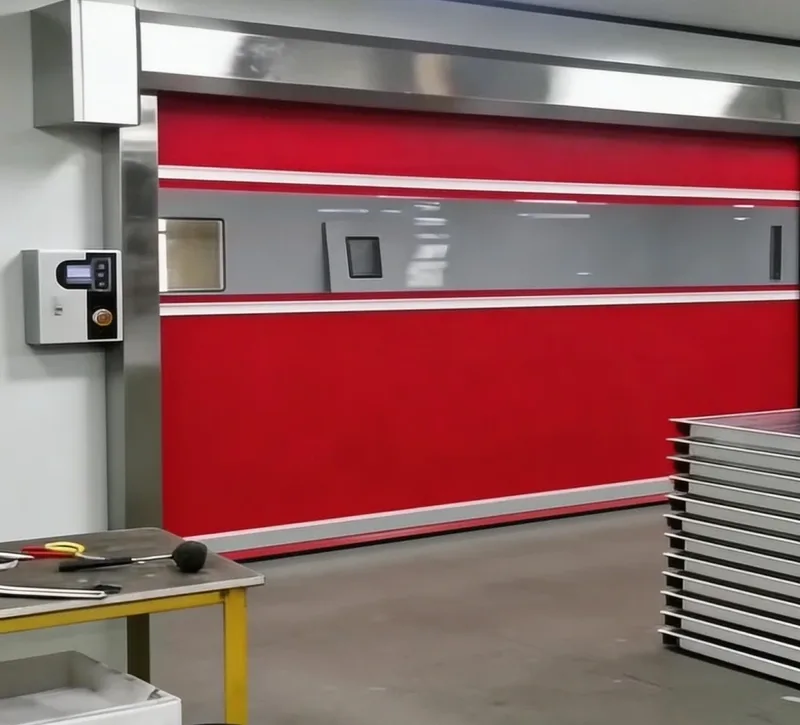
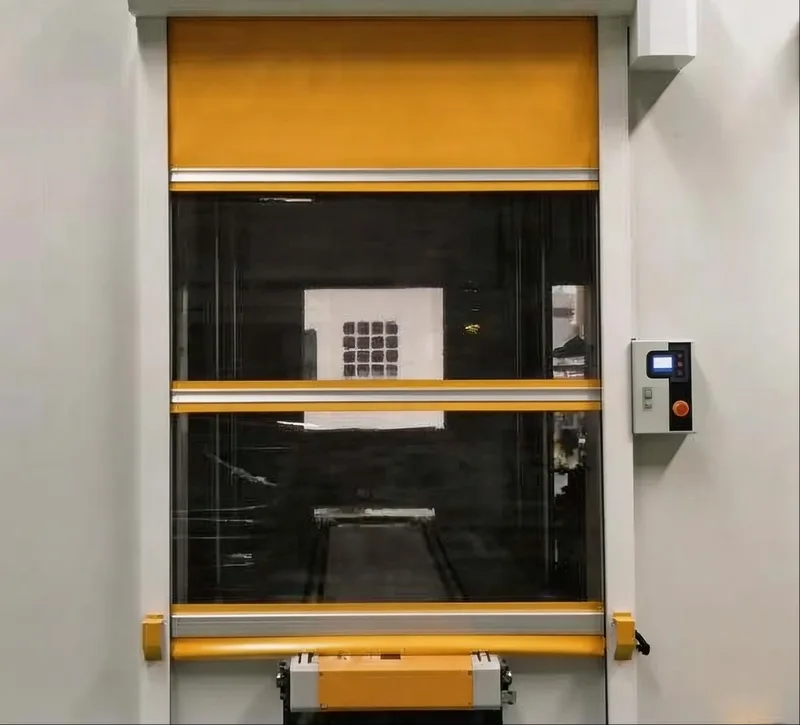
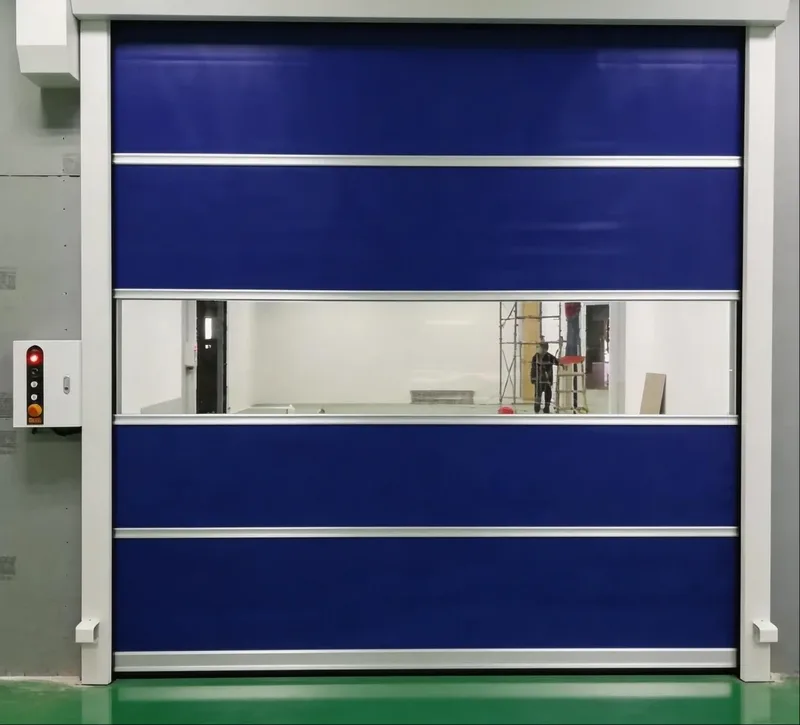
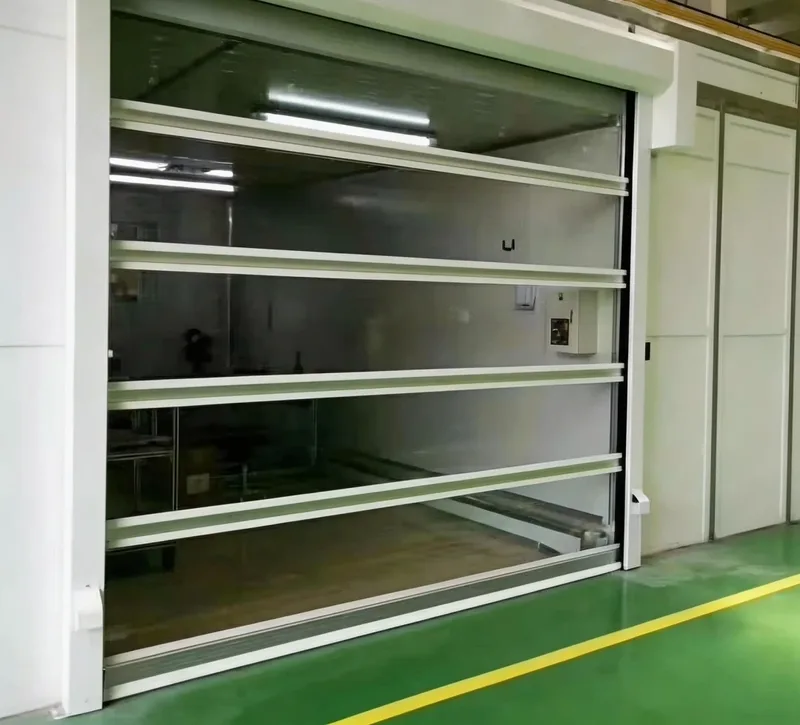
Photographs of this door family installed in industrial and logistics buildings. Door dimensions, panel colours, vision panels and track arrangements differ from project to project because every unit is made to measure.
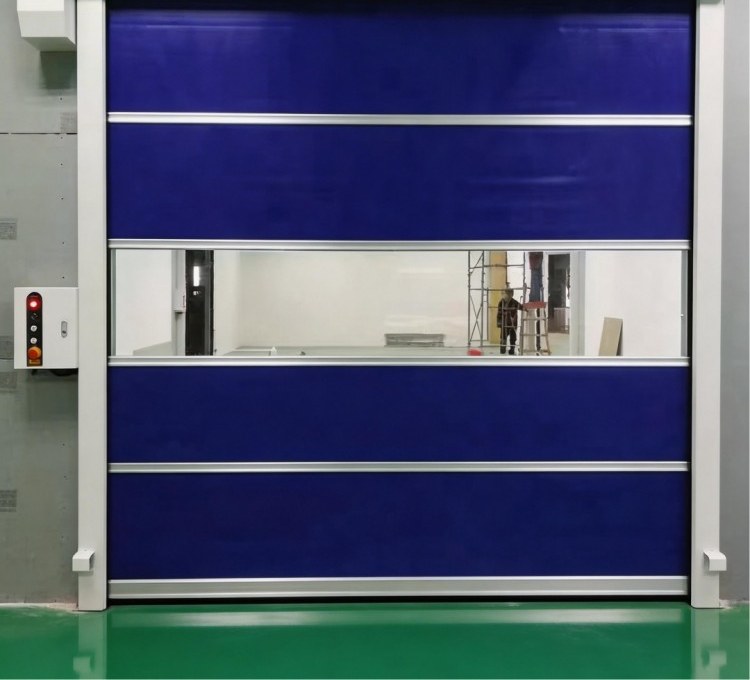
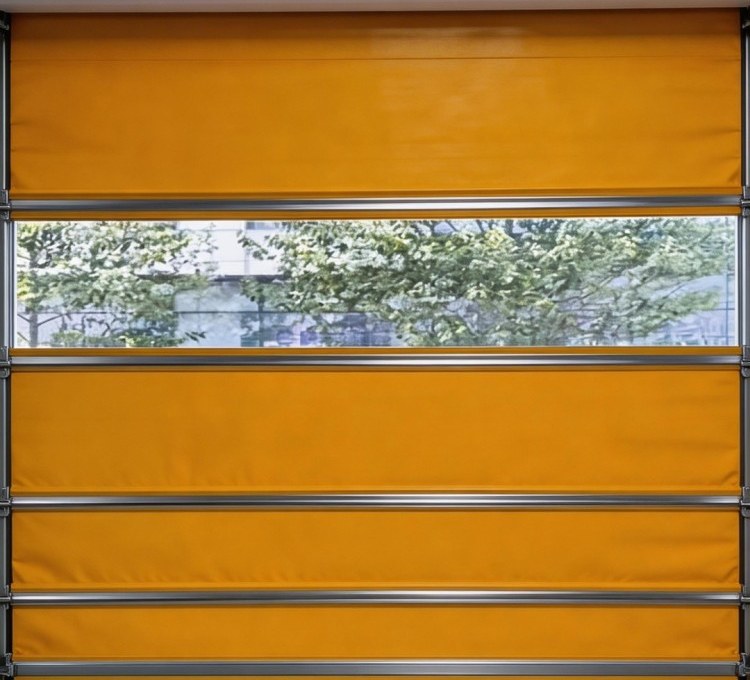
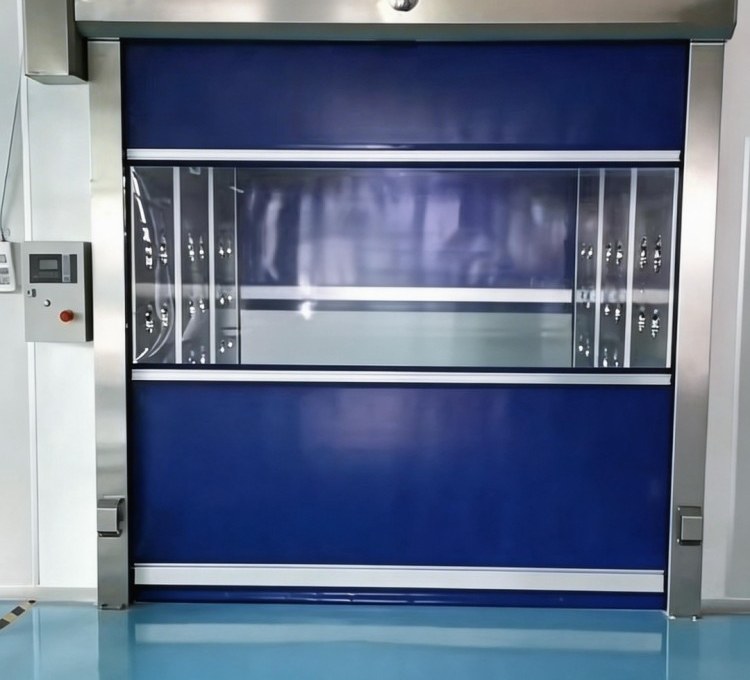
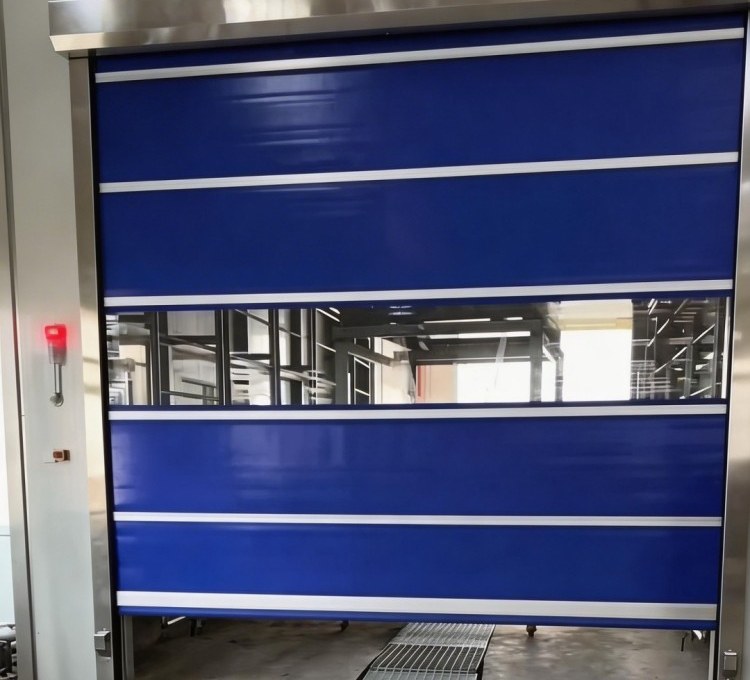
This section documents the engineering, service and compliance baseline for the PVC High-Speed Door.
Working principle and construction
A flexible PVC-coated polyester curtain winds onto a top roll. A weighted bottom bar with a wireless safety edge keeps the curtain taut; side brush seals or a zipper-type guide close the gap to the jambs and, on impact, let the curtain break out and be re-inserted without tools. A VFD drive sets opening and closing speed, and activation comes from radar, an induction loop, photocells, a pull cord, a push button or a remote, matched to the forklift and pedestrian traffic pattern. Cleanroom variants use a tighter seal package and interlocked airlock logic; the achievable pressure differential depends on the room design, not on the door alone. General arrangement drawings are issued per project after the survey.
| Component | Function | Industry-typical configuration |
|---|---|---|
| PVC curtain | Flexible leaf | 0.8-1.2 mm PVC-coated polyester, approx. 900-1300 g/m² |
| Top roll + VFD drive | Wind and unwind | 0.8-1.5 m/s opening, adjustable (indicative) |
| Side guides | Seal and break-out | Brush seals or zipper / self-reinserting guide |
| Bottom bar | Tension and safety | Weighted bar with wireless safety edge |
| Activation and safety | Trigger and protect | Radar / loop / photocell; light curtain (EN 12453) |
Technical drawings (general arrangement, section details and opening schedule) are issued per project after the on-site survey. No downloadable CAD file is claimed for this door family on this page; use the quotation button to request the current drawing set.
Service, warranty and project support
The levels below are industry-typical service terms used as a working basis because Anbixin's own policy schedule has not yet been supplied. They are indicative and are confirmed or adjusted in the written quotation and service agreement for each project.
- Warranty: 24 months on the door leaf, drive unit and control package from handover; wear items (seals, brushes, curtain fabric, impact damage) are excluded. Extended warranty terms can be quoted.
- After-sales support: acknowledgement within one working day, remote diagnostics for control faults, on-site attendance subject to location and schedule; common wear parts are kept available for replacement.
- On-site survey: measurement of clear width and height, headroom, side room, fixing structure, power supply and traffic pattern, followed by project-specific shop drawings before fabrication.
- Preventive maintenance: scheduled service visits with counterbalance check, safety-device function test, seal inspection and lubrication; panel, slat or curtain replacement is available.
- Project and volume pricing: tiered pricing for project orders, contractors, partners and multi-unit purchases; applicable terms are stated in the quotation, not as a published discount rate.
Nothing on this page constitutes a binding service commitment. Confirm warranty duration, response times, survey coverage and project pricing with the sales team before including them in a tender, advertisement or contract.
Standards, safety and compliance
Design and safety references for this product family: EN 13241 (product standard for industrial, commercial and garage doors), EN 12453 and EN 12445 (safety in use of power-operated doors and the related test methods), EN 12604 (mechanical requirements), EN 12424 and EN 12444 (wind-load classification and test), EN ISO 13849-1 (safety-related parts of control systems) and EN 60204-1 (electrical equipment of machines). These are design and test references, not a claim of certification: compliance, test reports and any third-party certificate are confirmed per project in the technical submittal. Fire-rated roller shutters belong to a separate product family selected to the fire-compartment requirements, where EN 13501-1 and EN 1634-1 apply; this page does not claim a fire rating.
Vietnamese market terminology
In Vietnam this door family is searched with the local Vietnamese terms listed below; they are kept untranslated here and used in headings, FAQs and metadata. 'Soft curtain high-speed door' is a literal translation, while the local term is the one used in searches and advertising. Cleanroom applications are usually searched together with the local term for a cleanroom door.
- cửa cuốn nhanh PVC — PVC high-speed door
- cửa rèm nhanh — fast curtain door
- cửa cuốn nhanh rèm mềm — soft-curtain high-speed door
- cửa cuốn nhanh tự động — automatic high-speed door
- cửa phòng sạch — cleanroom door
Typical applications in the Vietnamese market
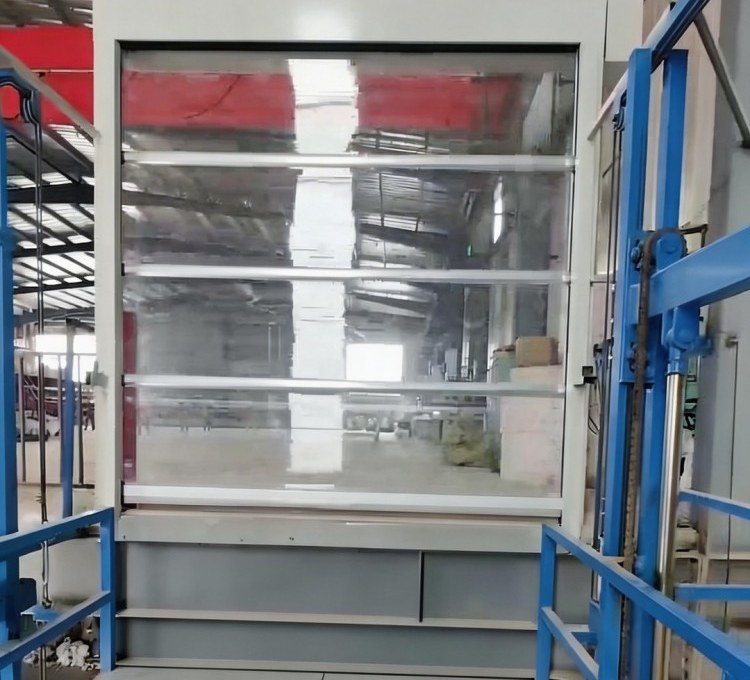
PVC high-speed door · internal partition
Internal partition between production zones with frequent forklift traffic; flexible curtain with a safety bottom edge.
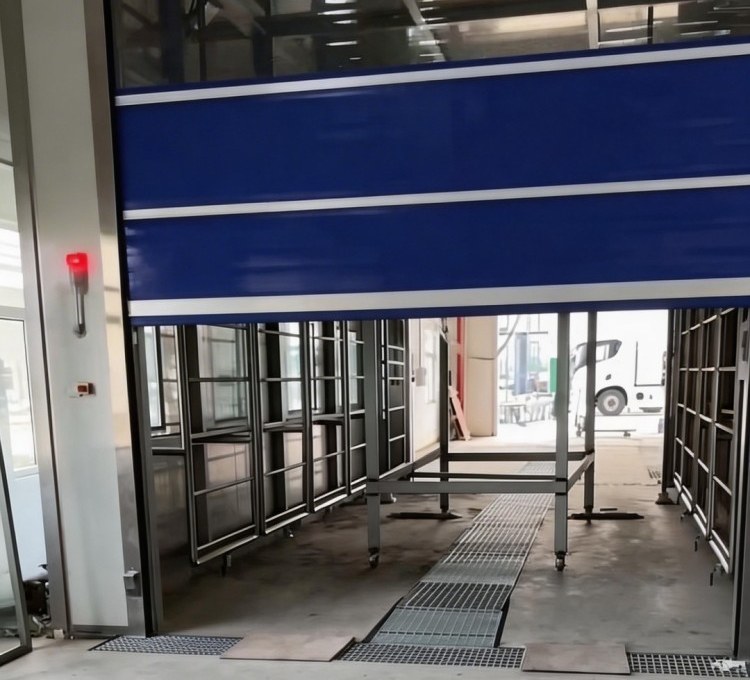
PVC high-speed door · low-temperature buffer
Buffer passage at low temperature, fast opening to limit cold-air loss; typical clear width 2-4 m.
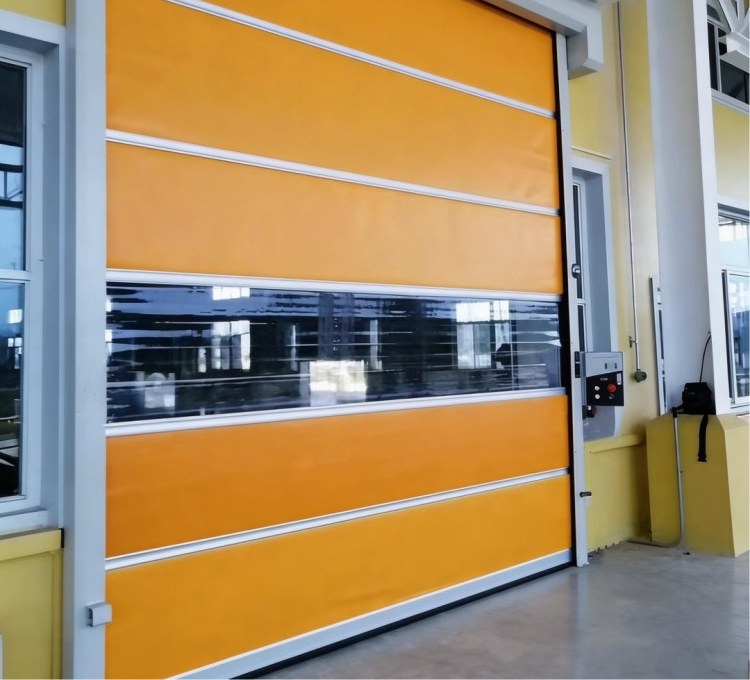
PVC high-speed door · external opening
External door with a transparent vision panel for safe two-way movement of forklifts and pedestrians.
Photographs below are from installations of this door family in Vietnam. Customer names are withheld; project details are available on request.
Frequently asked questions
Can a PVC curtain door be used outside?It can, but wind exposure is the constraint. A curtain deflects under pressure and loads its guides, so an exposed façade usually calls for a rigid panel door instead.
The curtain deflects and may leave its side guide. Re-seating it is usually a site task taking minutes, which is the main operational advantage over a rigid leaf.
Weakly. A single-layer curtain has little thermal resistance; a double-layer curtain is better but not comparable to an insulated panel. On a cold boundary it is paired with an insulated door rather than used alone.
Not to a controlled standard. The cleanroom variant improves the material and the seal detail, but a pressure envelope is a different construction.
When they mat and stop closing the gap, which depends on traffic and on the environment. The check is visual and the replacement is a consumable, not a repair.
Pain Points Solved
In low-temperature environments, conventional rapid doors are prone to frost and ice, affecting sealing performance and service life, leading to cold air infiltration and impacting the production environment.
Key Features
- Flexible PVC curtain, light and corrosion resistant
- Fast cycles reduce open time
- Bottom airbag plus side brush seals
- Safety light curtain and anti-crush protection
Technical Specifications
| Curtain material | PVC-coated polyester fabric, 0.8-1.2 mm, approx. 900-1300 g/m² |
|---|---|
| Top roll and drive | Tubular / external motor with VFD and encoder |
| Opening speed | 0.8-1.5 m/s, up to 2.0 m/s on smaller openings (indicative) |
| Closing speed | 0.5-1.0 m/s, VFD adjustable (indicative) |
| Max. clear opening | Up to approx. 5000 x 5000 mm; larger sizes reviewed per project |
| Wind load resistance | EN 12424 class 1-2, approx. 300-500 Pa; wind bars optional (indicative) |
| Side guides | Brush seals or zipper-type self-reinserting guide after impact |
| Bottom bar | Weighted bar with wireless safety edge / soft airbag |
| Vision panel | Transparent PVC window strip, optional |
| Activation | Radar, induction loop, photocell, pull cord, push button, remote |
| Safety (EN 12453) | Wireless bottom edge, safety light curtain, anti-crush protection |
| Cycle rate | Up to 500-800 cycles/day (indicative, duty-dependent) |
| Temperature range | Approx. -10 to +50 °C; low-temperature curtain optional (indicative) |
| Emergency operation | Manual release / crank; optional UPS |
| Product focus | Standard PVC high-speed curtain for internal process separations |
Gallery
Need a Reliable Solution for Your Project?
Tell us about your application and requirements — our team will help you specify the right product.