
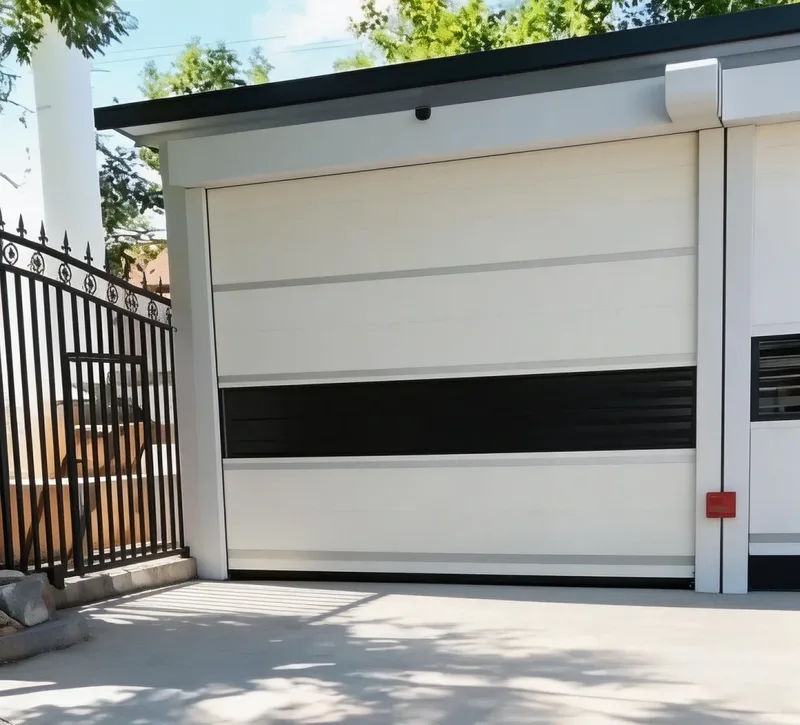
PVC Cleanroom High-Speed Door
Particles and Pressure — A cleanroom PVC door is about material and seal detail, not colour. What cleanroom grade changes, and why the door alone cannot hold a classified space.
- Curtain material
- PVC-coated polyester fabric, 0.8-1.2 mm, approx. 900-1300 g/m²
- Top roll and drive
- Tubular / external motor with VFD and encoder
- Opening speed
- 0.8-1.5 m/s, up to 2.0 m/s on smaller openings (indicative)
- Closing speed
- 0.5-1.0 m/s, VFD adjustable (indicative)
What cleanroom grade actually changes
A cleanroom-grade PVC fast door uses a curtain material that is smooth, non-shedding and disinfectable, with a seal arrangement that closes the perimeter more completely than a standard door: four-side brush seals plus a bottom airbag.
Those two changes address the two things a classified space cares about — particles and leakage — but only up to the limit of a curtain. Understanding that limit is what stops a project from expecting a door to deliver a room classification.
The material question
Three properties define a cleanroom curtain.
Non-shedding. The material must not release fibres or particles as it flexes. This is a property of the compound and the surface, and it is why a general-purpose curtain is unsuitable regardless of how well it seals: a door that sheds into the space is a contamination source that operates several hundred times a shift.
Smooth and cleanable. A surface that can be wiped and disinfected without degrading. Textured or woven surfaces trap residue and cannot be verified as clean, which matters in a pharmaceutical or food environment where cleaning has to be demonstrable.
Chemical compatibility. The curtain has to survive the site's cleaning agents. A material that is cleanable with one disinfectant and attacked by another is a material whose suitability depends on a document the supplier should be asked for.
None of these is visible. A curtain that looks identical to a standard one can be a different compound, which is why the material grade belongs in the specification rather than in the appearance.
The seal arrangement, and why four sides
A standard curtain door seals the bottom with an airbag and the sides with brushes. A cleanroom variant adds a top seal so that the perimeter is closed on all four sides.
The top seal matters more than it appears. On a standard door the gap at the header is a permanent opening above the curtain, and air moves through it continuously by stack effect — warm air rising and leaving at the top, replacement air entering at the bottom. In a classified space that is a continuous uncontrolled transfer, and it is invisible because the gap is above eye level.
Adding the top seal reduces that path. It does not make the door airtight, and the leakage rate remains a property of a brush seal rather than of a gasket. That is the honest position: better, not equivalent to a rigid door with a compression seal.
| Element | Standard curtain door | Cleanroom variant |
|---|---|---|
| Curtain material | General purpose | Non-shedding, disinfectable compound |
| Side sealing | Brush strip | Brush strip, closer tolerance |
| Top sealing | Open gap at header | Top seal added |
| Bottom sealing | Airbag | Airbag |
| Leakage character | Continuous, uncontrolled | Reduced, still brush-limited |
Why the door cannot hold a classification
A cleanroom classification is a property of the room: the air handling, the pressure cascade, the filtration and the envelope together. The door is one element of the envelope, and it is the element with the highest leakage per square metre by a wide margin.
So the door's contribution is to be predictable: a known leakage that the air balance can account for, and a material that does not add particles. A door that leaks unpredictably — because its brushes have matted, or because the top gap was left open — makes the room's balance drift, and the drift is attributed to the air handling rather than to the door.
This is the reason a curtain door in a cleanroom is usually specified at an internal traffic route where the pressure differential is modest, not at the boundary of the classified space itself. At the classified boundary the correct product is a rigid door with a compression seal, as described under insulated lifting doors, and the boundary logic is set out under electronics cleanroom doors and GMP cleanroom doors.
What else the space needs from the door
A defined opening cycle. A door held open defeats the boundary. In a cleanroom this shows up as a pressure alarm rather than as a draught, which is why the door's control should close it positively rather than relying on a spring.
Cleanable geometry. The frame and the guide have to be wipeable, with no open sections or exposed fixings that collect residue. The curtain is easy; the frame is where a cleaning validation usually fails.
A documented maintenance interval. Brushes mat, airbags leak and curtains crease. Each of those changes the leakage, and a cleanroom whose leakage is not maintained is a cleanroom that drifts out of classification between audits.
Where this product is the right answer
At an internal route inside a controlled area, where the traffic is frequent, the pressure step is small and the requirement is to keep the transfer short and the material clean. That is a real and common duty: a corridor between two production rooms, a transfer hatch route, a gowning area threshold.
It is not the right answer at the classified boundary itself, at an opening with a large pressure differential, or at a cold boundary where the thermal requirement dominates. Those cases belong with rigid constructions, and the comparison across fast door types is under high-speed doors.
What to establish before ordering
The pressure step across the door, because it decides whether a curtain is suitable at all. The cleaning agents used on site, since the curtain compound has to be compatible. Whether the opening is a classified boundary or an internal route. The cycle count, which sets the brush and airbag inspection interval. And what documentation the site's own quality system requires, because a cleanroom project usually needs a material statement rather than a datasheet.
Pricing and quotation
Every door is made to order. Because each unit is built to the actual clear opening, there is no fixed price list and no standard price range - the price changes with the opening width and height. It also depends on the panel or curtain specification, drive and control package, safety devices, fixing structure, site conditions and delivery location. Send the opening dimensions (width x height), the expected number of opening cycles per day and the installation address, and we will quote the exact configuration. Use the quote button above or the contact page to request a quotation.
Installed door photographs
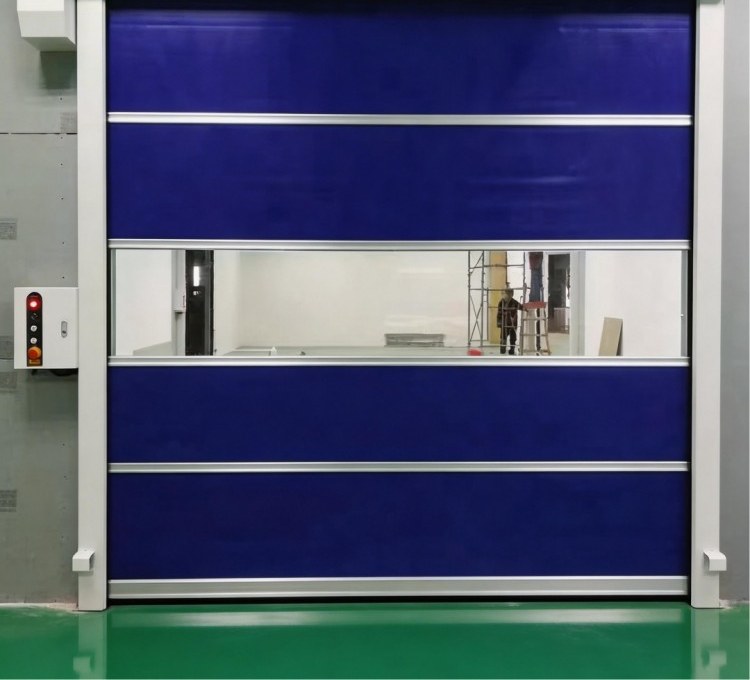
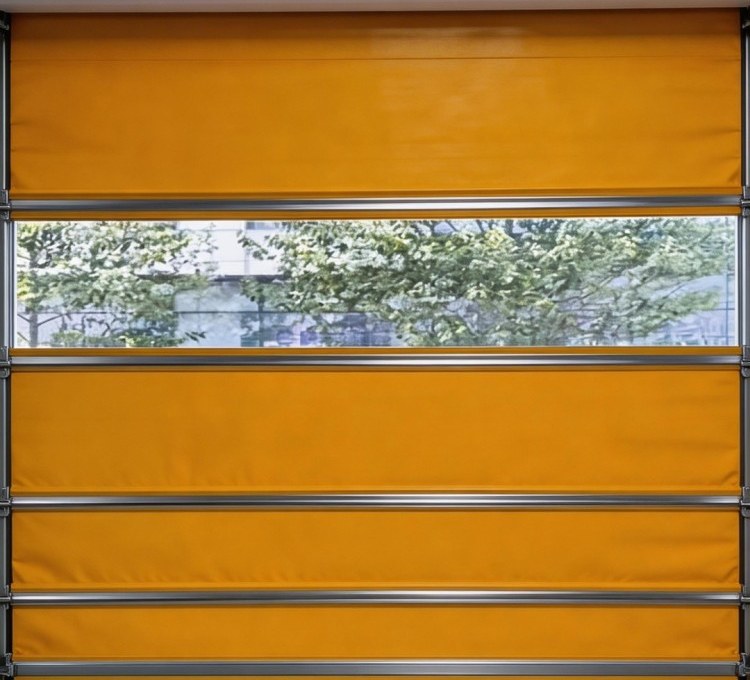
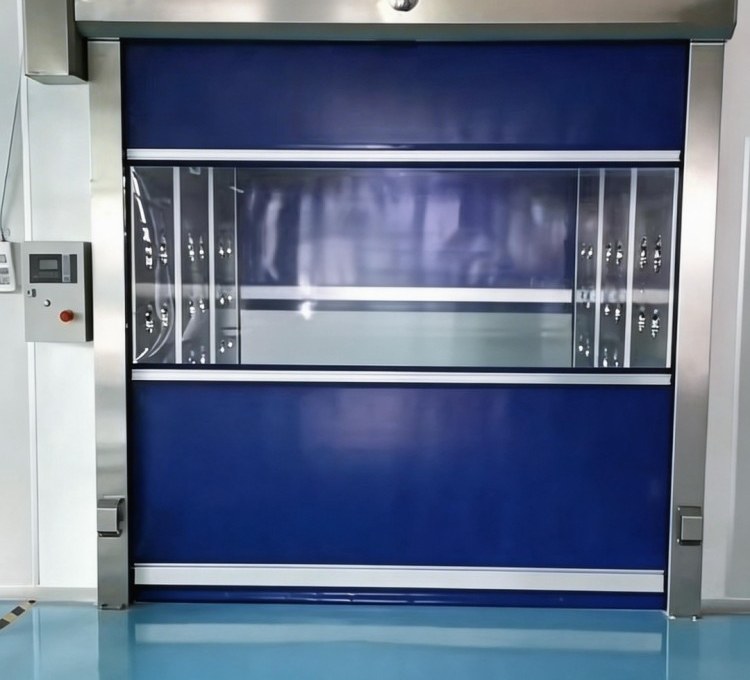
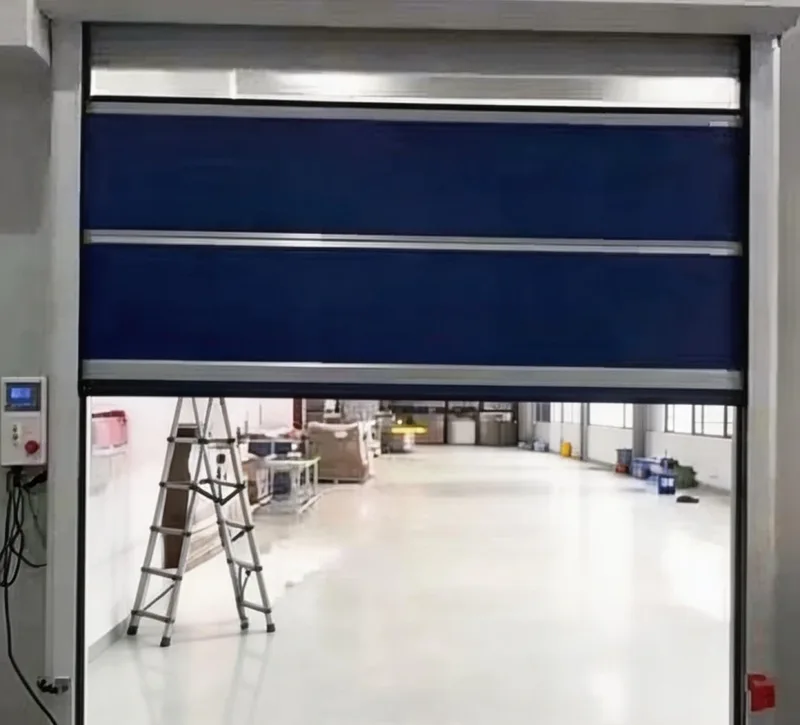
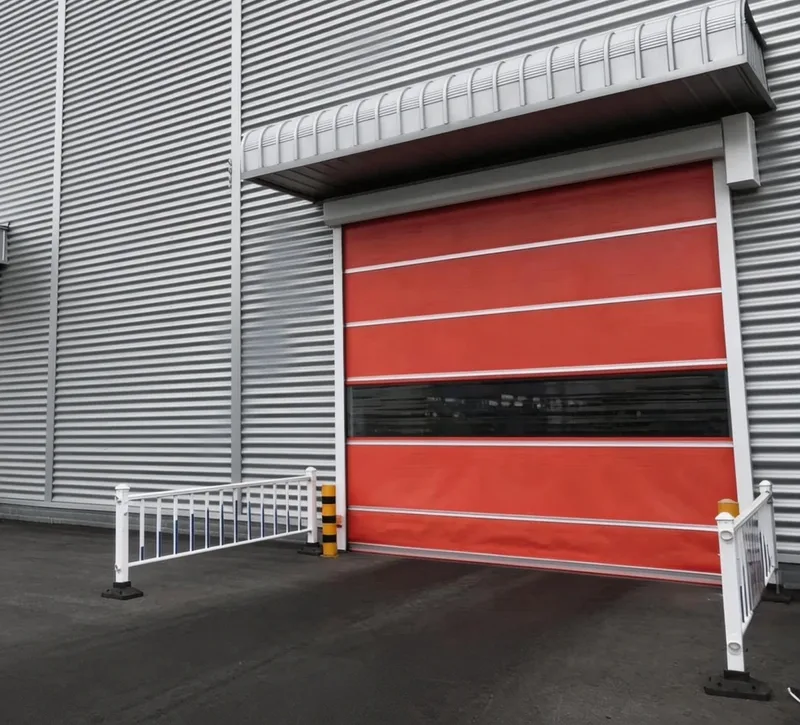
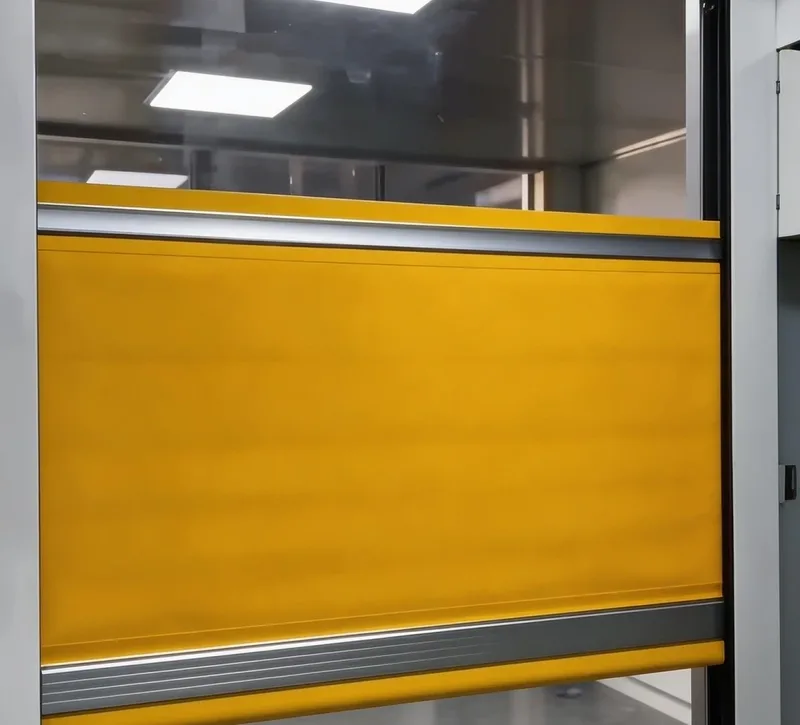
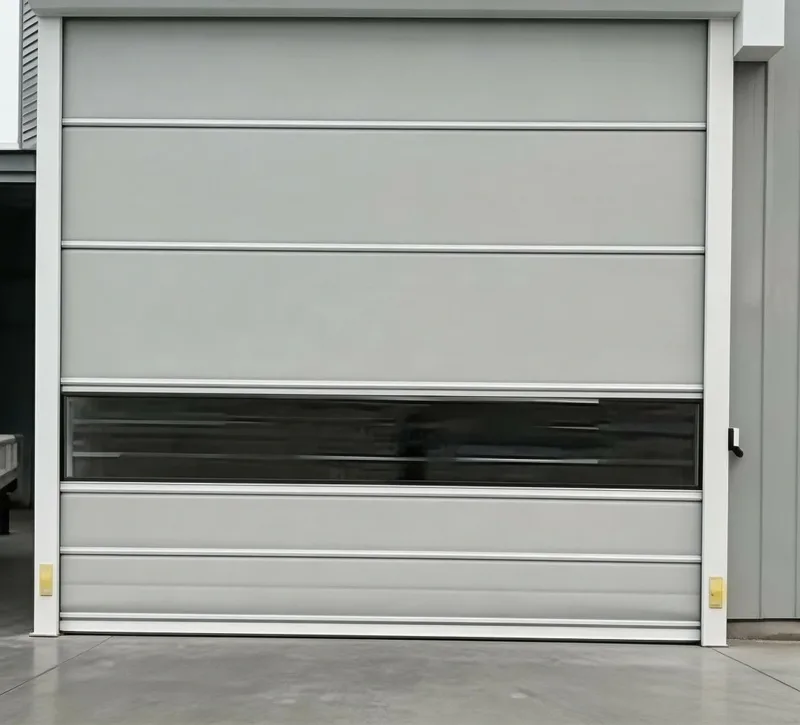
Photographs of this door family installed in industrial and logistics buildings. Door dimensions, panel colours, vision panels and track arrangements differ from project to project because every unit is made to measure.
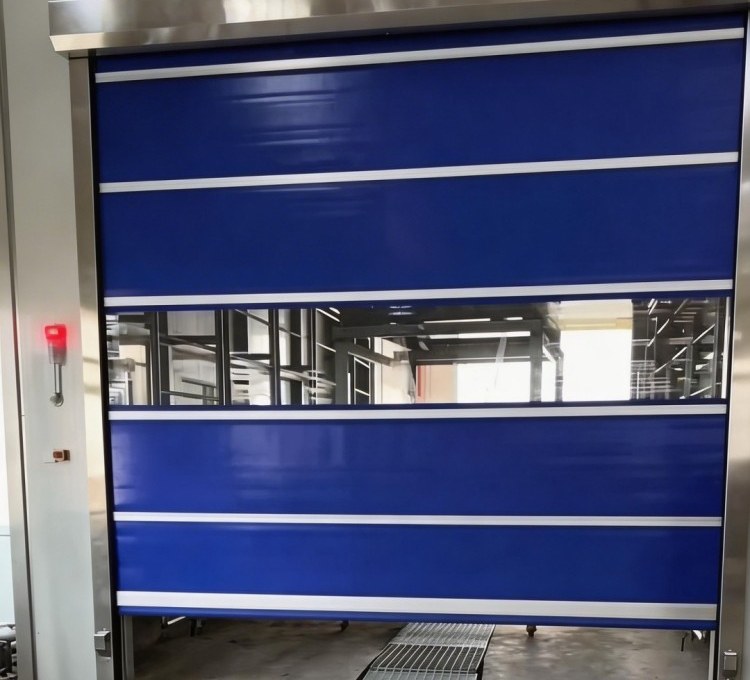
This section documents the engineering, service and compliance baseline for the PVC Cleanroom High-Speed Door.
Working principle and construction
A flexible PVC-coated polyester curtain winds onto a top roll. A weighted bottom bar with a wireless safety edge keeps the curtain taut; side brush seals or a zipper-type guide close the gap to the jambs and, on impact, let the curtain break out and be re-inserted without tools. A VFD drive sets opening and closing speed, and activation comes from radar, an induction loop, photocells, a pull cord, a push button or a remote, matched to the forklift and pedestrian traffic pattern. Cleanroom variants use a tighter seal package and interlocked airlock logic; the achievable pressure differential depends on the room design, not on the door alone. General arrangement drawings are issued per project after the survey.
| Component | Function | Industry-typical configuration |
|---|---|---|
| PVC curtain | Flexible leaf | 0.8-1.2 mm PVC-coated polyester, approx. 900-1300 g/m² |
| Top roll + VFD drive | Wind and unwind | 0.8-1.5 m/s opening, adjustable (indicative) |
| Side guides | Seal and break-out | Brush seals or zipper / self-reinserting guide |
| Bottom bar | Tension and safety | Weighted bar with wireless safety edge |
| Activation and safety | Trigger and protect | Radar / loop / photocell; light curtain (EN 12453) |
Technical drawings (general arrangement, section details and opening schedule) are issued per project after the on-site survey. No downloadable CAD file is claimed for this door family on this page; use the quotation button to request the current drawing set.
Service, warranty and project support
The levels below are industry-typical service terms used as a working basis because Anbixin's own policy schedule has not yet been supplied. They are indicative and are confirmed or adjusted in the written quotation and service agreement for each project.
- Warranty: 24 months on the door leaf, drive unit and control package from handover; wear items (seals, brushes, curtain fabric, impact damage) are excluded. Extended warranty terms can be quoted.
- After-sales support: acknowledgement within one working day, remote diagnostics for control faults, on-site attendance subject to location and schedule; common wear parts are kept available for replacement.
- On-site survey: measurement of clear width and height, headroom, side room, fixing structure, power supply and traffic pattern, followed by project-specific shop drawings before fabrication.
- Preventive maintenance: scheduled service visits with counterbalance check, safety-device function test, seal inspection and lubrication; panel, slat or curtain replacement is available.
- Project and volume pricing: tiered pricing for project orders, contractors, partners and multi-unit purchases; applicable terms are stated in the quotation, not as a published discount rate.
Nothing on this page constitutes a binding service commitment. Confirm warranty duration, response times, survey coverage and project pricing with the sales team before including them in a tender, advertisement or contract.
Standards, safety and compliance
Design and safety references for this product family: EN 13241 (product standard for industrial, commercial and garage doors), EN 12453 and EN 12445 (safety in use of power-operated doors and the related test methods), EN 12604 (mechanical requirements), EN 12424 and EN 12444 (wind-load classification and test), EN ISO 13849-1 (safety-related parts of control systems) and EN 60204-1 (electrical equipment of machines). These are design and test references, not a claim of certification: compliance, test reports and any third-party certificate are confirmed per project in the technical submittal. Fire-rated roller shutters belong to a separate product family selected to the fire-compartment requirements, where EN 13501-1 and EN 1634-1 apply; this page does not claim a fire rating.
Vietnamese market terminology
In Vietnam this door family is searched with the local Vietnamese terms listed below; they are kept untranslated here and used in headings, FAQs and metadata. 'Soft curtain high-speed door' is a literal translation, while the local term is the one used in searches and advertising. Cleanroom applications are usually searched together with the local term for a cleanroom door.
- cửa cuốn nhanh PVC — PVC high-speed door
- cửa rèm nhanh — fast curtain door
- cửa cuốn nhanh rèm mềm — soft-curtain high-speed door
- cửa cuốn nhanh tự động — automatic high-speed door
- cửa phòng sạch — cleanroom door
Typical applications in the Vietnamese market
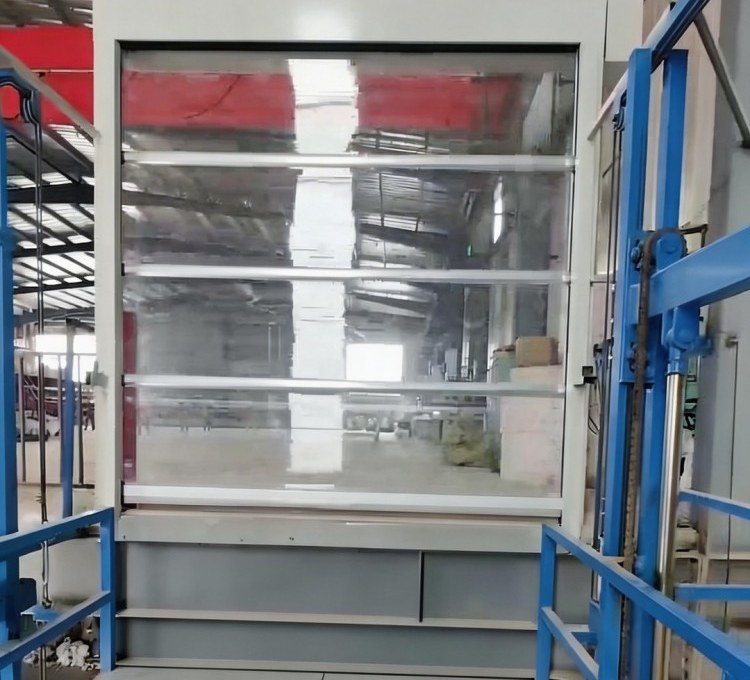
PVC high-speed door · internal partition
Internal partition between production zones with frequent forklift traffic; flexible curtain with a safety bottom edge.
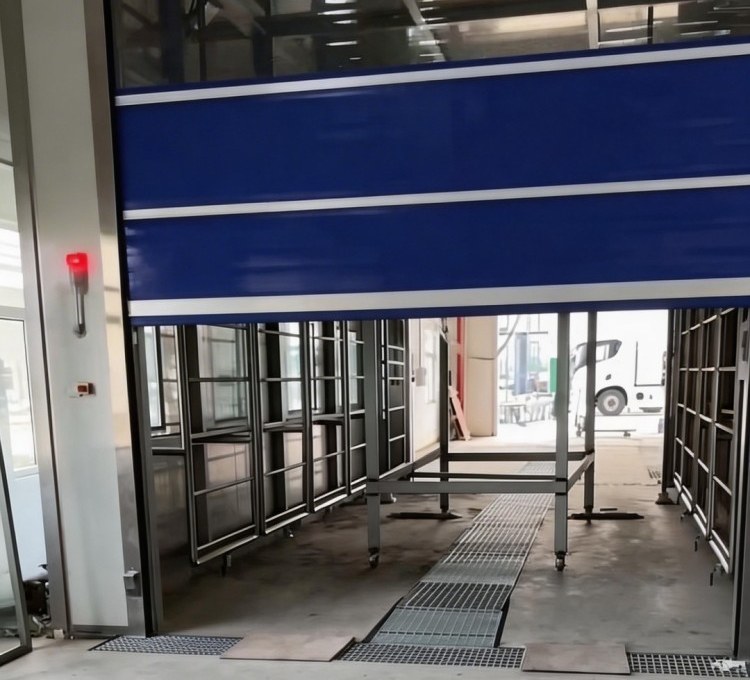
PVC high-speed door · low-temperature buffer
Buffer passage at low temperature, fast opening to limit cold-air loss; typical clear width 2-4 m.
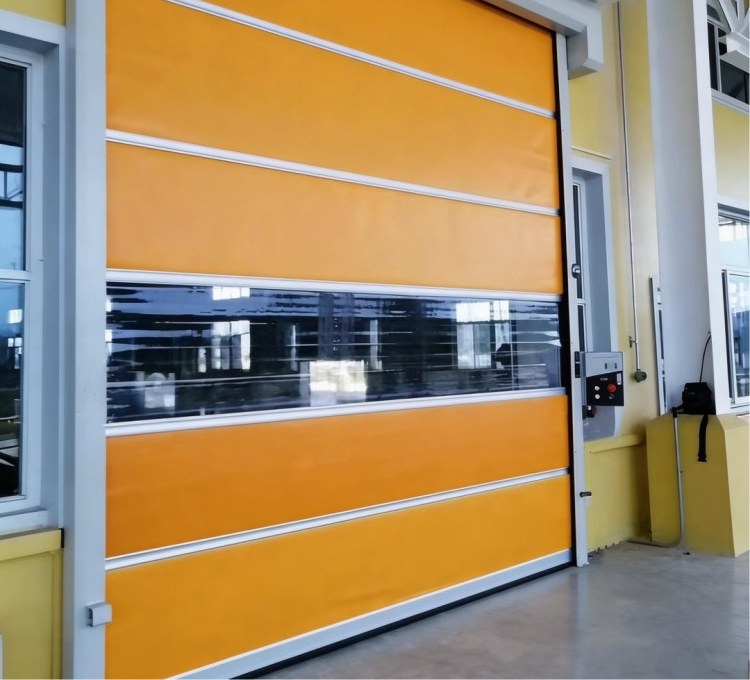
PVC high-speed door · external opening
External door with a transparent vision panel for safe two-way movement of forklifts and pedestrians.
Photographs below are from installations of this door family in Vietnam. Customer names are withheld; project details are available on request.
Frequently asked questions
Does a cleanroom door make a room clean?No. The classification comes from the air handling, the pressure cascade and the envelope together. The door's job is to be a predictable, non-shedding element of that envelope.
Because the gap at the header on a standard curtain door is a continuous path for air movement by stack effect. Closing it reduces an uncontrolled transfer that is invisible in a visual inspection.
A modest one. The seals are brushes and an airbag, so the leakage is reduced but brush-limited. A large differential needs a rigid door with a compression seal.
When they mat and stop closing the gap, which depends on traffic and cleaning regime. In a cleanroom the interval should be set by the leakage the room's balance assumes, not by appearance.
The cleanroom-grade compound is designed for it, but compatibility is specific: the site's actual cleaning agents have to be checked against the material rather than assumed.
Pain Points Solved
Traditional doors in cleanrooms have issues such as poor sealing, slow operation, and susceptibility to chemical corrosion, leading to a drop in cleanliness, affecting product quality and production efficiency.
Key Features
- Cleanroom-grade curtain with smooth, crevice-free surface
- Easy to clean and disinfect
- Four-side brush seals plus bottom airbag
- For cleanrooms and food or pharmaceutical production
Technical Specifications
| Curtain material | PVC-coated polyester fabric, 0.8-1.2 mm, approx. 900-1300 g/m² |
|---|---|
| Top roll and drive | Tubular / external motor with VFD and encoder |
| Opening speed | 0.8-1.5 m/s, up to 2.0 m/s on smaller openings (indicative) |
| Closing speed | 0.5-1.0 m/s, VFD adjustable (indicative) |
| Max. clear opening | Up to approx. 5000 x 5000 mm; larger sizes reviewed per project |
| Wind load resistance | EN 12424 class 1-2, approx. 300-500 Pa; wind bars optional (indicative) |
| Side guides | Brush seals or zipper-type self-reinserting guide after impact |
| Bottom bar | Weighted bar with wireless safety edge / soft airbag |
| Vision panel | Transparent PVC window strip, optional |
| Activation | Radar, induction loop, photocell, pull cord, push button, remote |
| Safety (EN 12453) | Wireless bottom edge, safety light curtain, anti-crush protection |
| Cycle rate | Up to 500-800 cycles/day (indicative, duty-dependent) |
| Temperature range | Approx. -10 to +50 °C; low-temperature curtain optional (indicative) |
| Emergency operation | Manual release / crank; optional UPS |
| Product focus | Cleanroom airlock variant; pressure differential depends on the room design, not the door alone |
Gallery
Need a Reliable Solution for Your Project?
Tell us about your application and requirements — our team will help you specify the right product.